

@the-second-opinion

The Worst of Goosebumps
July 24, 2014 in Uncategorized

As I said last time, reading all the Goosebumps books in the original series was just too much of a rollercoaster to convey in one blog.
R.L. Stine was never the most talented of authors, but he does have something of a knack for giving an audience just what they’re looking for. Still, when you’re cranking out 62 books over the span of 5 years, not to mention spinoff series, chances are you won’t be on top of your game every time. So now, to close this series on horror novellas and get back to movies and TV shows, here are the ten books in the series so bad they’re scary. But first, the theme song: http /www.youtube.com/watch?v=vIe6JwvnNoo
Dishonorable diss mention: I Live Your Basement
This is easily the sloppiest, most incoherent book in the series, but I can’t decide if I hate it for that or if I want to read it again. This is an off-the-wall onslaught of insanity that I will admit is never boring, and it does manage to be just a little creepy.
And with that out of the way, let’s get to the entries that I really don’t recommend
10. Don’t Go to Sleep

A boy bullied by his older siblings and regulated to the smallest bedroom decides to disobey his parents by secretly sleeping in the guest room, waking up to find that he’s been sucked into a nightmare. The setup sounds like standard Goosebumps material, maybe even good material at that. And to the books credit, it technically follows through on what it promises (save for the image on the cover). But this book is the series’ front-running example of stumbling at the delivery.
The “living nightmares†that the hero encounters can be categorized as one of two standard plots. One, the basic “be careful what you wish for†story, falls flat by going for laughs in a way that comes out annoying, letting the protagonist become the oldest sibling so the book can continue bullying him in the same manner. The other, a story about finding your way home from nightmare land before the thing gets you, is self-explanatory in its problem: “Nightmare land†is not in the least nightmarish, just the kid waking up as random people/things in the same neighborhood, and the thing after him, instead of, say, a remix of Freddy Kreuger by way of Return to Oz, turns out to be the “Reality Police.†The series has had bad entries, but few have been as off from start to finish, playing more like a six-year old’s attempt at sci-fi than the suspense-thriller it could have been.
9. Cuckoo Clock of Doom

A boy named Michael suffers a one-sided beat-down passing for a prank war at the hands of his little sister, whom his parents always side with. But when he attempts to even the score by framing her for touching their dad’s new cuckoo clock, time starts running backwards. This means we get to see him relive the Problem Child rehash that his life became thanks to his sister, before the obligatory “how to get to the clock and fix the damage before it’s too late†conflict. It’s most impressive achievement is making you hate pretty much everyone in it. The only exception is the one character we’re supposed to be laughing at (sadistically loving his suffering, maybe?), which is Michael, who’s pretty much a blank slate.
I hated this book when I first read it, more than any other in the series. Not only are the side characters insufferable, gullible idiots, the little sister is perhaps the most obnoxious character in the series. But though this is one of the few subjects on which my middle school-self might actually be the appropriate judge, I’m inclined to rein it in a little now. It’s a basic, solid story, even if it manages to cram in a lot more annoying material than most, and it has decent pacing on its cuckoo clock conflict. It even solves the main character’s sister problem at the end, which I suppose I should’ve appreciated. But the fact that it made me feel more deprived of the harsh, untempered revenge I’d been hoping to see is a probably a sign that 9th on the “worst†list is still warranted.
8. My Best Friend is Invisible

Sammy is the family black sheep for preferring sci-fi over actual science, and has only one friend, a girl named Roxanne. He finds himself stalked by some kind of ghost, who turns out to be an invisible boy named Brent. Brent wants to be Sammy’s friend, but his attempts to be friendly are everything from the opposite of help to potentially dangerous. I never had much investment in this one, probably because it’s not one I read when I was younger, so I’ll make this quick. Early on, it demonstrates what turns out to be about its standard for good storytelling by “casually†showing us the only invention we see from the parents: A flashlight that makes invisible organisms visible.
7. Say Cheese and Die–Again!

Greg, from the first book, includes the evil camera in his essay on what he did over the summer and gets an “F†from his grumpy teacher, Mr. Saur. (The book’s idea of “grumpy,†by the by, is a bastard who gets off on bullying children.) Greg then retrieves the camera from the abandoned house the gang returned it to, in attempt to prove his claim is true. But a few accidental pictures later, Greg can’t stop getting fatter, and his friend can’t stop getting thinner. (That, and a kid from the first few chapters gets a nail through the foot.)
The problem here is that’s pretty much it. Half of the first story was composed of the mystery behind the camera, and now that the characters know how it works, it should be pretty clear to everyone that they shouldn’t take any pictures. That aside, making people fatter and thinner is the least-interesting thing the camera has ever done. The series was suffering from a trend at this point of thinking that a supernatural menace amounting to nothing more than being a pain in the neck was satisfactory horror material. This book is the unfortunate epitome of that trend.
6. Deep Trouble 2

Billy and Sheena are once again traveling at sea with their uncle, Dr. Deep, and they’re keeping busy trying to scare each other. They come across a new brand of plankton that’s making all the animals eating it grow to enormous sizes. Then their ship is overtaken by Dr. Ritter and his thugs, who try to off the protagonists and use the plankton for their own needs.
It sounds like a standard episode of several generic adventure shows at once, right? This book, however, is the series’ crowning achievement in stupidity. Would you believe Billy trying to scare his sister into thinking he’s a shark by holding a gray pillow above water? Would you believe both of them are then actually chased by a shark, which is never mentioned again? Would you believe the three heroes escape Dr. Ritter in a lifeboat and spend a few days eating cocoanuts on a deserted island? Would you believe they escape by roping a friendly pair of dolphins? Would you believe the first thing they find is the boat again, picking up the exact same scenario they jumped out of a few pointless chapters ago? Would you believe that a character decides, instead of continuing the climactic struggle to prevent his opponent from calling the police, to turn himself into a fish forever and swim away? Would you believe I’m still not sure if I’ve conveyed the full amount of stupidity contained in this book? Yes, this one is a dud. But it’s so crazy that it might still be possible to be entertained by it, unlike…
5. Be Careful What You Wish For

Samantha Byrd is a klutz tormented by Judith Bellwood, the best basketball player on the team. She gets her chance to make it all better when she’s granted 3 wishes, all of which backfire through the most annoying, contrived technicalities imaginable. This makes the whole book a long beat down on the protagonist, whose helplessness and propensity for screwing up becomes downright pitiful. And it considers going out on simply the harshest blow yet an ending. I really don’t like this book.
There’s not much more to say. I kept waiting for this one to do something different, some form of back and forth with the conflict to make it engaging. But no, the entire book is just the story of how Samantha screwed up and the latest wish made things worse. This is quite possibly the most annoying of all the Goosebumps books. And yet, I never considered it for much higher than 5th, because with a complete beginning, middle and end, it at least qualifies as a story. Brace yourselves…
4. Chicken Chicken

Two kids accidentally knock over the town spinster, and she places a curse on them, whispering “Chicken chicken.†They spend the rest of the book slowly turning into chickens, pulling feathers out of their arms and leaving bloody holes in their place. Ew.
Arguably worse than annoying, this book is unpleasant. It’s not scary, and it’s not much of a story, but it’s definitely unpleasant. We simply watch them turn into chickens and try to hide it, suffering day by day, until they decide to confront the witch. I hope you weren’t hoping for a climax, because it turns out she cursed them to fulfull her obsession with teaching manners to rude little boys and girls. I don’t know if the most groan-inducing moment of the book is this revelation, the way they convince her to change them back, or what happens directly after this.
3. The Barking Ghost

Being menaced by “ghost dogs†is a more entertaining horror story than being turned into chickens, true enough. So, for that matter, is being turned into ghost dogs. But there’s one thing Chicken Chicken does that The Barking Ghost doesn’t do, and that’s at least wait until it’s almost over to let any story it was building come to a lame, screeching halt.
Two kids hear dogs constantly barking at them from the woods, until the investigate and are dragged by the dogs into the “changing room.†The dogs trade bodies with the kids, leaving them with the curse, and the rest of the book, spent with them trying to change back, seems to be under the impression that it’s giving us entertaining hijinks. I’m not entirely sure though, since it’s definitely not funny. Not only is the last portion pretty much useless, after a buildup that was nothing special in the first place, but the twist ending is one of the lamest in the entire series, as it’s really not an ending. This is one of the least-satisfying reads in the entire series.
2. Monster Blood 3

This was one of the first Goosebumps books I read, when I was about 10 years old. I knew nothing about the earlier books in the series. And yet, I was sure I’d like them better when I was done. Because even then, I could tell that I was reading an annoying story scrapped together from the others’ leftovers.
Evan and his friend Andy are tormented by annoying grade school prankster #???, Evan’s cousin, until they try to use their new can of Monster Blood to make the kid’s latest chemistry set experiment do something other than he intended. It accidentally shoots some Monster Blood down Evan’s throat, and he grows to an enormous size, just like he did in the last book. There’s not much more to summarize, but I do have a question:
How bored do you have to be with the concept of a living slime called “Monster Blood†to make even the characters treat it like a standard MacGuffin? There is no attempt at suspense or intrigue here. Evan grows, the other characters wonder how they’re going to set him right, and then they remember that the cousin invented a shrinking potion. You may also ask if the book attempts to do anything other than rehash what we’ve already seen, and I must admit, it does: It spends plenty of time on Stine’s two favorite obnoxious plot devices in the form of the mean prankster cousin and the loathsome bully from down the road. As per usual, neither are obstacles meant to be overcome. It’s just so much fun to see people making other people’s lives miserable.
1. Bad Hare Day

I read this back in the day, and I was disappointed. I reflected a little on how the annoying sister in it still wasn’t as bad as the one in The Cuckoo Clock of Doom and threw it over my shoulder. When I re-read it for this, speeding through the series, I considered how its stupidity stacked up to the rest and got caught up in comparing titles like I Live in Your Basement and Deep Trouble 2. But the more I thought about it, the more I realized it would have to place first. Bad Hare Day wins out as the worst Goosebumps book for proving that sometimes, it’s not what you do wrong. It’s what you don’t do right.
This book loses whatever vague ambitions for a plot it had amidst all the worst tendencies of the series playing at once. It offers you nothing. It just takes. It’s annoying, via the standard mean sister who gets away with what she pleases. It rattles off magic tricks in attempt to create a story about a kid who wants to be a magician, sloppily covering that it doesn’t know anything about the subject. And it’s boring, telling us a tale with no arcs, no conflict, certainly no horrors, and three actual significant events; the first is that the hero steals a magic kit from a rude magician, which happens in the first act. The second is that the sister turns into a rabbit, which happens within the last 20 pages. (This turns out to be a temporary transformation with no detriments, but I’ll count it anyway.) The third is that they return to ask the magician they stole the magic case from for his help, discovering that he is a magic rabbit who now wants to hire the protagonist to join his act. There’s really nothing else. The kid tries to do magic tricks, and they don’t work, for one reason or another, padding out the entire story. Never was the series so fresh out of inspiration as it was in Bad Hare Day, and that is why it’s the last book in the Goosebumps series you should read.
And now, for one last trivia question: How many spinoff horror series did Stine get to follow up the original Goosebumps books with to date?
If you think 3, click here
If you think 5, click here
If you think 6, click hereÂ
The Worst of Goosebumps
July 24, 2014 in Uncategorized
As I said last time, reading all the Goosebumps books in the original series was just too much of a rollercoaster to convey in one blog.
R.L. Stine was never the most talented of authors, but he does have something of a knack for giving an audience just what they’re looking for. Still, when you’re cranking out 62 books over the span of 5 years, not to mention spinoff series, chances are you won’t be on top of your game every time. So now, to close this series on horror novellas and get back to movies and TV shows, here are the ten books in the series so bad they’re scary. But first, the theme song: http/www.youtube.com/watch?v=vIe6JwvnNoo
Dishonorable diss mention: I Live Your Basement
This is easily the sloppiest, most incoherent book in the series, but I can’t decide if I hate it for that or if I want to read it again. This is an off-the-wall onslaught of insanity that I will admit is never boring, and it does manage to be just a little creepy.
And with that out of the way, let’s get to the entries that I really don’t recommend
10. Don’t Go to Sleep
A boy bullied by his older siblings and regulated to the smallest bedroom decides to disobey his parents by secretly sleeping in the guest room, waking up to find that he’s been sucked into a nightmare. The setup sounds like standard Goosebumps material, maybe even good material at that. And to the books credit, it technically follows through on what it promises (save for the image on the cover). But this book is the series’ front-running example of stumbling at the delivery.
The “living nightmares†that the hero encounters can be categorized as one of two standard plots. One, the basic “be careful what you wish for†story, falls flat by going for laughs in a way that comes out annoying, letting the protagonist become the oldest sibling so the book can continue bullying him in the same manner. The other, a story about finding your way home from nightmare land before the thing gets you, is self-explanatory in its problem: “Nightmare land†is not in the least nightmarish, just the kid waking up as random people/things in the same neighborhood, and the thing after him, instead of, say, a remix of Freddy Kreuger by way of Return to Oz, turns out to be the “Reality Police.†The series has had bad entries, but few have been as off from start to finish, playing more like a six-year old’s attempt at sci-fi than the suspense-thriller it could have been.
9. Cuckoo Clock of Doom
A boy named Michael suffers a one-sided beat-down passing for a prank war at the hands of his little sister, whom his parents always side with. But when he attempts to even the score by framing her for touching their dad’s new cuckoo clock, time starts running backwards. This means we get to see him relive the Problem Child rehash that his life became thanks to his sister, before the obligatory “how to get to the clock and fix the damage before it’s too late†conflict. It’s most impressive achievement is making you hate pretty much everyone in it. The only exception is the one character we’re supposed to be laughing at (sadistically loving his suffering, maybe?), which is Michael, who’s pretty much a blank slate.
I hated this book when I first read it, more than any other in the series. Not only are the side characters insufferable, gullible idiots, the little sister is perhaps the most obnoxious character in the series. But though this is one of the few subjects on which my middle school-self might actually be the appropriate judge, I’m inclined to rein it in a little now. It’s a basic, solid story, even if it manages to cram in a lot more annoying material than most, and it has decent pacing on its cuckoo clock conflict. It even solves the main character’s sister problem at the end, which I suppose I should’ve appreciated. But the fact that it made me feel more deprived of the harsh, untempered revenge I’d been hoping to see is a probably a sign that 9th on the “worst†list is still warranted.
8. My Best Friend is Invisible
Sammy is the family black sheep for preferring sci-fi over actual science, and has only one friend, a girl named Roxanne. He finds himself stalked by some kind of ghost, who turns out to be an invisible boy named Brent. Brent wants to be Sammy’s friend, but his attempts to be friendly are everything from the opposite of help to potentially dangerous. I never had much investment in this one, probably because it’s not one I read when I was younger, so I’ll make this quick. Early on, it demonstrates what turns out to be about its standard for good storytelling by “casually†showing us the only invention we see from the parents: A flashlight that makes invisible organisms visible.
7. Say Cheese and Die–Again!
Greg, from the first book, includes the evil camera in his essay on what he did over the summer and gets an “F†from his grumpy teacher, Mr. Saur. (The book’s idea of “grumpy,†by the by, is a bastard who gets off on bullying children.) Greg then retrieves the camera from the abandoned house the gang returned it to, in attempt to prove his claim is true. But a few accidental pictures later, Greg can’t stop getting fatter, and his friend can’t stop getting thinner. (That, and a kid from the first few chapters gets a nail through the foot.)
The problem here is that’s pretty much it. Half of the first story was composed of the mystery behind the camera, and now that the characters know how it works, it should be pretty clear to everyone that they shouldn’t take any pictures. That aside, making people fatter and thinner is the least-interesting thing the camera has ever done. The series was suffering from a trend at this point of thinking that a supernatural menace amounting to nothing more than being a pain in the neck was satisfactory horror material. This book is the unfortunate epitome of that trend.
6. Deep Trouble 2
Billy and Sheena are once again traveling at sea with their uncle, Dr. Deep, and they’re keeping busy trying to scare each other. They come across a new brand of plankton that’s making all the animals eating it grow to enormous sizes. Then their ship is overtaken by Dr. Ritter and his thugs, who try to off the protagonists and use the plankton for their own needs.
It sounds like a standard episode of several generic adventure shows at once, right? This book, however, is the series’ crowning achievement in stupidity. Would you believe Billy trying to scare his sister into thinking he’s a shark by holding a gray pillow above water? Would you believe both of them are then actually chased by a shark, which is never mentioned again? Would you believe the three heroes escape Dr. Ritter in a lifeboat and spend a few days eating cocoanuts on a deserted island? Would you believe they escape by roping a friendly pair of dolphins? Would you believe the first thing they find is the boat again, picking up the exact same scenario they jumped out of a few pointless chapters ago? Would you believe that a character decides, instead of continuing the climactic struggle to prevent his opponent from calling the police, to turn himself into a fish forever and swim away? Would you believe I’m still not sure if I’ve conveyed the full amount of stupidity contained in this book? Yes, this one is a dud. But it’s so crazy that it might still be possible to be entertained by it, unlike…
5. Be Careful What You Wish For
Samantha Byrd is a klutz tormented by Judith Bellwood, the best basketball player on the team. She gets her chance to make it all better when she’s granted 3 wishes, all of which backfire through the most annoying, contrived technicalities imaginable. This makes the whole book a long beat down on the protagonist, whose helplessness and propensity for screwing up becomes downright pitiful. And it considers going out on simply the harshest blow yet an ending. I really don’t like this book.
There’s not much more to say. I kept waiting for this one to do something different, some form of back and forth with the conflict to make it engaging. But no, the entire book is just the story of how Samantha screwed up and the latest wish made things worse. This is quite possibly the most annoying of all the Goosebumps books. And yet, I never considered it for much higher than 5th, because with a complete beginning, middle and end, it at least qualifies as a story. Brace yourselves…
4. Chicken Chicken
Two kids accidentally knock over the town spinster, and she places a curse on them, whispering “Chicken chicken.†They spend the rest of the book slowly turning into chickens, pulling feathers out of their arms and leaving bloody holes in their place. Ew.
Arguably worse than annoying, this book is unpleasant. It’s not scary, and it’s not much of a story, but it’s definitely unpleasant. We simply watch them turn into chickens and try to hide it, suffering day by day, until they decide to confront the witch. I hope you weren’t hoping for a climax, because it turns out she cursed them to fulfull her obsession with teaching manners to rude little boys and girls. I don’t know if the most groan-inducing moment of the book is this revelation, the way they convince her to change them back, or what happens directly after this.
3. The Barking Ghost
Being menaced by “ghost dogs†is a more entertaining horror story than being turned into chickens, true enough. So, for that matter, is being turned into ghost dogs. But there’s one thing Chicken Chicken does that The Barking Ghost doesn’t do, and that’s at least wait until it’s almost over to let any story it was building come to a lame, screeching halt.
Two kids hear dogs constantly barking at them from the woods, until the investigate and are dragged by the dogs into the “changing room.†The dogs trade bodies with the kids, leaving them with the curse, and the rest of the book, spent with them trying to change back, seems to be under the impression that it’s giving us entertaining hijinks. I’m not entirely sure though, since it’s definitely not funny. Not only is the last portion pretty much useless, after a buildup that was nothing special in the first place, but the twist ending is one of the lamest in the entire series, as it’s really not an ending. This is one of the least-satisfying reads in the entire series.
2. Monster Blood 3
This was one of the first Goosebumps books I read, when I was about 10 years old. I knew nothing about the earlier books in the series. And yet, I was sure I’d like them better when I was done. Because even then, I could tell that I was reading an annoying story scrapped together from the others’ leftovers.
Evan and his friend Andy are tormented by annoying grade school prankster #???, Evan’s cousin, until they try to use their new can of Monster Blood to make the kid’s latest chemistry set experiment do something other than he intended. It accidentally shoots some Monster Blood down Evan’s throat, and he grows to an enormous size, just like he did in the last book. There’s not much more to summarize, but I do have a question:
How bored do you have to be with the concept of a living slime called “Monster Blood†to make even the characters treat it like a standard MacGuffin? There is no attempt at suspense or intrigue here. Evan grows, the other characters wonder how they’re going to set him right, and then they remember that the cousin invented a shrinking potion. You may also ask if the book attempts to do anything other than rehash what we’ve already seen, and I must admit, it does: It spends plenty of time on Stine’s two favorite obnoxious plot devices in the form of the mean prankster cousin and the loathsome bully from down the road. As per usual, neither are obstacles meant to be overcome. It’s just so much fun to see people making other people’s lives miserable.
1. Bad Hare Day
I read this back in the day, and I was disappointed. I reflected a little on how the annoying sister in it still wasn’t as bad as the one in The Cuckoo Clock of Doom and threw it over my shoulder. When I re-read it for this, speeding through the series, I considered how its stupidity stacked up to the rest and got caught up in comparing titles like I Live in Your Basement and Deep Trouble 2. But the more I thought about it, the more I realized it would have to place first. Bad Hare Day wins out as the worst Goosebumps book for proving that sometimes, it’s not what you do wrong. It’s what you don’t do right.
This book loses whatever vague ambitions for a plot it had amidst all the worst tendencies of the series playing at once. It offers you nothing. It just takes. It’s annoying, via the standard mean sister who gets away with what she pleases. It rattles off magic tricks in attempt to create a story about a kid who wants to be a magician, sloppily covering that it doesn’t know anything about the subject. And it’s boring, telling us a tale with no arcs, no conflict, certainly no horrors, and three actual significant events; the first is that the hero steals a magic kit from a rude magician, which happens in the first act. The second is that the sister turns into a rabbit, which happens within the last 20 pages. (This turns out to be a temporary transformation with no detriments, but I’ll count it anyway.) The third is that they return to ask the magician they stole the magic case from for his help, discovering that he is a magic rabbit who now wants to hire the protagonist to join his act. There’s really nothing else. The kid tries to do magic tricks, and they don’t work, for one reason or another, padding out the entire story. Never was the series so fresh out of inspiration as it was in Bad Hare Day, and that is why it’s the last book in the Goosebumps series you should read.
And now, for one last trivia question: How many spinoff horror series did Stine get to follow up the original Goosebumps books with to date?
If you think 3, click here
If you think 5, click here
If you think 6, click hereÂ
Top 7 Favorite Horror Movies
July 24, 2014 in Uncategorized
The joys of Halloween are far too layered for just one form of entertainment to demonstrate in full. This is why I’m sure I’ll have plenty to write about next year. This Halloween season, my tribute went out to the good old fashioned scares, and now it’s time to cap them off with my 7 favorite horror movies.
Note: On my “favorite movies†list, I already covered A Nightmare on Elm Street (1984), The Shining (1980), and Invasion of the Body Snatchers (1956). I’m not fond of repeating myself, and you can probably guess this means that they’ve pretty much been given the all-time favorite award. So there’s no need for me to repeat myself, which I’m not fond of.
7. Frankenstein (1931)
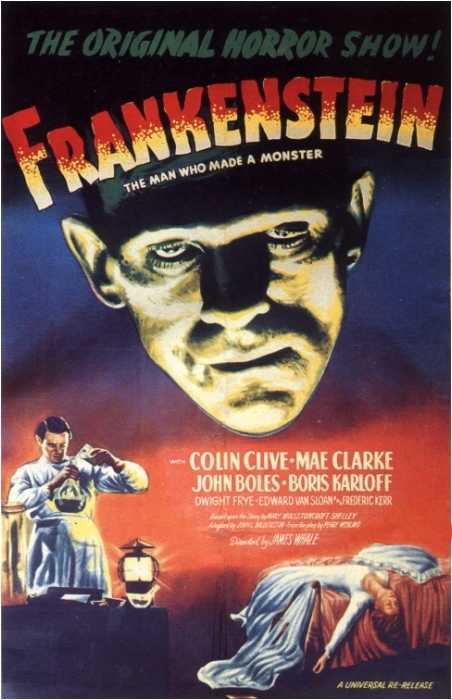
Here’s another one on the very short list of old black and white horror movies that managed to hit me with the intended effect in just about every shot. Frankenstein is moody, unsettling, and fully-realized. It has something to say, and it knows how to speak with both words and body language.
It’s a bit funny to think that many of these elements have become camp clichés in the present day. Though the later sequels are mostly responsible for this, it’s the title “Frankenstein†that they’re more or less grouped under. For this, first time viewers may be a little surprised by the movie they get; Boris Karloff’s monster is not a robotic zombie, grunting, lumbering and lunging at everything he comes across. He’s a blank slate trying to understand his surroundings, and unfortunately, anger, sadism, and fear are some of the first things he learns from his peers. And Dr. Frankenstein is not a cartoonish mad scientist who just happens to choose insane, nonsensical experiments as his favorite way to pass the time. He’s a real one. He’s a man whose ambition is so high, he teeters on the line of brilliance and insanity, rushing a daring dream into the realm of a heartless nightmare. And the surprise is that as he comes to understand the consequences of his actions, he becomes sane again. This is one thing his creation can never truly do, and it’s the reason why, no matter which of them was truly the monster in all of this, Dr. Frankenstein is the one who receives a chance at redemption.
6. Halloween (1978 )

You know the one. Halloween captured lightning in a bottle. It formed the groundwork for maniac-on-the-loose slasher movies now done to death by giving us only the core elements of what makes it all so frightening. And it gave them to us in spades.
Actually, while the movie earns every bit of its reputation as a classic, it did show me a downside that its biggest lauders probably didn’t care about: The buildup seems to drag a bit. As well done as it is, it keeps going, with no action in-between, after it’s already accomplished everything it set out to do. All the pieces – the mysterious stalker escaped from the asylum, the doctor who’s vowed to stop his evil, and the babysitter who keeps spotting him over her shoulder – are in place, and none of them are moving. But this, rest assured, is a small price to pay. When it gets moving, move it does, raising the pulse scene-by-scene. And while we may have seen these scenes before, this is perhaps the only time in which none of them are going through the motions.
5. Manhunter (1986)

Those of you not familiar with the lesser-known first film to feature Hannibal “Lecktor†should consider it. While its Oscar-winning follow-up The Silence of the Lambs (1991) is a sharp and scary movie, this underappreciated cult classic is the one I name as my favorite of the series. Aren’t I an edgy mind who knows how to think against the grain?
Actually, based just on content, the “edgier†viewer would probably side with Silence of the Lambs, which is the grittier, more descriptive and more openly grotesque movie. Manhunter is more stylized and more subtle. Often times, it only alludes to the horrors that took place or tells us in passing. It’s almost free of gore, trusting the power of the viewers’ imaginations. And with Tom Noonan’s performance as the horrifying yet human Francis Dollarhyde driving them, that’s a pretty good bet. This is not in and of itself a superior approach, granted, but in the end, the truth is that I just happened to find Manhunter more intriguing.
What sold me more than anything else, however, was William Peterson’s star turn as Will Graham, the FBI agent hired to catch the criminal. The character he conveys is both a driven soul determined to save lives and an unstable mind that could have easily become as bad as the criminals he’s so talented at reading. He admits, at one point, to having dreamed “the ugliest thoughts in the world†while investigating a case. And even more disturbing, perhaps, is the fact that this is his most sympathetic trait of all.
4. Misery (1990)

My favorite Stephen King adaptation after The Shining, Misery is one of the tensest movies I’ve ever seen. Imagine, if you will, that you’re an author at the end of a Faustian bargain, making your fortune on a commercial series of romance novels that you don’t enjoy writing. The last novel in your series has just hit the shelves, and you’re driving the manuscript for your proudest work in some time to your editor, when your car skids on any icy back road and careens over a hill. You wake up in the home of a large, jovial woman, who claims to be your biggest fan. She’s a nurse who’s already applied splints for your broken legs and tells you she needs to contact a hospital just as soon as the roads clear up.
Now imagine that through daily conversation, your excellent caregiver slowly reveals that she doesn’t just love your romance novels. Her life seems to revolve around them. She gushes over the main character like a beloved daughter, and she asks you everything about the writing process, flaring up at odd intervals when you tell her something she doesn’t particularly like. One day, moving around the room in your new wheelchair, you discover something suggesting what you’ve vaguely feared, that this woman might not be a safe or stable individual. And now imagine that she’s just finished your newest novel, in which you’ve killed off the main character.
Misery squeezes everything from its simple scenario and the performance of its two leads, that being James Caan and – especially powerful – Kathy Bates. Caan’s author walks a very thin tightrope, balancing what he must force himself to do physically before it’s too late, with the very likely chance of failure, against what he shouldn’t do, lest he force his tormentor’s hand. Bate’s nurse conveys love at its most twisted, as a passion that drives her to hurt, the results of which fuel her fire even more. The two of them engage in a psychological duel, which evolves and devolves into a very complex relationship, and when things are bad, it’s scary enough to make the movie even more morbidly spellbinding when they’re good.
3. Bride of Frankenstein (1935)

Would you know it, the sequel that had even less to do with the novel topped the first one. Bride of Frankenstein delivers more of what Frankenstein did so well, with unsettling, gothic moments and superior art direction, while also adding a subtly campy and humorous tone, just enough to be funny without stripping the story of its dignity. But it also adds something that, against what logic would suggest, pushes it above its predecessor: A little bit of heart.
In turning Boris Karloff’s monster into more or less the main character, it adds a very humane element, watching the creature start to long for personal peace and harmony. This shows in spades during its most famous scenes, in which the monster comes across a blind hermit living by himself, and both are grateful to have found each other. It’s a touching sequence that we bear in mind for the rest of the movie and can tell the monster does as well. But once again, nobody has a way in mind to redeem what has transpired, leading to an ending that’s not entirely happy or sad and can only be summarized by the monster’s immortal statement: “You stay. We belong dead!â€
2. Paranormal Activity (2007)

Aw heck, sue me. This divisive movie, from the divisive “found footage†genre, is among the number I can count on one hand that legitimately scared me. I’ve seen the four corners of horror. I’ve watched brutal gore and been everything from mildly intimidated to depressed. I’ve seen some of the most stylish and creative monster movies ever made. I’ve watched supernatural forces at work just off screen and waited for depraved beings to emerge from around the corner and spring their horrific trap. I’ve seen blood, guts, shadows, campiness, and leviathans that make us realize how infinitesimal we really are. But Paranormal Activity is the only one, during and after, to make me uneasy at the thought of what could be concealed in the dark, just out of sight.
It’s often compared with The Blair Witch Project (1999), which seems to be the marginally more respected of the two. Personally, I thought Paranormal Activity answered some of the issues people take with that movie, including the shaky cam and the total reliance on vague speculation for scares. A couple setting up a camera to record strange phenomena in their house takes away the limits on what they’d be able to record, allowing the movie to show us as much or as little as it wants.
The movie appeals to our tendency to cling to the possibility that unexplained everyday occurrences could be caused by something out of the ordinary. Just the possibility fires the imagination, and Paranormal Activity plays on this with a simple approach that directly turns the product of this imagination into its antagonist. At first, the movie is almost wish-fulfillment, sating the urge we share with the protagonists to see our suspicions confirmed. But as the possibility of danger becomes more prominent, we begin to search for answers, and the movie provides terrifying implications for us to swallow. And all of it builds to a climactic strong contender for the single most unnerving final sequence I’ve ever seen.
1. Aliens (1986)

The first Alien (1979) is a movie experience that might be forever lost to me, on account of a damaged VHS and a dim screen. I think I’ll wait at least a couple more years before I try again, just to make sure it has a chance to top itself, after striking me as a very good movie none the less. But I think we can at least agree that it’s not as overwhelming a movie as its sequel. Alien had peaks and valleys. Aliens had me from the start.
I was legitimately surprised by the story given to Sigourney Weaver’s returning character, Ellen Ripley. Instead of just a second-in-command trying to fend off a dangerous invader to her ship and crew, she is now a woman who’s lost everything. Stranded and preserved in space after the events of the first movie, she’s missed her daughter’s entire life and has nothing left, except her knowledge of the horrible creature she faced and killed. This movie is about her fighting to win back her life.
But most importantly, the fight itself is an onslaught of horror. Stranded with a militia near a hive’s worth of aliens, Ripley struggles to save them all from the impending attack. A militia in a base are able to fight back much better than her former crewmates, but the alien blitz is overwhelming and absolutely horrifying. Its staged to perfection, and it doesn’t let up on the rapid-fire, gruesome rollercoaster of an attack, even for a moment. If the movie has a flaw, it’s that it’s all too much to be with it every step of the way. The movie can actually desensitize viewers to itself. Not a bad problem to have, really, as I’d rather a movie be sure it gave us everything than hold something back. It guarantees that the uplift we hit at the end is genuine, a sweet relief that everyone has truly earned after an enveloping nightmare.
Top 7 Favorite Horror Movies
July 24, 2014 in Uncategorized
The joys of Halloween are far too layered for just one form of entertainment to demonstrate in full. This is why I’m sure I’ll have plenty to write about next year. This Halloween season, my tribute went out to the good old fashioned scares, and now it’s time to cap them off with my 7 favorite horror movies.
Note: On my “favorite movies†list, I already covered A Nightmare on Elm Street (1984), The Shining (1980), and Invasion of the Body Snatchers (1956). I’m not fond of repeating myself, and you can probably guess this means that they’ve pretty much been given the all-time favorite award. So there’s no need for me to repeat myself, which I’m not fond of.
7. Frankenstein (1931)
Here’s another one on the very short list of old black and white horror movies that managed to hit me with the intended effect in just about every shot. Frankenstein is moody, unsettling, and fully-realized. It has something to say, and it knows how to speak with both words and body language.
It’s a bit funny to think that many of these elements have become camp clichés in the present day. Though the later sequels are mostly responsible for this, it’s the title “Frankenstein†that they’re more or less grouped under. For this, first time viewers may be a little surprised by the movie they get; Boris Karloff’s monster is not a robotic zombie, grunting, lumbering and lunging at everything he comes across. He’s a blank slate trying to understand his surroundings, and unfortunately, anger, sadism, and fear are some of the first things he learns from his peers. And Dr. Frankenstein is not a cartoonish mad scientist who just happens to choose insane, nonsensical experiments as his favorite way to pass the time. He’s a real one. He’s a man whose ambition is so high, he teeters on the line of brilliance and insanity, rushing a daring dream into the realm of a heartless nightmare. And the surprise is that as he comes to understand the consequences of his actions, he becomes sane again. This is one thing his creation can never truly do, and it’s the reason why, no matter which of them was truly the monster in all of this, Dr. Frankenstein is the one who receives a chance at redemption.
6. Halloween (1978 )
You know the one. Halloween captured lightning in a bottle. It formed the groundwork for maniac-on-the-loose slasher movies now done to death by giving us only the core elements of what makes it all so frightening. And it gave them to us in spades.
Actually, while the movie earns every bit of its reputation as a classic, it did show me a downside that its biggest lauders probably didn’t care about: The buildup seems to drag a bit. As well done as it is, it keeps going, with no action in-between, after it’s already accomplished everything it set out to do. All the pieces – the mysterious stalker escaped from the asylum, the doctor who’s vowed to stop his evil, and the babysitter who keeps spotting him over her shoulder – are in place, and none of them are moving. But this, rest assured, is a small price to pay. When it gets moving, move it does, raising the pulse scene-by-scene. And while we may have seen these scenes before, this is perhaps the only time in which none of them are going through the motions.
5. Manhunter (1986)
Those of you not familiar with the lesser-known first film to feature Hannibal “Lecktor†should consider it. While its Oscar-winning follow-up The Silence of the Lambs (1991) is a sharp and scary movie, this underappreciated cult classic is the one I name as my favorite of the series. Aren’t I an edgy mind who knows how to think against the grain?
Actually, based just on content, the “edgier†viewer would probably side with Silence of the Lambs, which is the grittier, more descriptive and more openly grotesque movie. Manhunter is more stylized and more subtle. Often times, it only alludes to the horrors that took place or tells us in passing. It’s almost free of gore, trusting the power of the viewers’ imaginations. And with Tom Noonan’s performance as the horrifying yet human Francis Dollarhyde driving them, that’s a pretty good bet. This is not in and of itself a superior approach, granted, but in the end, the truth is that I just happened to find Manhunter more intriguing.
What sold me more than anything else, however, was William Peterson’s star turn as Will Graham, the FBI agent hired to catch the criminal. The character he conveys is both a driven soul determined to save lives and an unstable mind that could have easily become as bad as the criminals he’s so talented at reading. He admits, at one point, to having dreamed “the ugliest thoughts in the world†while investigating a case. And even more disturbing, perhaps, is the fact that this is his most sympathetic trait of all.
4. Misery (1990)
My favorite Stephen King adaptation after The Shining, Misery is one of the tensest movies I’ve ever seen. Imagine, if you will, that you’re an author at the end of a Faustian bargain, making your fortune on a commercial series of romance novels that you don’t enjoy writing. The last novel in your series has just hit the shelves, and you’re driving the manuscript for your proudest work in some time to your editor, when your car skids on any icy back road and careens over a hill. You wake up in the home of a large, jovial woman, who claims to be your biggest fan. She’s a nurse who’s already applied splints for your broken legs and tells you she needs to contact a hospital just as soon as the roads clear up.
Now imagine that through daily conversation, your excellent caregiver slowly reveals that she doesn’t just love your romance novels. Her life seems to revolve around them. She gushes over the main character like a beloved daughter, and she asks you everything about the writing process, flaring up at odd intervals when you tell her something she doesn’t particularly like. One day, moving around the room in your new wheelchair, you discover something suggesting what you’ve vaguely feared, that this woman might not be a safe or stable individual. And now imagine that she’s just finished your newest novel, in which you’ve killed off the main character.
Misery squeezes everything from its simple scenario and the performance of its two leads, that being James Caan and – especially powerful – Kathy Bates. Caan’s author walks a very thin tightrope, balancing what he must force himself to do physically before it’s too late, with the very likely chance of failure, against what he shouldn’t do, lest he force his tormentor’s hand. Bate’s nurse conveys love at its most twisted, as a passion that drives her to hurt, the results of which fuel her fire even more. The two of them engage in a psychological duel, which evolves and devolves into a very complex relationship, and when things are bad, it’s scary enough to make the movie even more morbidly spellbinding when they’re good.
3. Bride of Frankenstein (1935)
Would you know it, the sequel that had even less to do with the novel topped the first one. Bride of Frankenstein delivers more of what Frankenstein did so well, with unsettling, gothic moments and superior art direction, while also adding a subtly campy and humorous tone, just enough to be funny without stripping the story of its dignity. But it also adds something that, against what logic would suggest, pushes it above its predecessor: A little bit of heart.
In turning Boris Karloff’s monster into more or less the main character, it adds a very humane element, watching the creature start to long for personal peace and harmony. This shows in spades during its most famous scenes, in which the monster comes across a blind hermit living by himself, and both are grateful to have found each other. It’s a touching sequence that we bear in mind for the rest of the movie and can tell the monster does as well. But once again, nobody has a way in mind to redeem what has transpired, leading to an ending that’s not entirely happy or sad and can only be summarized by the monster’s immortal statement: “You stay. We belong dead!â€
2. Paranormal Activity (2007)
Aw heck, sue me. This divisive movie, from the divisive “found footage†genre, is among the number I can count on one hand that legitimately scared me. I’ve seen the four corners of horror. I’ve watched brutal gore and been everything from mildly intimidated to depressed. I’ve seen some of the most stylish and creative monster movies ever made. I’ve watched supernatural forces at work just off screen and waited for depraved beings to emerge from around the corner and spring their horrific trap. I’ve seen blood, guts, shadows, campiness, and leviathans that make us realize how infinitesimal we really are. But Paranormal Activity is the only one, during and after, to make me uneasy at the thought of what could be concealed in the dark, just out of sight.
It’s often compared with The Blair Witch Project (1999), which seems to be the marginally more respected of the two. Personally, I thought Paranormal Activity answered some of the issues people take with that movie, including the shaky cam and the total reliance on vague speculation for scares. A couple setting up a camera to record strange phenomena in their house takes away the limits on what they’d be able to record, allowing the movie to show us as much or as little as it wants.
The movie appeals to our tendency to cling to the possibility that unexplained everyday occurrences could be caused by something out of the ordinary. Just the possibility fires the imagination, and Paranormal Activity plays on this with a simple approach that directly turns the product of this imagination into its antagonist. At first, the movie is almost wish-fulfillment, sating the urge we share with the protagonists to see our suspicions confirmed. But as the possibility of danger becomes more prominent, we begin to search for answers, and the movie provides terrifying implications for us to swallow. And all of it builds to a climactic strong contender for the single most unnerving final sequence I’ve ever seen.
1. Aliens (1986)
The first Alien (1979) is a movie experience that might be forever lost to me, on account of a damaged VHS and a dim screen. I think I’ll wait at least a couple more years before I try again, just to make sure it has a chance to top itself, after striking me as a very good movie none the less. But I think we can at least agree that it’s not as overwhelming a movie as its sequel. Alien had peaks and valleys. Aliens had me from the start.
I was legitimately surprised by the story given to Sigourney Weaver’s returning character, Ellen Ripley. Instead of just a second-in-command trying to fend off a dangerous invader to her ship and crew, she is now a woman who’s lost everything. Stranded and preserved in space after the events of the first movie, she’s missed her daughter’s entire life and has nothing left, except her knowledge of the horrible creature she faced and killed. This movie is about her fighting to win back her life.
But most importantly, the fight itself is an onslaught of horror. Stranded with a militia near a hive’s worth of aliens, Ripley struggles to save them all from the impending attack. A militia in a base are able to fight back much better than her former crewmates, but the alien blitz is overwhelming and absolutely horrifying. Its staged to perfection, and it doesn’t let up on the rapid-fire, gruesome rollercoaster of an attack, even for a moment. If the movie has a flaw, it’s that it’s all too much to be with it every step of the way. The movie can actually desensitize viewers to itself. Not a bad problem to have, really, as I’d rather a movie be sure it gave us everything than hold something back. It guarantees that the uplift we hit at the end is genuine, a sweet relief that everyone has truly earned after an enveloping nightmare.
The Top 5 Least Awful Thanksgiving songs
July 24, 2014 in Uncategorized
Why is Thanksgiving, with it’s strong central message, the holiday without a single trademark song, or poem or even a chant working its way into the public consciousness? (Even Halloween has “Trick or treat! Smell my feet!”) Unfortunately, while Halloween has spooks and candy, and Valentine’s Day has love and, uh, candy, and Christmas has pretty much everything, the only trademarks of Thanksgiving are eating turkey and, well, giving thanks. What’s more, Patrice O’Neil, of Friday infamy, recently did his best to make it seem like a lost cause. Still, a noteworthy few have found a way to work with it.
Rules:
– It must refer to something Thanksgiving-related (and not just something in the same ballpark).
– If it’s not written unmistakably about Thanksgiving, it must, in present day, be associated more with Thanksgiving than anything else.
Honorable Mention:
–Jingle Bells (James Pierpont): Actually, would you know it, Jingle Bells was originally written to be sung on Thanksgiving. Alas, it doesn’t mention Thanksgiving anywhere in its verses, and it’s now in the public consciousness as a Christmas song, so it must be disqualified.
–SNL’s Thanksgiving Song (Adam Sandler): Not exactly a “good” song, but it can be a fun time. If I found it as funny as some people seem to, it might have made the list.
–Alice’s Restaurant Massacree (Arlo Davy Guthrie): This classic that’s really more of a musical monologue than a song technically breaks rule #2 because it’s really about – and is more associated with – the Vietnam War. It happens to take place on Thanksgiving, and there the connection pretty much ends.
5. Thanksgiving Prayer (Johnny Cash): Guest star Johnny Cash sings an earnest little ode to the holiday on an episode of Dr. Quinn, Medicine Woman. This song is sweet, if a bit generic, and Cash sells it. That’s more than you can say for most attempts. https/www.youtube.com/watch?v=WdQQJPboFyc
4. Shining Time Station – Thanksgiving (Kevin Roth): A little piece of my childhood that stuck with me, video and all, from a show that went out of its way not to phone it in, this one manages to root itself in Thanksgiving without sounding forced or contrived. What’s more, it manages to sound like an actual song, not just a preschool jingle, and a half-decent song at that. Granted, I’ve put it on at Thanksgiving and had my carol-hating relatives brush it off as sappy, but I’m sticking to my guns on this one. Half-decent. https/www.youtube.com/watch?v=jwvbdZf6u6w
3. Thanksgiving Song (Mary Chapin Carpenter): The most serious attempt on the list to put a Thanksgiving song into the world of contemporary music and probably the most acclaimed, this song was actually the lone Thanksgiving number on Carpenter’s Christmas album. I’m a bit mixed on it, as my first impression was that it walked the line between soulful and soppy, losing ground on the more upbeat competitors. However, the album’s warm reviews were hard to ignore, especially when they singled out this song in particular. After taking a closer look at the lyrics and message, I admit, it hit harder than before. It’s not the tune to play during the festivities with the family, but as a way to get into the spirit of Thanksgiving, it’s sort of powerful. https/www.youtube.com/watch?v=7NSQLMPUK-8
2. Over the River and Through the Woods (Lydia Maria Child): Yep, this one’s a Thanksgiving song too. It straight up says so in the segment nobody remembers. Granted, it may be remembered more as a Christmas/winter classic, but that’s more than I can say for most Thanksgiving songs. It’s a fun, bouncy little carol that’s more ecstatic than most to start celebrating the holidays. Too bad I could only find one version with the right lyrics. https/www.youtube.com/watch?v=Sac2CVHs5Do
1. We Gather Together (Adriaen Valerius): If you’re a Christian, it’s possible that you remember this song as the Thanksgiving mainstay I claimed doesn’t exist. This triumphant and ardent little folk song about coming together to celebrate is short, unmistakably religious, and as close to timeless as a Thanksgiving song ever got. It wasn’t written for the holiday, but it’s become associated with it more than any other event, and likewise, Thanksgiving is associated with it more than just about any other song. It’s really not memorable enough to match the Christmas tunes we know by heart, but if only it were a blood relationship and the song just once mentioned Thanksgiving by name, it might have truly given the holiday that signature verse it lacks. https/www.youtube.com/watch?v=Y0JVqR8KnF4
Happy Thanksgiving everyone!
When Directors Clash: Hayao Miyazaki vs. Don Bluth, Final Round
July 24, 2014 in Uncategorized
Well, now that Bluth got us started, it’s time for Miyazaki to show us what he’s made of one more time, here in the twilight days of his career.
Going through Bluth’s final two movies made via a move to Fox Animation Studios (a sort of last stand as it were), he had some of his better results (http/www.manic-expression.com/apps/blog/show/29389333-when-directors-clash-hayao-miyazaki-vs-don-bluth-final-round-part-1-), but not only does Miyazaki have plenty of leeway here, he’s saved some of his most interesting entries for last. One final time, we put these two against each other and separate the great from the all-time great.
Anastasia and Titan A.E.
Vs.
Spirited Away and Howl’s Moving Castle
Spirited Away: Here it is, the single greatest success of Hayao Miyazaki’s career. Spirited Away, the story of a ten year old girl’s journey into a world of spirits and forced survival by her own wits, broke records as the most successful film in Japan, as well as one of the most popular anime films in the United States. But it has occurred to me what an insignificant rehash it would be to go on about its acclaim as one of the greatest pieces of animation of all time, or how it’s a new take on an Alice in Wonderland-type concept, or how close it came to becoming my favorite of all Miyazaki’s movies. No, I should be talking about something a bit more distinct. How about that many of the fellow Miyazaki fans I’ve talked to actually consider it one of their least favorite movies of his?
The reason, they tell me, is the main character, ten year old Chihiro. She begins the story as a spoiled and whiny girl, moving with her family to a new place, and what she learns through her adventure is not, explicitly, to change this attitude. Instead, after she enters an empty amusement park with her parents – against her will – the rug is swept out from under her altogether, and she finds herself alone, scared, and scrambling to save herself on the outskirts of a strange bathhouse. In a sea of bizarre creatures that consider her the only outcast, and one lone mysterious ally who comes and goes, is there no time to learn a lesson?
Actually, it’s worth saying that there’s a reason the story hasn’t drawn so many direct comparisons to Alice in Wonderland as it has to its sequel, Through the Looking Glass. (The latter is almost better known as a phrase than a storybook title. Most don’t seem to know, for example, that it’s actually the story in which Humpty Dumpty, Tweedledee and Tweedledum made their first appearances.) Even the titles are a tip off as to why; “Alice in Wonderland†practically summarizes the story, where a girl stumbles into a land of oddities mostly just to watch and witness for a while. But who knows what someone would do, or find, if they were able to go “through the looking glass,†into a world extending from a distorted image of our own?
That, not the construction of “Wonderland,†is the essence of Spirited Away, and it’s put towards the same type of story as Through the Looking Glass: a coming of age adventure. Chihiro, forced to get a job at the bathhouse to save herself, is suddenly made to sink or swim on her own resilience and cunning. Her name is – literally – stolen away from her by the malicious overseer, replaced with the name “Sen,†and recalling it is essential to rejoining her old world. In the meantime, she is made to bathe stink spirits and entertain everything from gigantic babies to the mysterious creature “No-Face.†But with no leeway to complain, she shows impressive pluck, and a little kindness starts to win her some friends around the place. In fact, some of them begin turning to her for help, even the mysterious Haku, who saves her several times because he remembers her name from somewhere far back. This must be significant, considering he can’t even remember his own.
Miyazaki was inspired to make this movie after witnessing the indifference of the ten year old daughter of his friend towards her parents, noting that she seemed to live in her own sort of world. What the movie draws from its inspiration, including Chihiro, is clear, and personally, I think her character is essential to the movie’s success. The story couldn’t be driven the same way by just “a nice girl.†This is not the story of Alice deciding what she thinks of Wonderland. It requires someone who could never come back the same as they started, if they come back at all, and it requires they have a little more defiance than your average shrinking violet; Chihiro might be prone to whining, but she’s not weak, and she doesn’t need to be moralized. She’s just a little out of her element, at the awkward age of 10, and sometimes it’s the strangest trips that finally make us comfortable in our own shoes.
Final Score: 9.5/10
Howl’s Moving Castle: What we have here could be Miyazaki’s strangest feature. Howl’s Moving Castle, adapted from a sleeper hit novel, takes several would-be simple plots, turns them out in directions most conventional filmmaker would not have gone, and then pulls them together in a tangled web none-the-less firmly bound together, still leaving some pieces obscured below the surface. Of his ten theatrical releases as director, the critical reception for this one, an important measure of his ability to carry on at this stage, was probably the worst. It was overwhelmingly positive.
Sophie is an introverted hat maker, who works each day to carry on her father’s business, resolved to a solemn, lonelier life than her attractive younger sister leads. In the novel, this is explained to be one of the accepted tropes of the fairy tale world they live in; not only are witches, wizards and curses prominent and feared, but the oldest sibling is never the one who gets a happy ending. In the movie, however, Sophie is simply a hard worker with no faith in her own worth. She stays after hours, puts her family members – deceased and living – ahead of herself, and walks the streets with her head bowed under a large hat. In a tender moment, she steps up to a mirror, strikes a smiling pose to herself, and then scowls and pulls her hat over her eyes.
This gives the story an even stronger resemblance to the self-insert female fantasies becoming more common in the present day. Not only is Sophie a seemingly-flawless, humble, and underappreciated gem, but soon she catches the eye of a good-looking and powerful but emotional wizard who needs her to be all he can be. There’s even a brief appearance later by a sort of “Jacob,†who also finds Sophie to be the girl of his dreams. There’s just one detail that keeps me from labeling it as such: After Sophie meets and is saved by the romantic lead, who later turns out to be the infamous recluse Howl, his jealous ex-lover, the Witch of the Waste, casts a curse that turns Sophie into a shriveled old lady. I can’t imagine many women fantasizing about that one.
Prevented by the curse from even telling anyone what happened, Sophie flees town and, with nowhere else to turn, takes refuge in Howl’s moving castle, more tired than afraid in her old age. But when Howl turns out to be the man who saved her, instead of the infamous predator that rumors suggest, Sophie finds that she fits in rather well with him and his crew; even without a cursed old woman, Howl was captain of an odd ship, with a fire spirit whose very life is tied to Howl’s heart (and by extension, his moving castle) and his young apprentice Markl – whose best trick is to transform into an old secretary and answer Howl’s clients – as his closest allies. In fact, being old woman seems to give Sophie some much-needed fortitude. As a smug and formidable grandmother, instead of a black sheep sister, she becomes the center of her new makeshift family.
I can’t be sure if calling the plot complicated would be about right or an understatement. Through the last hour of the movie, we cover Sophie’s curse – which seems to fade each time she opens up her love for Howl – Howl’s past becoming a wizard, attempts by his mentor to draft him into the war, his evolution from a fun-loving but melodramatic coward to a self-sacrificing lover, his bond with the fire demon, his relationship with the Witch of the Waste (whose importance quickly dies away), and Sophie and crew’s rather complex last effort to save him. It probably doesn’t reach the level of investment of Miyazaki’s best movies, but it doesn’t lose us, because for all the strange and sudden turns, the focus always seems to revolve around Sophie and Howl. Their development, for all the chaos flying around them, is what drives the story, and, as is, they certainly have a lot to play off of.
I will take a point away here for letting certain themes seem tangent to the rest of the story, despite the story itself carrying its weight just fine. But I cannot criticize the movie as a self-insert fantasy, because Sophie is not made to be replaced by the viewer. Her meek shyness is presented as an obstacle, not an absence of flaws, and she is made to overcome it as the tale progresses. And if Howl can’t help seeming like a textbook pretty boy, at least he’s also a fun guy with a full range of personality, which is on display from his darkest moments to his lightest, and from his most humiliating to his proudest. Howl’s Moving Castle takes the self-insert fantasy, rips out pretense and vanity, and replaces them with a genuine heart and an active mind.
Final score: 8/10
Winner: Well, Bluth’s scores of 8 and 7.5 out of 10 should be a clear indicator. Whether it comes to the most ambitious or most unwieldy stories, it seems Miyazaki is able to push the envelope further and more coherently. Bluth’s last stand is admirable, but at the core of these entries, we have Bluth trying to live up to himself vs. Miyazaki trying to surpass himself. The difference speaks for itself.
And with that, this long blow for blow match has finally come to end. The results have been all across the board, but now, let’s see the final scorecard in this ten round match:
Bluth:
Recommended: 7
Unapproved: 3
Miyazaki:
Recommended: 10
Unapproved: 0
Highest average: Miyazaki
Bluth: 7/10
Miyazaki: 8.5/10
Single highest score: Bluth
Bluth: 9.5/10
Miyazaki: 9.5/10
Single lowest score: Bluth
Bluth: 4.5/10
Miyazaki: 7/10
Most rounds won: Miyazaki
Miyazaki: 8
Bluth: 1
Ties: 1
In the end, Bluth’s ambition was his greatest weapon, but it lacked the supporting foundation that Miyazaki always seems to have. At least once, Bluth managed to reach such heights that he at least prevented an irrefutable sweep, but it only amounted to a single hard-won bright spot against a long list of victories won by a clear master of the genre. Hayao Miyazaki is a man with both wonderful imagination and powerful, clear visions, and there may never be another director like him. Even great names in the genre are dwarfed by his; Bluth is perhaps one of a handful who could have even held up this well.
Winner: Hayao Miyazaki
And now that the sentimentality is setting in, I’d like to thank everyone who took the time to read this series and give me their feedback. Here at the end, I’m definitely hoping that we get more movies from both Don Bluth and Hayao Miyazaki before the time comes from them to set down their pens, because men with their drive and talent don’t come around very often. But since it’s probably the last time I review his stuff for a long while, I also have to send a thank you out to Don Bluth. It was his most distinct films, and the incredible stories behind them, that helped spark my enthusiasm for movies. It’s become my favorite hobby, which just goes to show you how a little enthusiasm can spread.
When Directors Clash: Hayao Miyazaki vs. Don Bluth, Final Round (part 1)
July 24, 2014 in Uncategorized
Well, I’m sure glad I was able to keep this 10 part series right on schedule. It was one year ago today that I first posted an entry in this series, which was also two parts at once, and that’s how it’s going out as this match between two of the most important figures in animation comes to a close.
As many probably predicted, Hayao Miyazaki had been dominating the bulk of this match when we left off all the way back in December. Granted, there have been a few Bluth bright spots over the months but hardly enough to say he’s holding his own. Still, he put a major chink in Miyazaki’s impending victory when I found his All Dogs Go To Heaven the best of the sixteen movies reviewed in this series to date (though it’s safe to say that some readers did not agree). There have never been any guarantees in these matches, and considering that these final entries show both careers – now in their twilight days – venturing out in new directions, it’s truer now than ever.
Anastasia and Titan A.E.
Vs.
Spirited Away and Howl’s Moving Castle
New, Familiar, and Always Audacious
Anastasia: Like Bluth’s earlier Thumbelina, Anastasia takes some blows from film enthusiasts for being a knockoff of Disney. (Not of any film in particular, that is, just a “Disney†knockoff.) On the other hand, viewers not in either of those categories usually assume it that is a Disney movie. And they remember it in the same fond light as their other childhood favorites.
The movie, like many before it, explores the legend of the Grand Duchess Anastasia Nikolaevna – that she survived the execution of the imperial family – using history to create a musical fantasy based around the idea of “what if?†(The creators freely explained this before the movie’s release, but many still feel the need to share their vast knowledge and inform us that the story of a miraculous conspiracy involving amnesia, an immortal and vengeful mystic, con men, servants of the dark arts made of green magical energy, and a talking white bat is altogether – brace yourself for this one – not historically accurate.) What puts the story on par with Disney, where most people are able to tell the difference with Thumbelina, is the way the movie explores and brings out the potential of each aspect. After four movies of modest, unspectacular ambition and storytelling, Bluth returns here at full force, giving us an adventure with strong characters and engaging dilemmas.
The movie has some freedom to choose how, exactly, Anastasia escaped and went missing for several years, as one of the details essential to the legend is that she was not where history says she was. The result is the amnesiac young woman named Anya, who turns down a job in a fishing village to journey to Paris, where her one remaining family keepsake directs her. The character’s design puts her right in line with the many “princess†characters filling up fantasies and fairy tales – inside of Disney and out – but the filmmakers do manage to give her some distinct characterization that seems to take into account the mischievous and humorous personality attributed to the historical figure. Anya has the same fiery resilience as many of the modern princesses, but she’s simultaneously rougher around the edges – a bit cynical and sarcastic – and more vulnerable, more sensitive. You get the sense that she’s picked some genuine heartache over the years.
Her trip to Paris with two con men hoping to pass her off to her grandmother as the real Anastasia (creating the story’s most noted angle of having Anastasia be a fraud who isn’t a fraud at all) packs its share of adventure, especially when they’re pursued by the infamous Rasputin. The “mad monk†is reimagined here as a decent villain, living in seclusion after sealing the doom of the imperial family – save for one. Having sold his soul to complete the curse, he vengefully sics his dark creatures on Anastasia and her friends, indifferent as his rotting limbs fall off and are screwed back on. (From what history has recorded, he may or may not be the most unfairly represented figure in this movie, but I’m prepared to say that Antonio Salieri is higher up on the list of historical figures owed an apology by modern filmmakers.)
The movie was a fitting comeback for Bluth and co., as their move to Fox Animation Studios seemingly provided them with the time, the energy, the improved songwriting, and the appealing new art style (despite some awkward CGI intergration) that they needed to make a grand, layered, and fresh new movie. Anastasia has heart, style, excitement, and even a few particularly gentle and delicate moments, such as the gradual redemption of lead con artist and love interest Dimitri and the reunion between Anastasia and her grandmother. Empress Maria Feodorovna, whose desires are given weight of their own in this interpretation, was never able to publicly accept the deaths of her child and grandchildren before her own passing in 1928, by which point her son in law had commented that she was “ready to meet her Creator.†Anastasia, it could be said, pays a kind of tribute to more than one lost soul.
(Note: Those who would still say that every aspect of this type of story exclusively belongs to and should only be made by Disney’s brand should see the movie’s real inspiration: the 1956 movie of the same name.)
Final score: 8/10
Titan A.E.: “Children can handle just about anything as long as you attach a happy ending.†– Don Bluth
The first thing that came to mind upon reading that quote was the trailer to Titan A.E., which seemed to be a direct test for the philosophy. The first thing that happens is the destruction of planet earth and – presumably – most of the human race. Being in the fourth grade when I saw it, it seemed a little heavier than the movies I was looking to see at the time. But at the same time, this was such a massive conflict that I was still sort of tempted to see the movie, just to see how it was resolved. In the end, I opted not to, which is a shame, because I probably would have loved it. The movie is upbeat, action-packed, visually awesome, and mostly triumphant. Today, having finally caught up with it after discovering my admiration for Don Bluth, I do like it, but it doesn’t dig as deep as it could.
In 3028 A.D., the human race discovers a new level of technology that they name “The Titan Project.” But the capabilities are such that an alien race formed from pure energy known as the Drej invade and destroy the earth, sheerly for the sake of their own survival. Humanity does have one remaining hope, however, as the mysterious Titan Project is shipped away from earth and hidden in space just in time. Fifteen years later, the son of the Titan’s creator, 19 year old Cale Tucker, works as a janitor of sorts – whose job includes everything from rags to chainsaws with laser(?) blades – and doesn’t know that he is the only chance to access the map to the Titan’s location. He soon learns the hard way, however, and quickly ends up joining a crew in a race against the Drej to find it.
To be sure, there are some interesting relationships among the crew, including a man who knew Cale’s father and a love interest, who collects old memorabilia of earth. Where the movie disappoints is the way it doesn’t dig especially deep into any of them, or the implications they must be dealing with as the last of the human race, as well as its last chance for survival. It’s not so much that anyone is inherently shallow, not at all, but that the movie makes few efforts to take them to the next level of development, putting most of its focus on the action and the adventure. From that angle, the movie has above-average action and superior visuals, with the intelligence and depth it does show thrown in as a bonus. The problem isn’t even what plotting we do get, which is solid and serviceable enough. But the story’s outline is so substantial that a movie like this almost isn’t enough to acceptably convey it. Almost.
As is, we only find ourselves wishing for more substance when the movie slows down in attempt to deliver it, so sit back and enjoy the ride. The movie delivers fun moments one after another, as well as a few great ones, including a chase through a field of ice rings, the final showdown with the Drej, and an encounter with “an intelligent guard,†something truly unusual for such a movie. And though I harped on it for being shallow, I should keep this in proportion; in the areas where the movie isn’t great, it is passable, and by the end, I was invested in Cale and his friends as they raced to save their race. As for those of you getting caught up in the science that may or may not hold water in the movie, I can only advise that you learn to see the forest through the trees.
Final score: 7.5/10
Next time, Miyazaki will counter with two of his most recent movies as director, one his biggest success and one his most polarizing feature, bringing this series to a close once and for all.
When Directors Clash: Hayao Miyazaki vs. Don Bluth round 8
July 24, 2014 in Uncategorized
Round 8: Childlike Simplicity
      A Troll in Central Park vs. My Neighbor Totoro
How to Treat Your Audience
It’s been a busy semester, but now, with the holidays slowing down, it’s time to pick up this series again. As of this post, Bluth has only won or tied against Miyazaki in two of seven rounds, but with this and two more rounds to go, he still has time to finish strong.
The line between movies for kids and movies for little kids is thicker than people realize. Kid movies can include material as intense or dark as that found in The Incredibles or The Witches, but if the primary audience is not meant to deal with anything more intense complicated than something found on “Sesame Street,” they’re an especially young demographic. Movies at this level get a bad reputation, as many have failed through a need to condescend and pander, but this is not the rule. Quality is quality, and we’ve already covered a good movie delivered by Miyazaki on this front (Ponyo). In this match, we compare the first attempts of each director to charm their smallest audience members. Can they succeed where so many have failed?
 My Neighbor Totoro: The truth is, even after a months-long hiatus from reviewing Miyazaki’s movies, I don’t feel like I have much original to say about this one, partly because I already said it. Could I really have avoided mentioning it like I did in my reviews of his other works? My Neighbor Totoro is not just one of Miyazaki’s biggest trademarks, it practically set, scratch that, defined the standard of all his most character-driven movies.
Perhaps going through the motions will help. The plot; two young girls move to a new house with their father, while their mother is recovering from a long-term illness in the hospital. I’ve already set myself up for a fall here, because from there, whether the movie acts as a “story†or an “experience†is up for debate. The girls begin catching sight of little forest spirits, gradually learning that there is some magic in the woods, until Mei, the younger sister, gives chase to a few and winds up on the gigantic tummy of the titular character. They skim the mandatory introductions before “Totoro†(Mei’s attempt to pronounce it is probably as good as any), gets back to his nap, with Mei gladly joining in. She wakes up back at home, alone in the garden. But soon after…
Miyazaki, as always, displays talent in his ability to capture the “magic†in everyday life, but My Neighbor Totoro becomes his quintessential display of this skill. Granted, that’s life with a lot of “actual†magic added in. But then, the line presented here between imagination and reality is so thin, that sometimes the forest spirits seem like the simple embodiment of nature’s very real power. (There is a reason the word in the title is “neighbor†that whoever changed it to “friend†in the first English release did not understand). The tone is often lighter and fluffier than anything more serious than “Teletubbies†would every try to be, and the two girls are permitted to act their age, with plenty of energy at that. In fact, Mei’s design is one of the more cartoonish of Miyazaki’s human characters. Still, when the movie opens with the two of them enjoying the moving trip in the back of their dad’s pickup truck, ducking under the furniture when he spots policemen coming, we know that nobody’s talking down to us. The leads are (mostly) genuine kids, not dense, wide-eyed observers in a censored world of lukewarm “thrills.†Miyazaki’s climax does not neglect the darker points in his portrayal of life, allowing that it can be a little scary in ways that Satsuki, the big sister, is just old enough to understand. Yet, some of the best moments are like none of the above, as when the girls, while waiting in the rain at the bus stop, are silently joined by you-know-who. Only one of the three is expecting the bus that arrives first.
What is it that makes this gentle little movie works so well? Is it the animation? The characters? (I won’t bother suggesting the plot.) Maybe it’s all of the above beautifully serving a vision of such warmth and resonance that it’s not just loveable; it’s distinct, even by Miyazaki’s standards. I’d be a bit compelled to say it’s not his most challenging work, but, wait, did I mention the other reasons it wasn’t easy to review?
 Final score: 8.5/10
 A Troll in Central Park: If there’s one movie in this lineup people would expect to know my opinion on ahead of time, this is probably it. Until recently, A Troll in Central Park was probably Don Bluth’s least-known theatrical release. The people marketing it put forth so little effort that its intake failed to exceed 5 digits, and the few reviews it got were dismissive, with its overall ratings falling just above The Pebble and the Penguin (below all of his other films). Outside of perhaps a minor cult following, it was one of those films that was just never mentioned. Then a couple of the rising online shows about beat down reviews shone the spotlight on it for an episode, and viewers jumped for joy, thinking they’d found the newest “Barney and Friends†or “Care Bears,†something childish and also lame enough to “deserve†all the easy shots they could take at it. Personally, I think they should have stuck with “Care Bears.†I have nothing against lambasting the condescending dreck made to keep kids quiet and sell them toys, but watching A Troll in Central Park -which admittedly has its uninspired points- makes it clearer than ever to me that Bluth is a passionate creator. Even when the idea begs for it, he’s not one to resign himself to clichés.
We open in the kingdom of the trolls, where bad = good and vice versa. It would have been easy enough to make it one of the many generic “evil†worlds, but instead the story weaves in a parable on conformity, suggesting the land is only this way because Queen Gnorga demands it be so and rules with an iron fist. Troll enforcers roam the streets singing their “bad troll†anthems of loyalty, an aspect that has been hastily written off as a way to label them “villains†in a condescending manner. Gnorga, by the way, is sort of like Oscar the Grouch if he became an extremist and possessed evil powers, the most prominent of which is her magic thumb that turns whatever it touches to stone. Only one troll loves greenery and flowers enough to defy her, a meek and tiny guy named Stanley, voiced by Dom DeLuise, with a power of his own; his (literally) green thumb grows plants on whatever he touches. That is, as many as he can will.
From here the plot is short; Stanley is caught by Gnorga, whose husband talks her into banishing him to a place where nothing grows (New York City) instead of turning him to stone. He’s discouraged by what he meets there, but he makes his way into Central Park and meets two new friends; a cutesy toddler named Rosie and her older brother Gus, who’s become a bit trollish himself after feeling neglected by his parents. He entertains the two with his magic while Gnorga decides to just finish him off, the attempts at which constitute the rest of runtime. Bluth seems to be going for a similar effect to My Neighbor Totoro, drawing power from sincere simplicity, but his craft doesn’t measure up. Gus and Stanley are not failures as characters, but where Satsuki and Mei had dimension, Rosie is cloying. As such, sequences meant to be “sweet†or “charming†come off as rather dense instead. Gnorga, meanwhile, is let down by King Lort, a weak comedic plot device. But Bluth does have a vision of his own, and when he finds ways channel his passion, the movie begins to work.
The songs, all of them worth it for the first and only time on Bluth’s box-office failing streak, act as microcosms of the movie’s strengths. Gnorga’s “Queen of Mean†has a nice beat to it and, by riding out her “terrible is wonderful†gag with some fun animation, makes for an amusing 2 minutes. When Stanley finds the motivation to start growing his plants again, the movie channels something like John Lennon’s “Imagine,†and the result is “Absolutely Green,†a warm and sincere expression of hope. Bluth even manages to create small moments of intrigue, such as the trip on Stanley’s boat that’s made of “a dream,†accompanied by the song “Welcome to My World.â€
“Anything that’s real starts with a dream,†explains Stanley, a claim that some have inexplicably misconstrued as an assertion that just dreaming of something makes it real. In fact, Stanley is eventually forced to recognize that to have any chance at realizing his own dreams, he will have to stand up to Gnorga.
What holds the movie together is the fact that both Gus and Stanley undergo character arcs that involve learning from each other. Stanley is sensitive and understands that spreading good will brings one more joy than malice does. Gus is aggressive but brave, and doesn’t hesitate to challenge Gnorga when she kidnaps his sister. Stanley wants to help, but unlike the generic payoff of disregarding fear and charging in, Stanley, however hard he tries, cannot ignore the fact that he is afraid. Only when he considers what he holds dear and could lose does the battle become worth fighting. Gus, meanwhile, walks a thin line between an evil troll and a good one, and without finding his way, he could unwittingly do some harm. The final payoff is rather perfect, at least until it goes overboard in a sequence I have an easier time pretending isn’t supposed to be literal.
The movie is made primarily for a pre-k crowd, and while it doesn’t fall back on clichés about believing in friendship or doing the impossible, this is clearly the only audience it expected. But again, quality, not genre, is always the deciding factor; My Neighbor Totoro and The Many Adventures of Winnie the Pooh are classics plain and simple, Follow That Bird and Elmo in Grouchland are solid options for tykes and anyone feeling nostalgic, The Care Bears Movie and The Oogieloves in the Big Balloon Adventure are lame, pandering wastes of time, and below that are some of the laziest, most condescending attempts to make a fast buck ever put onscreen. A Troll In Central Park doesn’t really make either of those first two categories, but I’d say it at least tried and got somewhere.
 Final score: 6/10
Winner: In case anyone skips to this part, let me make this clear; the fact that I don’t hate A Troll In Central Park does not mean I’m about to do the unthinkable. My Neighbor Totoro is a classic that trumps it in every department, except maybe the soundtrack. And even there, Totoro still has first-rate background tracks that work perfectly in accenting the mood. While both manage a pass, Miyazaki takes another clear win.


