

@the-second-opinion

The Toughest Combat Robots in BattleBots: Part 2, The Top Ten
July 24, 2014 in Uncategorized
Last week, we went through the heavyweight robots (no higher than 220 lbs) who used to compete on BattleBots and were tough but not tough enough. (http /www.manic-expression.com/apps/blog/show/26413445-the-toughest-combat-robots-in-america-battlebots-era-part-1-runner-ups-) One must understand them to know just how powerful the top ten are and why they are truly the best. It’s time for the real destruction now.
1. Biohazard (27 wins, 3 losses)Â –http /secretweapon.netfirms.com/images/bot-00026.jpg:
Your robot has – pick one – a wedge, forklift, or plow mounted on the front. You drive it full force at the 4 inch tall rectangle of an opponent, ready to ram the little guy across the arena. They collide, and your bot slides right overtop the other one, as if it weren’t there. That seemed to defy physics a bit… is your front bent out of shape? You spin around to try again, but the other bot is right on your tail, and you’ve already accidently driven up its side a little. You hit reverse to slide off and try another ram, but the other bot pushes forward, getting its front firmly underneath you. A lifting arm pops out of its back, about five times as high as the robot itself, and your bot flips up and rolls right onto its back. Didn’t add a self-righting mechanism? You’ve just finished 20 seconds of fighting Biohazard.
We could only start with this one. There’s virtually no robot on this list that didn’t have to worry about Biohazard at some point or another. It was both the first and last heavyweight champion of BattleBots, winning the title four times out of seven. It also left nothing in doubt; save for one resounding defeat, Biohazard eventually fought and definitively beat every bot to make any legitimate claim to a title shot. Leverage was its weapon, and with wedged titanium “skirt†flaps on all sides combined with its long but low profile, it had more of this than probably any robot to date. In 30 matches, only 2 robots even managed to get underneath it.
Even though it was the first champion, this was in one of the show’s lesser-known “pre-season 1†tournaments, so Biohazard didn’t make much of a name for itself until tournament #4. In tournament #2, long-suffering rival Vlad the Impaler managed to catch it in an early round and pay it back for making Vlad sit out the placing rounds in all the past tournaments they’d entered, dating back even before BattleBots. In tournament #3, having already been turned from a champion to a nobody, a robot called Voltronic managed to hand Biohazard the biggest upset of its career and Vlad came out the champion once again.
Biohazard would settle with Voltronic in tournament #7 (http/www.youtube.com/watch?v=e_XLcBE9lkg), but in #4, it met Vlad for the last time in their only championship fight. After a match that lived up to its hype, Biohazard emerged as one of the greatest competitors in BattleBots history. Its later career would only add to its legend.
–Best win
Biohazard and Vlad the Impaler settle the score once and for all in this fight, laying into each other with everything in their arsenal. The hazards around them actually start to seem trivial, barely distracting the two from each other:Â http/www.youtube.com/watch?v=lMuvAIzjJmU
2. Son of Whyachi (7 wins, 0 losses) –http /images1.wikia.nocookie.net/__cb20121217181537/battlebots/images/2/21/Whyachi_sf01.jpg:
What can you say about a robot that manages a sweeping first place finish over all the best competitors and then steps up a weight class due to a rule change and never does anything else significant? You could make the argument that Son of Whyachi should be at #1. It’s the only robot in BattleBots to score an unavenged victory over Biohazard. You could also make the argument that it should be disqualified from the whole list.
The design was a “walker†bot (which, at the time, meant it could be heavier than the weight class limit) with a propeller on its back and “hammers†extending down nearly to the floor. But Son of Whyachi was more than a league above the earlier, faultier “spinbots†like Phrizbee or Mauler. Its first televised match in tournament #5 was against Nightmare, a robot you may remember from the “honorable mention†list, and the announcers predicted it would be a “classic†vertical spinner vs. horizontal spinner match. It was a classic all right: http/www.youtube.com/watch?v=mQFYzyrfrP0
After that little statement to the competition that they weren’t dealing with the average newbie, Son of Whyachi proceeded to knock out more big names on its way to the championship, including another familiar “honorable mention†bot, Hexadecimator. In the championship match, it punched off Biohazard’s wedged skirts one-by-one, and just when it seemed the defending champ was about to win out anyway on sheer resilience, well, watch it for yourself.
Still, even if you don’t count its weight advantage against it, the thing is, Biohazard proved it could avenge losses, and Son of Whyachi (which showed its limits trying to push around bots in the “super heavyweight†class) had more than one close call in its single big tournament. The win goes a long way, but where the rest of the bots we’ll see had at least one true shortcoming, Biohazard – who went on to reclaim the championship next year – has the type of sustained success I just can’t concede to a one-hit wonder.
–Best win
The brutal Son of Whyachi vs. Biohazard match may well be the best you’ll see from this show: http/www.youtube.com/watch?v=eYCryx-1gqc
3. Vlad the Impaler (16 wins, 4 losses) –http /images4.wikia.nocookie.net/__cb20121215230232/battlebots/images/2/20/Vlads3.jpg:
Here it is, the last of BattleBots 3 heavyweight champions. You’ve heard me start its story already: This vampire was forced below the radar for a long time, once even by two journeymen bots who caught Vlad on a bad day and kept it from even taking a shot at Biohazard in tournament #1. But when Vlad’s time finally came (http/www.youtube.com/watch?v=sYajNQQZaaQ), it was perfectly aligned with BattleBots’ breakout success, vaunting it to prominence as the show’s first revered champion.
It was really the only way for Vlad to get the recognition it deserved. Vlad’s sharpened lifting forks gave it superior leverage, and its bulky, tank-like shape made sure they had plenty of power behind them. It wasn’t the only bot ever to flip Biohazard for nothing. It also added a retractable “self-righting piston†on its back, which came in handy against Biohazard (otherwise, Vlad never needed it). Altogether, Vlad combined the best traits of Voltronic and Punjar (see honorable mention list), both on the long list of big names it added to its win record along the way.
Sadly, Vlad’s career ended on a low note. After the final Biohazard match, Vlad returned the following season, only to be beaten in the first round by a newcomer. The builder then made the mistake of retiring Vlad and designing the inferior Vlad the Impaler 2. (Have I got stories to tell about that smaller, sleeker, complete failure of an experiment.) But even if its David and Goliath rivalry with Biohazard ultimately left it in the “Goliath†role, at least it was part of the greatest rivalry in the entire history of the show.
–Best win
I got the one-sided Biohazard fight out of the way because this is supposed to be all about Vlad, so let’s see it win the championship instead: http/www.youtube.com/watch?v=J0rEdvage4c
4. Mechavore (7 wins, 3 losses) –http /images2.wikia.nocookie.net/__cb20121215231012/battlebots/images/1/1a/Mechavore.jpg:
What we have here is simply the most underrated robot in all of BattleBots. Mechavore took using a saw as a weapon to the next level. Unlike Nightmare or Surgeon General, pretty much designed in the hope that the blade would do the work for them, Mechavore played to the strength of its weapon. It had a bulky, heavily armored design with a “shield†strip surrounding its four wheels, which gave it solid pushing power on its own and made it difficult to flip. With the powerful saw skillfully built into its body, it was even harder to out-damage, which only one robot (Son of Whyachi) just barely managed to do. It’s not hard to see why it’s overlooked; it was only ever a quarterfinalist, and it does have 3 losses out of only 10 matches. But it was also the only bot to face all three heavyweight champions in its career, giving all of them great matches. And beating one of them.
Mechavore’s brackets were always stacked pretty heavily against it, but in the first tournament (#5), that actually helped it show what it could do. After pulling off a huge upset over Vlad the Impaler, Mechavore proceeded to knock out Surgeon General and then face Son of Whyachi. This match is even closer than Whyachi’s fight with Biohazard: http/www.youtube.com/watch?v=jOIaKRIrPFY
In the next tournament, it lost to Overkill, a robot geared to beat spinning weapons, which it always did (including Warhead, Surgeon General, and M.O.E), but Mechavore came the closest. This loss pretty much sealed Mechavore’s reputation, despite the fact that, since Overkill got crushed in its only match with Vlad, it really only evened up the two of them. Then came Mechavore’s last tournament, where it didn’t get far before being placed against Biohazard. Biohazard quickly became the only bot to flip Mechavore, leaving it helpless. But it was only slightly less helpless than Mechavore left Biohazard, having cleaved its lifting arm clean off on the way down.
-Best win
At the time, viewers probably expected Vlad the Impaler to go to town, but Mechavore delivers so much damage that Vlad goes from struggling to, by the halfway point, in deep trouble:Â http/www.youtube.com/watch?v=8hCD5tv1uv8
5. Overkill (13 wins, 5 losses) –http /shadow.wizards.com/magic/expert/battlebots/images/Wallpaper/overkill_640x480.bmp:
The primary weapon of Overkill was a pretty basic design, a wedge attached to two big tires in the hope of plowing through the other bot. But earning its name with a second weapon, a big sword attached to its back that it could bring down like a mousetrap, is what brought out its unorthodox potential. For the first two seasons, Overkill sat in the shadow of its big brother, the “super heavyweight†champion Minion. Then their builder, Christian Carlberg, decided to turn his defending champion over to his teammates and put all his focus on improving with Overkill. By season 4, Overkill had stolen the spotlight, meeting Biohazard in the finals. And this was in between two very strong appearances in the semi-finals no less.
Overkills had good power, decent leverage, and a nice arsenal of ways to attack, but its greatest strength was its ability to absorb damage. The 18 matches on its record is the longest any heavyweight went on the show without getting knocked out. It was solid enough to take hits but also not grounded enough to really lay into. Not to mention it could drive inverted, which came in handy just about every other match. Even the blade helped it absorb attacks; attempting to cut through it was what killed the saws of Mechavore and Surgeon General.
You might have noticed that, even if winning its only fight with Mechavore just makes them even, as I claim, its semi-finals and second place finishes were greater successes to boot. Well, unlike Mechavore, Overkill does have a genuinely embarrassing loss on its record (to a mediocre bot called Frostbite, in its early days). But no, Overkill also has a longer list of notable wins, so, I admit, the call is mostly opinion-based. Even in its losing matches to the defending/future champions, Mechavore made me believe that it was borderline-champion material (if beating Vlad the Impaler wasn’t already proof-enough of that). Overkill always seemed a little out of its league against Vlad or Biohazard. If the chips had fallen its way, it’s possible that Mechavore could’ve won it all at least once, while Overkill definitely hit its limit at second place.
–Best win
Overkill shows the tournament wildcard and crowd favorite what the real competitors in BattleBots can do, in the first match I remember being truly disappointed over. Warhead (see honorable mention list) had knocked out all of its opponents and was making a fan out of me, but Overkill at the top of its game here is still hard not to admire:Â http/www.youtube.com/watch?v=3Jut0dAtuco
6. Voltronic/Voltarc (16 wins, 8 losses) –http /images1.wikia.nocookie.net/__cb20121217181608/battlebots/images/7/79/Voltronic_sf01.jpg:
Personally, I prefer the name “Voltronic,†which it switched to after “Voltarc†turned out to be the name of a lighting company. It looked like a poor man’s Hexadecimator, a wedge on wheels with an arm that only lifted bots, rather than flipping them, but this turned out to be great innovation that allowed it to turn its matches into one-sided trips to every arena hazard. This one was a solid competitor you could always count on to deal with the fancy, hot-shot wannabes. It also added a couple decent names to its win list along the way, like Punjar, and even Overkill in a win that left them split at one each. And Biohazard.
Actually, choosing the better robot between Voltronic and Overkill was the hardest decision in this ranking. Each beat the other one once. Voltronic has three semi-embarrassing losses, and Overkill has one genuinely embarrassing loss. Voltronic made it to the final round more, but only Overkill was never beaten in the first round. Voltronic beat two robots that beat Overkill, and Overkill beat one robot twice that beat Voltronic. Overkill has more notable wins than Voltronic, but Voltronic’s win over Biohazard is easily the greatest one (even if it was avenged later). It comes down to what you’re more impressed by. Voltronic won bigger and lost bigger, and with that in mind, I lean towards Overkill. I’m just partial to consistency; the opposite indicates that you’re depending on luck a bit more.
–Best win
It was never a guarantee, but here Voltronic demonstrates its ability to menace even Biohazard, succeeding where so many other bots failed:Â http/www.youtube.com/watch?v=xZc6ntLCN2M
7. Rhino (9 wins, 3 losses) –http /www.robotcombat.com/images/bblv99/rhino.GIF:
As the tournaments passed, the competition got steeper and stronger robots started to fill the brackets. But there were a few impressive contenders that were only around in the early days, and one of them was Rhino, a bot that ended up the inspiration for its great successor, the superheavyweight champion “Toro.” In fact, looking over it again, it was so impressive that I wonder if I should have ranked it higher. In just two tournaments, Rhino compiled a list of victories including Voltarc, Razor, Nightmare, Tazbot (we’ll get to that), and Vlad the Impaler. But it does hurt a little that the latter two still split it 1-1.
Rhino was a box, a little shorter and wider than Punjar, and its weapon was a spike at the corner meant to be its front. Not many bots used spikes to great success, but then, other bots didn’t shoot it out of their body in a punch strong enough to poke holes in the opponent. The builders also hung a flail on its body as a tail, because why not?
The win over Voltarc might suggest that their places should be switched, and, I admit, it’s another tough call to make. Rhino does have consistency, for which I just rewarded Overkill the prize in question, but of the two, Rhino’s record is perhaps a hair less impressive. Also, while it’s otherwise hard to sniff out a favorable point in their respective records, Voltarc splitting Biohazard has to be worth more than Rhino splitting Vlad. And though it’s worth noting that Rhino won their only fight, cut Voltarc a break; that was during its first, and worst, tournament ever (hence why I’m calling it “Voltarc†here).
-Best win
Unfortunately, its match with Vlad isn’t available, but in this match against Nightmare, Rhino shows off its great durability and power, its invaluable spike, and some surprising maneuverability: http/www.youtube.com/watch?v=u1pf-O2nOOQ
8. Killerhurtz (12 wins, 7 losses) –http /images3.wikia.nocookie.net/__cb20121215225653/battlebots/images/d/d5/Killerhurtz3.0.jpg:
You might remember me going on for a while about this one – and some of its many failures to robots on the honorable mention list. Actually, it gets worse. It also lost to a below-average bot called Gold Digger, because the builders forgot to check and make sure its axe was working. So who did it beat to make up for that? Well, in its first BattleBots tournament alone, Punjar, Nighmare, Rhino, and Vlad the Impaler. Yes, the same robot to lose four times to bots I wouldn’t even consider for 11th place is one of two robots to score an unavenged victory over Vlad. It may be the least consistent robot on the list, but its achievements are on the level you can’t ignore.
It’s worth noting that Killerhurtz is also a British bot, and, like Razer on the honorable mention list, it also competed on shows in both countries. Ironically, its results in the UK were nothing to write home about, but there are two easy explanations. The first is the technical difficulties and inconsistencies we saw plenty of times on BattleBots. The other is the fact that the UK show started with a strange “heat†challenge Killerhurtz never got past, determining which two robots among five moved on with challenges that had nothing to do with one-on-one combat.
Like Rhino, Killerhurtz used a weapon that wasn’t usually a winner, an axe on its back that it would mechanically swing downwards to damage and self-right. It improved the usual design by, one, putting 800 kg of force behind its axe and, two, using a spike instead of a blade, which would punch through and hook the opponent’s armor, allowing Killerhurtz to hold it at a distance and push it around the arena. Also, despite using polycarbonate for armor, it was a solid bot with good pushing power and speed, once beating a spinbot called Mauler on ramming power alone, after its axe was punched off (http/www.youtube.com/watch?v=COQZqCyH6vQ). Its lows were pretty low, but its highs were undeniable.
-Best win
No Vlad match available here either, but there is this match against the half-decent Omega 13. Killerhurtz shows great dominance in one of its ever-decreasing bright spots in the later seasons:Â http/www.youtube.com/watch?v=gAlpIkGRXTM
9. M.O.E (5 wins, 3 losses) –http /images2.wikia.nocookie.net/__cb20121121160838/battlebots/images/7/72/MOE.jpg:
As you might have guessed from that record, we’ve now reached the bots that had to plead their case to beat out the ones on the honorable mention list. After entering tournament #4 with the most fragile combat bot I’ve ever seen (complete with an ineffective spike), the builders went back to the drawing board with a vengeance. What emerged was a solid, invertible robot complete with a ditch cutter (and later a spinning bar, which made for a more destructive weapon). Proud of their improvement, they named it after their first one: M.O.E, aka, Marvel of Engineering.
Unfortunately, its first match in tournament #5 was against Overkill, the last bot you wanted to face with a spinning weapon. Tournament #6, however, is what singlehandedly gets it on this list. There, M.O.E picked up all five of its wins, including a damaging victory over Voltronic – it’s claim to 9th place – and a win over the half-decent bot The Matador (great flipping arm but with wheels that didn’t have the best traction). Then… it ran into Overkill again.
The last tournament saw M.O.E beaten out in the first round by an average bot called Stealth Terminator, in one of the more despised decisions in the history of the sport. I will say, there’s no question as to which one was damaged more.
–Best win
The Voltronic fight also isn’t available (#!*?), but the Matador fight here is a great demonstration of M.O.E’s power: http/www.youtube.com/watch?vsSVItSO4LI
10. Tazbot (10 wins, 8 losses) –http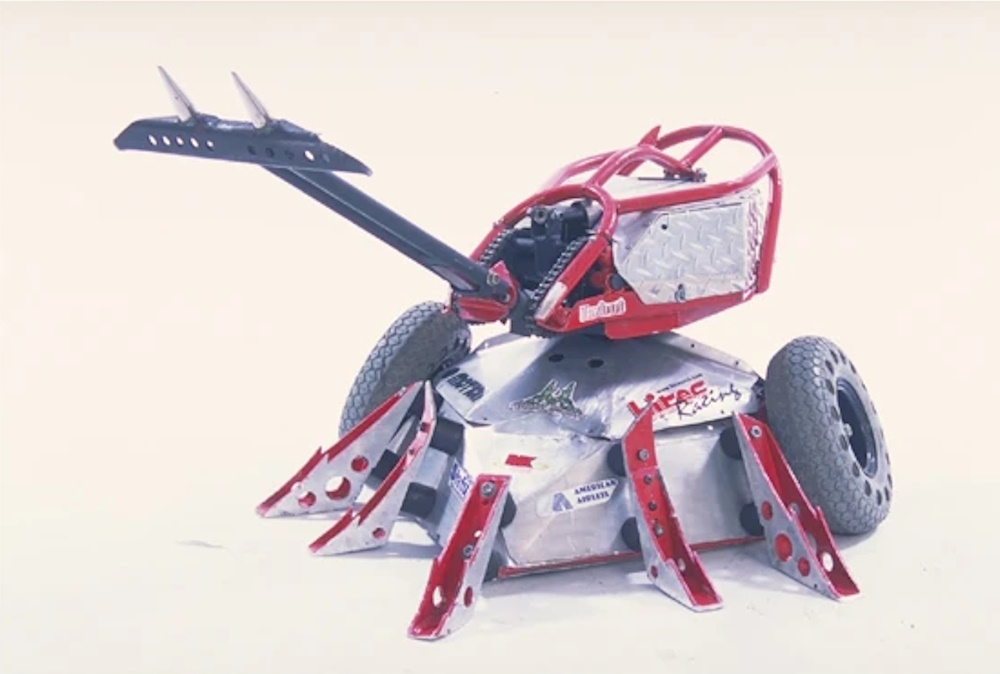 /images2.wikia.nocookie.net/__cb20120923114632/battlebots/images/c/c4/Tazbotofficial.jpg:
Tazbot was there with Vlad and Biohazard – fighting several matches with both – from the pre-BattleBots tournament all the way to the end of the show. It’s unusual, insect head design also made it a crowd favorite, winning the “Coolest Robot†award in season 4. Just one problem with the love: As often as not, it came without Tazbot actually doing anything worthwhile. Almost.
Tazbot’s design allowed it to change direction pretty nimbly and gave it a wide, angled stance, hard to knock over. Its weapon was interesting as well, a lifting arm attached to its spinning head that it could use to strike, nimbly parry the opponent, and lift with surprising power. If Overkill had a katana and Vlad the Impaler had a lance, Tazbot had a rapier. But it wasn’t enough to out-push or flip Biohazard or Vlad, losing to them five times altogether. And two of the three times it wasn’t them, Tazbot instead fell to the mediocre – if even – Mortis and Ringmaster, by breaking its arm and going in with undercharged batteries respectively. (Okay, maybe the latter can’t be blamed on the bot itself.) Meanwhile, after the first tournament, in which it beat Punjar and split Rhino, Tazbot went a long time without doing much.
Originally, as I said in the last entry, I was going to restrict it to honorable mention in favor of Aces and Eights. But as it turns out, they fought each other in tournament #6 when Aces and Eights was using the name “Botulizer,†and Tazbot won. This gives it a much needed 3rd noteworthy win and brings Aces and Eights down just enough for me to switch them.
–Best win
Tazbot puts Gold Digger in its place, after the bulky pile of mediocrity was apparently encouraged to come back by its fluke-win over Killerhurtz. That alone is worth the price of admission, but you also get some commentary by Bill Nye:http/www.youtube.com/watch?v=d6FBsWwxORM
And finally, just for fun, here’s two minutes of the two strongest combat bots in the world today going at it: Last Rites, the irresistible force, vs. Original Sin, the unmovable object: http/www.youtube.com/watch?v=000ipjXHDkU
The Toughest Combat Robots in BattleBots: Part 2, The Top Ten
July 24, 2014 in Uncategorized
Last week, we went through the heavyweight robots (no higher than 220 lbs) who used to compete on BattleBots and were tough but not tough enough. (http/www.manic-expression.com/apps/blog/show/26413445-the-toughest-combat-robots-in-america-battlebots-era-part-1-runner-ups-) One must understand them to know just how powerful the top ten are and why they are truly the best. It’s time for the real destruction now.
1. Biohazard (27 wins, 3 losses)Â –http/secretweapon.netfirms.com/images/bot-00026.jpg:
Your robot has – pick one – a wedge, forklift, or plow mounted on the front. You drive it full force at the 4 inch tall rectangle of an opponent, ready to ram the little guy across the arena. They collide, and your bot slides right overtop the other one, as if it weren’t there. That seemed to defy physics a bit… is your front bent out of shape? You spin around to try again, but the other bot is right on your tail, and you’ve already accidently driven up its side a little. You hit reverse to slide off and try another ram, but the other bot pushes forward, getting its front firmly underneath you. A lifting arm pops out of its back, about five times as high as the robot itself, and your bot flips up and rolls right onto its back. Didn’t add a self-righting mechanism? You’ve just finished 20 seconds of fighting Biohazard.
We could only start with this one. There’s virtually no robot on this list that didn’t have to worry about Biohazard at some point or another. It was both the first and last heavyweight champion of BattleBots, winning the title four times out of seven. It also left nothing in doubt; save for one resounding defeat, Biohazard eventually fought and definitively beat every bot to make any legitimate claim to a title shot. Leverage was its weapon, and with wedged titanium “skirt†flaps on all sides combined with its long but low profile, it had more of this than probably any robot to date. In 30 matches, only 2 robots even managed to get underneath it.
Even though it was the first champion, this was in one of the show’s lesser-known “pre-season 1†tournaments, so Biohazard didn’t make much of a name for itself until tournament #4. In tournament #2, long-suffering rival Vlad the Impaler managed to catch it in an early round and pay it back for making Vlad sit out the placing rounds in all the past tournaments they’d entered, dating back even before BattleBots. In tournament #3, having already been turned from a champion to a nobody, a robot called Voltronic managed to hand Biohazard the biggest upset of its career and Vlad came out the champion once again.
Biohazard would settle with Voltronic in tournament #7 (http/www.youtube.com/watch?v=e_XLcBE9lkg), but in #4, it met Vlad for the last time in their only championship fight. After a match that lived up to its hype, Biohazard emerged as one of the greatest competitors in BattleBots history. Its later career would only add to its legend.
–Best win
Biohazard and Vlad the Impaler settle the score once and for all in this fight, laying into each other with everything in their arsenal. The hazards around them actually start to seem trivial, barely distracting the two from each other:Â http/www.youtube.com/watch?v=lMuvAIzjJmU
2. Son of Whyachi (7 wins, 0 losses) –http/images1.wikia.nocookie.net/__cb20121217181537/battlebots/images/2/21/Whyachi_sf01.jpg:
What can you say about a robot that manages a sweeping first place finish over all the best competitors and then steps up a weight class due to a rule change and never does anything else significant? You could make the argument that Son of Whyachi should be at #1. It’s the only robot in BattleBots to score an unavenged victory over Biohazard. You could also make the argument that it should be disqualified from the whole list.
The design was a “walker†bot (which, at the time, meant it could be heavier than the weight class limit) with a propeller on its back and “hammers†extending down nearly to the floor. But Son of Whyachi was more than a league above the earlier, faultier “spinbots†like Phrizbee or Mauler. Its first televised match in tournament #5 was against Nightmare, a robot you may remember from the “honorable mention†list, and the announcers predicted it would be a “classic†vertical spinner vs. horizontal spinner match. It was a classic all right: http/www.youtube.com/watch?v=mQFYzyrfrP0
After that little statement to the competition that they weren’t dealing with the average newbie, Son of Whyachi proceeded to knock out more big names on its way to the championship, including another familiar “honorable mention†bot, Hexadecimator. In the championship match, it punched off Biohazard’s wedged skirts one-by-one, and just when it seemed the defending champ was about to win out anyway on sheer resilience, well, watch it for yourself.
Still, even if you don’t count its weight advantage against it, the thing is, Biohazard proved it could avenge losses, and Son of Whyachi (which showed its limits trying to push around bots in the “super heavyweight†class) had more than one close call in its single big tournament. The win goes a long way, but where the rest of the bots we’ll see had at least one true shortcoming, Biohazard – who went on to reclaim the championship next year – has the type of sustained success I just can’t concede to a one-hit wonder.
–Best win
The brutal Son of Whyachi vs. Biohazard match may well be the best you’ll see from this show: http/www.youtube.com/watch?v=eYCryx-1gqc
3. Vlad the Impaler (16 wins, 4 losses) –http/images4.wikia.nocookie.net/__cb20121215230232/battlebots/images/2/20/Vlads3.jpg:
Here it is, the last of BattleBots 3 heavyweight champions. You’ve heard me start its story already: This vampire was forced below the radar for a long time, once even by two journeymen bots who caught Vlad on a bad day and kept it from even taking a shot at Biohazard in tournament #1. But when Vlad’s time finally came (http/www.youtube.com/watch?v=sYajNQQZaaQ), it was perfectly aligned with BattleBots’ breakout success, vaunting it to prominence as the show’s first revered champion.
It was really the only way for Vlad to get the recognition it deserved. Vlad’s sharpened lifting forks gave it superior leverage, and its bulky, tank-like shape made sure they had plenty of power behind them. It wasn’t the only bot ever to flip Biohazard for nothing. It also added a retractable “self-righting piston†on its back, which came in handy against Biohazard (otherwise, Vlad never needed it). Altogether, Vlad combined the best traits of Voltronic and Punjar (see honorable mention list), both on the long list of big names it added to its win record along the way.
Sadly, Vlad’s career ended on a low note. After the final Biohazard match, Vlad returned the following season, only to be beaten in the first round by a newcomer. The builder then made the mistake of retiring Vlad and designing the inferior Vlad the Impaler 2. (Have I got stories to tell about that smaller, sleeker, complete failure of an experiment.) But even if its David and Goliath rivalry with Biohazard ultimately left it in the “Goliath†role, at least it was part of the greatest rivalry in the entire history of the show.
–Best win
I got the one-sided Biohazard fight out of the way because this is supposed to be all about Vlad, so let’s see it win the championship instead: http/www.youtube.com/watch?v=J0rEdvage4c
4. Mechavore (7 wins, 3 losses) –http/images2.wikia.nocookie.net/__cb20121215231012/battlebots/images/1/1a/Mechavore.jpg:
What we have here is simply the most underrated robot in all of BattleBots. Mechavore took using a saw as a weapon to the next level. Unlike Nightmare or Surgeon General, pretty much designed in the hope that the blade would do the work for them, Mechavore played to the strength of its weapon. It had a bulky, heavily armored design with a “shield†strip surrounding its four wheels, which gave it solid pushing power on its own and made it difficult to flip. With the powerful saw skillfully built into its body, it was even harder to out-damage, which only one robot (Son of Whyachi) just barely managed to do. It’s not hard to see why it’s overlooked; it was only ever a quarterfinalist, and it does have 3 losses out of only 10 matches. But it was also the only bot to face all three heavyweight champions in its career, giving all of them great matches. And beating one of them.
Mechavore’s brackets were always stacked pretty heavily against it, but in the first tournament (#5), that actually helped it show what it could do. After pulling off a huge upset over Vlad the Impaler, Mechavore proceeded to knock out Surgeon General and then face Son of Whyachi. This match is even closer than Whyachi’s fight with Biohazard: http/www.youtube.com/watch?v=jOIaKRIrPFY
In the next tournament, it lost to Overkill, a robot geared to beat spinning weapons, which it always did (including Warhead, Surgeon General, and M.O.E), but Mechavore came the closest. This loss pretty much sealed Mechavore’s reputation, despite the fact that, since Overkill got crushed in its only match with Vlad, it really only evened up the two of them. Then came Mechavore’s last tournament, where it didn’t get far before being placed against Biohazard. Biohazard quickly became the only bot to flip Mechavore, leaving it helpless. But it was only slightly less helpless than Mechavore left Biohazard, having cleaved its lifting arm clean off on the way down.
-Best win
At the time, viewers probably expected Vlad the Impaler to go to town, but Mechavore delivers so much damage that Vlad goes from struggling to, by the halfway point, in deep trouble:Â http/www.youtube.com/watch?v=8hCD5tv1uv8
5. Overkill (13 wins, 5 losses) –http/shadow.wizards.com/magic/expert/battlebots/images/Wallpaper/overkill_640x480.bmp:
The primary weapon of Overkill was a pretty basic design, a wedge attached to two big tires in the hope of plowing through the other bot. But earning its name with a second weapon, a big sword attached to its back that it could bring down like a mousetrap, is what brought out its unorthodox potential. For the first two seasons, Overkill sat in the shadow of its big brother, the “super heavyweight†champion Minion. Then their builder, Christian Carlberg, decided to turn his defending champion over to his teammates and put all his focus on improving with Overkill. By season 4, Overkill had stolen the spotlight, meeting Biohazard in the finals. And this was in between two very strong appearances in the semi-finals no less.
Overkills had good power, decent leverage, and a nice arsenal of ways to attack, but its greatest strength was its ability to absorb damage. The 18 matches on its record is the longest any heavyweight went on the show without getting knocked out. It was solid enough to take hits but also not grounded enough to really lay into. Not to mention it could drive inverted, which came in handy just about every other match. Even the blade helped it absorb attacks; attempting to cut through it was what killed the saws of Mechavore and Surgeon General.
You might have noticed that, even if winning its only fight with Mechavore just makes them even, as I claim, its semi-finals and second place finishes were greater successes to boot. Well, unlike Mechavore, Overkill does have a genuinely embarrassing loss on its record (to a mediocre bot called Frostbite, in its early days). But no, Overkill also has a longer list of notable wins, so, I admit, the call is mostly opinion-based. Even in its losing matches to the defending/future champions, Mechavore made me believe that it was borderline-champion material (if beating Vlad the Impaler wasn’t already proof-enough of that). Overkill always seemed a little out of its league against Vlad or Biohazard. If the chips had fallen its way, it’s possible that Mechavore could’ve won it all at least once, while Overkill definitely hit its limit at second place.
–Best win
Overkill shows the tournament wildcard and crowd favorite what the real competitors in BattleBots can do, in the first match I remember being truly disappointed over. Warhead (see honorable mention list) had knocked out all of its opponents and was making a fan out of me, but Overkill at the top of its game here is still hard not to admire:Â http/www.youtube.com/watch?v=3Jut0dAtuco
6. Voltronic/Voltarc (16 wins, 8 losses) –http/images1.wikia.nocookie.net/__cb20121217181608/battlebots/images/7/79/Voltronic_sf01.jpg:
Personally, I prefer the name “Voltronic,†which it switched to after “Voltarc†turned out to be the name of a lighting company. It looked like a poor man’s Hexadecimator, a wedge on wheels with an arm that only lifted bots, rather than flipping them, but this turned out to be great innovation that allowed it to turn its matches into one-sided trips to every arena hazard. This one was a solid competitor you could always count on to deal with the fancy, hot-shot wannabes. It also added a couple decent names to its win list along the way, like Punjar, and even Overkill in a win that left them split at one each. And Biohazard.
Actually, choosing the better robot between Voltronic and Overkill was the hardest decision in this ranking. Each beat the other one once. Voltronic has three semi-embarrassing losses, and Overkill has one genuinely embarrassing loss. Voltronic made it to the final round more, but only Overkill was never beaten in the first round. Voltronic beat two robots that beat Overkill, and Overkill beat one robot twice that beat Voltronic. Overkill has more notable wins than Voltronic, but Voltronic’s win over Biohazard is easily the greatest one (even if it was avenged later). It comes down to what you’re more impressed by. Voltronic won bigger and lost bigger, and with that in mind, I lean towards Overkill. I’m just partial to consistency; the opposite indicates that you’re depending on luck a bit more.
–Best win
It was never a guarantee, but here Voltronic demonstrates its ability to menace even Biohazard, succeeding where so many other bots failed:Â http/www.youtube.com/watch?v=xZc6ntLCN2M
7. Rhino (9 wins, 3 losses) –http/www.robotcombat.com/images/bblv99/rhino.GIF:
As the tournaments passed, the competition got steeper and stronger robots started to fill the brackets. But there were a few impressive contenders that were only around in the early days, and one of them was Rhino, a bot that ended up the inspiration for its great successor, the superheavyweight champion “Toro.” In fact, looking over it again, it was so impressive that I wonder if I should have ranked it higher. In just two tournaments, Rhino compiled a list of victories including Voltarc, Razor, Nightmare, Tazbot (we’ll get to that), and Vlad the Impaler. But it does hurt a little that the latter two still split it 1-1.
Rhino was a box, a little shorter and wider than Punjar, and its weapon was a spike at the corner meant to be its front. Not many bots used spikes to great success, but then, other bots didn’t shoot it out of their body in a punch strong enough to poke holes in the opponent. The builders also hung a flail on its body as a tail, because why not?
The win over Voltarc might suggest that their places should be switched, and, I admit, it’s another tough call to make. Rhino does have consistency, for which I just rewarded Overkill the prize in question, but of the two, Rhino’s record is perhaps a hair less impressive. Also, while it’s otherwise hard to sniff out a favorable point in their respective records, Voltarc splitting Biohazard has to be worth more than Rhino splitting Vlad. And though it’s worth noting that Rhino won their only fight, cut Voltarc a break; that was during its first, and worst, tournament ever (hence why I’m calling it “Voltarc†here).
-Best win
Unfortunately, its match with Vlad isn’t available, but in this match against Nightmare, Rhino shows off its great durability and power, its invaluable spike, and some surprising maneuverability: http/www.youtube.com/watch?v=u1pf-O2nOOQ
8. Killerhurtz (12 wins, 7 losses) –http/images3.wikia.nocookie.net/__cb20121215225653/battlebots/images/d/d5/Killerhurtz3.0.jpg:
You might remember me going on for a while about this one – and some of its many failures to robots on the honorable mention list. Actually, it gets worse. It also lost to a below-average bot called Gold Digger, because the builders forgot to check and make sure its axe was working. So who did it beat to make up for that? Well, in its first BattleBots tournament alone, Punjar, Nighmare, Rhino, and Vlad the Impaler. Yes, the same robot to lose four times to bots I wouldn’t even consider for 11th place is one of two robots to score an unavenged victory over Vlad. It may be the least consistent robot on the list, but its achievements are on the level you can’t ignore.
It’s worth noting that Killerhurtz is also a British bot, and, like Razer on the honorable mention list, it also competed on shows in both countries. Ironically, its results in the UK were nothing to write home about, but there are two easy explanations. The first is the technical difficulties and inconsistencies we saw plenty of times on BattleBots. The other is the fact that the UK show started with a strange “heat†challenge Killerhurtz never got past, determining which two robots among five moved on with challenges that had nothing to do with one-on-one combat.
Like Rhino, Killerhurtz used a weapon that wasn’t usually a winner, an axe on its back that it would mechanically swing downwards to damage and self-right. It improved the usual design by, one, putting 800 kg of force behind its axe and, two, using a spike instead of a blade, which would punch through and hook the opponent’s armor, allowing Killerhurtz to hold it at a distance and push it around the arena. Also, despite using polycarbonate for armor, it was a solid bot with good pushing power and speed, once beating a spinbot called Mauler on ramming power alone, after its axe was punched off (http/www.youtube.com/watch?v=COQZqCyH6vQ). Its lows were pretty low, but its highs were undeniable.
-Best win
No Vlad match available here either, but there is this match against the half-decent Omega 13. Killerhurtz shows great dominance in one of its ever-decreasing bright spots in the later seasons:Â http/www.youtube.com/watch?v=gAlpIkGRXTM
9. M.O.E (5 wins, 3 losses) –http/images2.wikia.nocookie.net/__cb20121121160838/battlebots/images/7/72/MOE.jpg:
As you might have guessed from that record, we’ve now reached the bots that had to plead their case to beat out the ones on the honorable mention list. After entering tournament #4 with the most fragile combat bot I’ve ever seen (complete with an ineffective spike), the builders went back to the drawing board with a vengeance. What emerged was a solid, invertible robot complete with a ditch cutter (and later a spinning bar, which made for a more destructive weapon). Proud of their improvement, they named it after their first one: M.O.E, aka, Marvel of Engineering.
Unfortunately, its first match in tournament #5 was against Overkill, the last bot you wanted to face with a spinning weapon. Tournament #6, however, is what singlehandedly gets it on this list. There, M.O.E picked up all five of its wins, including a damaging victory over Voltronic – it’s claim to 9th place – and a win over the half-decent bot The Matador (great flipping arm but with wheels that didn’t have the best traction). Then… it ran into Overkill again.
The last tournament saw M.O.E beaten out in the first round by an average bot called Stealth Terminator, in one of the more despised decisions in the history of the sport. I will say, there’s no question as to which one was damaged more.
–Best win
The Voltronic fight also isn’t available (#!*?), but the Matador fight here is a great demonstration of M.O.E’s power: http/www.youtube.com/watch?vsSVItSO4LI
10. Tazbot (10 wins, 8 losses) –http/images2.wikia.nocookie.net/__cb20120923114632/battlebots/images/c/c4/Tazbotofficial.jpg:
Tazbot was there with Vlad and Biohazard – fighting several matches with both – from the pre-BattleBots tournament all the way to the end of the show. It’s unusual, insect head design also made it a crowd favorite, winning the “Coolest Robot†award in season 4. Just one problem with the love: As often as not, it came without Tazbot actually doing anything worthwhile. Almost.
Tazbot’s design allowed it to change direction pretty nimbly and gave it a wide, angled stance, hard to knock over. Its weapon was interesting as well, a lifting arm attached to its spinning head that it could use to strike, nimbly parry the opponent, and lift with surprising power. If Overkill had a katana and Vlad the Impaler had a lance, Tazbot had a rapier. But it wasn’t enough to out-push or flip Biohazard or Vlad, losing to them five times altogether. And two of the three times it wasn’t them, Tazbot instead fell to the mediocre – if even – Mortis and Ringmaster, by breaking its arm and going in with undercharged batteries respectively. (Okay, maybe the latter can’t be blamed on the bot itself.) Meanwhile, after the first tournament, in which it beat Punjar and split Rhino, Tazbot went a long time without doing much.
Originally, as I said in the last entry, I was going to restrict it to honorable mention in favor of Aces and Eights. But as it turns out, they fought each other in tournament #6 when Aces and Eights was using the name “Botulizer,†and Tazbot won. This gives it a much needed 3rd noteworthy win and brings Aces and Eights down just enough for me to switch them.
–Best win
Tazbot puts Gold Digger in its place, after the bulky pile of mediocrity was apparently encouraged to come back by its fluke-win over Killerhurtz. That alone is worth the price of admission, but you also get some commentary by Bill Nye:http/www.youtube.com/watch?v=d6FBsWwxORM
And finally, just for fun, here’s two minutes of the two strongest combat bots in the world today going at it: Last Rites, the irresistible force, vs. Original Sin, the unmovable object: http/www.youtube.com/watch?v=000ipjXHDkU
The Toughest Combat Robots in America (BattleBots era): Part 1, Runner-ups
July 24, 2014 in Uncategorized
Having sat out the bulk of the fandom discussions and spent most of my tenure here at manic expression critiquing movies from all across the board, I thought I’d loosen up this week and do something with one of my big guilty pleasures.
You might have heard of BattleBots or Robot Wars, or else seen the Simpsons’ version in the episode I, (Annoyed Grunt)-Bot. Tournaments are still held today, but the golden era in the U.S. was 1999-2002, when Battlebots Inc. hit their peak in popularity and got their tournaments – seven in all – broadcast on Comedy Central (complete with everyone from Bill Nye to Carmen Electra as hosts and the MythBusters, Jamie Hyneman and Adam Savage, as competitors). Anyone could enter, as long as your robot met the requirements (Chief Wiggum would’ve been disqualified for giving his handgun to his robot as a weapon), and there were a lot of colorful competitors. But nowhere was the competition more intense than in the heavyweight – 220 lbs max – class. And now, drawing from the records and footage available online, it’s time to look into this still-debated topic and rank the ten best.
…But first, the runner-ups; some were innovative designs that later bots would perfect, some were solid but not quite spectacular enough, and most importantly, most of them are keys to understanding why the ten greatest stand as tall as they do. As we’ll see, they still gave us some of the best fights available in this sport.
Honorable Mention:
– Nightmare (8 wins, 8 losses): Proof that putting a big saw on wheels was a shortcut that could only get you so far, Nightmare was a glass cannon with explosive wins and huge losses. It was a fan favorite, as something flashing a weapon that big is bound to be, but none-the-less was still all weapon and no balance or durability, though some did find its lank design hard lay into. Actually, with a .500 win/loss record and only one significant opponent on its list of wins, you could argue that it doesn’t even deserve this much. Still, I give it credit for coming back every season, always at very least getting in a good hit, and acting as a rite of passage for the truly strong bots.
Best win
It did defy its reputation a couple times and go the distance for hard-fought wins, but let’s face it, the match with Slam Job here is what people really wanted to see: http/www.youtube.com/watch?v=FJYbKqZNPGo
–Punjar (11 wins, 6 losses): Sort of an inverse of Nightmare, Punjar was an armored box, all sturdiness and no weapon, unless you count its scoop-shaped front. The same goes for its career, beating chumps and losing to champs, just this time in ramming matches that usually went the distance. To be fair, Punjar was probably the better of the two (it did win their only fight), and where Nightmare usually won a couple and then lost, Punjar has genuinely good tournaments on its resume, with even a couple noteworthy wins. But just when you think Punjar is starting to look impressive, we get to the last two tournaments, in which it was beaten out in the first round by mediocre bots. Oh well.
Best win
Punjar is at its peak here, managing to overwhelm the impressive but inconsistent Killerhurtz, who we’ll get to later: http/www.youtube.com/watch?v=JSqt_xz8rAs
–Hexadecimator (9 wins, 3 losses): In only 3 tournaments, Hexadecimator became one of the winningest bots in all of BattleBots. So who did it beat? …Well, Killerhurtz again, with the help of a technicality. With a wedge design complete with one of the best flipping arms in battlebots, Hexy D, as it was nicknamed, came close to making the list but lost out for losing to 3 of its 4 most noteworthy opponents (2 of which weren’t good enough to make the list either).
Best win
Phrizbee was an early attempt at the “spinbot†design – perfected years later to create much better robots – with a record of 5 wins and 3 losses that would have been more impressive if it had beaten anything with more than 2 career wins. Still, the design was Hexadecimator’s weakness, and Phrizbee was one of the few, at the time, that was at least solid enough to avoid self-destructing. Their match was one of Hexy D’s toughest, complete with one of the sweetest comebacks seen during the show’s run:http/www.youtube.com/watch?v=rNKHJ4Eleb4
–Surgeon General (6 wins, 4 losses): As another saw robot, Surgeon General used a horizontal blade to be a more balanced, probably better robot than Nightmare, despite the fact that it happens to be Nightmare’s aforementioned only noteworthy win. Nightmare could overpower it, but the General could take hits and still dish out well enough to beat bots like Hexy D and this Killerhurtz that everyone keeps talking about. Still, with those two as its only good wins, 4 losses is too much disappointment for that to cover, even if Nightmare is perhaps the only embarrassing one. (Besides, in the post-BattleBots tournaments I’m not counting towards the records, Hexy D avenged the loss by beating bots that beat Surgeon General.)
Best win
I have to admit, the Hexadecimator fight was pretty cool:Â http/www.youtube.com/watch?v=faVLYGUSagE
–Razer and Warhead (3 wins, 3 losses and 5 wins, 1 loss): And now, an insult to the entire UK division of this sport: Robot fighting was even bigger in the UK, and for a longer time, than it was in the U.S., and these two are the reason I don’t think holding this strictly to entrants in America is a big loss. The most famous and successful of the UK bots was Razer, a sort of Venus Flytrap robot, except the upper lip was a “beak†powerful enough to punch through steel. Since most BattleBots participants never competed in the UK, I can only go by the two early BattleBots Tournaments Razer entered, in which its performance was… eh. It had four noteworthy matches, with robots we’ll get to later, and lost three of them. The one it won was its opponent’s first match ever, which it avenged in the next tournament in the first round, ending Razer’s BattleBots career. One could argue that “honorable mention†is generous.
Team Razer came back for the very last tournament with a robot called Warhead, and actually, I’ll be nice to this one. Warhead was cool. It had movable wings to right itself when knocked over, a scorpion tail just because, and a spinning disc head that packed enough punch to overpower Nightmare. I wanted to put it on the list, and if it’d competed in more tournaments, maybe I could have. But how many points can you really give to a robot whose only noteworthy win was Nightmare, before it lost to one of the semifinalists?
Best win
Watch Robot Wars to see Razer show off. This one goes to Warhead vs. Nightmare: http/www.youtube.com/watch?v=VKW64NT0yic
–Aces and Eights (6 wins, 2 losses): If I had to pick 11th place, this would probably be it. An even simpler design than Punjar, Aces and Eights was all driving skill, a block of metal on fast wheels that shrugged off and ran circles around better-armed bots. It was also invertible, which some builders tended to undervalue. At first, research said it only entered the last tournament, in which it beat Hexy D and Surgeon General, losing only to the best competitor in all of BattleBots. So it’s definitively better than the “honorable mention†bots and possibly even better than that, right? Well, as it turns out, it entered the previous year with a different name but the same design (if it was the reverse, I wouldn’t count it); it picked up a few more wins over nobodies but also a loss to another robot that was vying for 10th place, which was just enough for me to switch their positions.
Best win
Even this much attention is a bigger nod than it usually gets, as this is the only televised footage of Aces and Eights. (Don’t worry; it’s most of the good stuff compressed):  http/www.youtube.com/watch?v=nHjdJFk1lRE
Come back next time for the top ten, and see what it takes to become the best!
The Toughest Combat Robots in America (BattleBots era): Part 1, Runner-ups
July 24, 2014 in Uncategorized
Having sat out the bulk of the fandom discussions and spent most of my tenure here at manic expression critiquing movies from all across the board, I thought I’d loosen up this week and do something with one of my big guilty pleasures.
You might have heard of BattleBots or Robot Wars, or else seen the Simpsons’ version in the episode I, (Annoyed Grunt)-Bot. Tournaments are still held today, but the golden era in the U.S. was 1999-2002, when Battlebots Inc. hit their peak in popularity and got their tournaments – seven in all – broadcast on Comedy Central (complete with everyone from Bill Nye to Carmen Electra as hosts and the MythBusters, Jamie Hyneman and Adam Savage, as competitors). Anyone could enter, as long as your robot met the requirements (Chief Wiggum would’ve been disqualified for giving his robot his handgun as a weapon), and there were a lot of colorful competitors. But nowhere was the competition more intense than in the heavyweight – 220 lbs max – class. And now, drawing from the records and footage available online, it’s time to look into this still-debated topic and rank the ten best.
…But first, the runner-ups; some were innovative designs that later bots would perfect, some were solid but not quite spectacular enough, but most importantly, most of them are keys to understanding why the ten greatest stand as tall as they do. As we’ll see, they still gave us some of the best fights available in this sport.
Honorable Mention:
– Nightmare (8 wins, 8 losses): Proof that putting a big saw on wheels was a shortcut that could only get you so far, Nightmare was a glass cannon with explosive wins and huge losses. It was a fan favorite, as something flashing a weapon that big is bound to be, but none-the-less was still all weapon and no balance or durability, though some did find its lank design hard really lay into. Actually, with a .500 win/loss record and only one significant opponent on its list of wins, you could argue that it doesn’t even deserve this much. Still, I give it credit for coming back every season, always at very least getting in a good hit, and acting as a rite of passage for the truly strong bots.
Best win
It did defy its reputation a couple times and go the distance for hard-fought wins, but, let’s face it, the match with Slam Job here is what people really wanted to see: http/www.youtube.com/watch?v=FJYbKqZNPGo
–Punjar (11 wins, 6 losses): Sort of an inverse of Nightmare, Punjar was an armored box, all sturdiness and no weapon, unless you count its scoop-shaped front. The same goes for its career, beating chumps and losing to champs, just this time in ramming matches that usually went the distance. To be fair, Punjar was probably the better of the two (it did win their only fight), and where Nightmare usually won a couple and then lost, Punjar has genuinely good tournaments on its resume, with even a couple noteworthy wins. But just when you think Punjar and its career are starting to look impressive, we get to the last two tournaments, in which it was beaten out in the first round by mediocre bots. Oh well.
Best win
Punjar is at its peak here, managing to overwhelm the impressive but inconsistent Killerhurtz, who we’ll get to later: http/www.youtube.com/watch?v=JSqt_xz8rAs
–Hexadecimator (9 wins, 3 losses): In only 3 tournaments, Hexadecimator became one of the winningest bots in all of BattleBots. So who did it beat? …Well, Killerhurtz again, with the help of a technicality. With a wedge design complete with one of the best flipping arms in battlebots, Hexy D, as it was nicknamed, came close to making the list but lost out for losing to 3 of its 4 most noteworthy opponents (2 of which weren’t good enough to make the list either).
Best win
Phrizbee was an early attempt at the “spinbot†design – perfected years later to create much better robots – with a record of 5 wins and 3 losses that would have been more impressive if it had beaten anything with more than 2 career wins. Still, the design was Hexadecimator’s weakness, and Phrizbee was one of the few, at the time, that was at least solid enough to avoid self-destructing. Their match was one of Hexy D’s toughest, complete with one of the sweetest comebacks seen during the show’s run:http/www.youtube.com/watch?v=rNKHJ4Eleb4
–Surgeon General (6 wins, 4 losses): As another saw robot, Surgeon General used a horizontal blade to be a more balanced, probably better robot than Nightmare, despite the fact that it happens to be Nightmare’s aforementioned only noteworthy win. Nightmare could overpower it, but the General could take hits and still dish out well enough to beat bots like Hexy D and this Killerhurtz that everyone keeps talking about. Still, with those two as its only good wins, 4 losses is too much disappointment for that to cover, even if Nightmare is perhaps the only embarrassing one. (Besides, in the post-BattleBots tournaments I’m not counting towards the records, Hexy D avenged the loss by beating bots that beat Surgeon General.)
Best win
I have to admit, the Hexadecimator fight was pretty cool:Â http/www.youtube.com/watch?v=faVLYGUSagE
–Razer and Warhead (3 wins, 3 losses and 5 wins, 1 loss): And now, an insult to the entire UK division of this sport: Robot fighting was even bigger in the UK, and for a longer time, than it was in the U.S., and these two are the reason I don’t think holding to strictly to entrants in America is a big loss. The most famous and successful of the UK bots was Razer, a sort of Venus Flytrap robot, except the upper lip was a “beak†powerful enough to punch through steel. Since most BattleBots participants never competed in the UK, I can only go by the two early BattleBots Tournaments Razer entered, in which its performance was… eh. It had four noteworthy matches, with robots we’ll get to later, and lost three of them. The one it won was its opponent’s first match ever, which it avenged in the next tournament in the first round, ending Razer’s BattleBots career. One could argue that “honorable mention†is generous.
Team Razer came back for the very last tournament with a robot called Warhead, and, actually, I’ll be nice to this one. Warhead was cool. It had movable wings to right itself when knocked over, a scorpion tail just because, and a spinning disc head that packed enough punch to overpower Nightmare. I wanted to put it on the list, and if it’d competed in more tournaments, maybe I could have. But how many points can you really give to a robot whose only noteworthy win was Nightmare, before it lost to one of the semifinalists?
Best win
Watch Robot Wars to see Razer show off. This one goes to Warhead vs. Nightmare: http/www.youtube.com/watch?v=VKW64NT0yic
–Aces and Eights (6 wins, 2 losses): If I had to pick 11th place, this would probably be it. An even simpler design than Punjar, Aces and Eights was all driving skill, a block of metal on fast wheels that shrugged off and ran circles around better-armed bots. It was also invertible, which some builders tended to undervalue. At first, research said it only entered the last tournament, in which it beat Hexy D and Surgeon General, losing only to the best competitor in all of BattleBots. So it’s definitively better than the “honorable mention†bots and possibly even better than that, right? Well, as it turns out, it entered the previous year with a different name but the same design (if it was the reverse, I wouldn’t count it); it picked up a few more wins over nobodies but also a loss to another robot that was vying for 10th place, which was just enough for me to switch their positions.
Best win
Even this much attention is a bigger nod than it usually gets, as this is the only televised footage of Aces and Eights. (Don’t worry; it’s most of the good stuff compressed):  http/www.youtube.com/watch?v=nHjdJFk1lRE
Come back next time for the top ten, and see what it takes to become the best!
Second opinions: Spring Awakening
July 24, 2014 in Uncategorized
 Well, if my editor takes any longer to get back to me, I’ll probably start releasing Pittsburgh Against the World on this website and let the people on the other one play catch up. But in the meantime, I’ll take the opportunity this week to try something different and actually act as a second opinion. So for today’s topic, here’s the lauded musical “Spring Awakening.”
I’m usually more of a movie guy, but I do have a soft spot for musicals, and when I was asked to see the show performed by the Carnegie Mellon School of Drama, I was looking forward to it. I went out of my way to be fair in my review, but I will admit, writing this was cathartic.
Problems Awakening
To some, rock musical “Spring Awakening” was an instant classic upon its premiere in 2006, winning a slew of Tony Awards, a Grammy, and more. Now, Carnegie Mellon School of Drama is demonstrating their take the show, and the good news is, under the direction of Tomè Cousin, it comes together in solid fashion. Barring the occasional flat read and the distracting use of chairs with lights built in underneath – which comprise much of the set – CMU offers good acting, good lighting, and quality set pieces, including one that acts as a whole forest. The downside is odd to notice just seven years after the show’s debut: it doesn’t age well.
But then, how could it? All “Spring Awakening” ever aspired to be was a novelty show. But whether the writers realized this is doubtful. The same material has been praised as “revolutionary†in musicals for decades now.
The show, in short, is a rejection of the conservative mindset, exploring sexual repression in the late nineteenth century. The hero, Melchior (Taylor Jack Hemboldt), is an intelligent atheist teenager who dares to explore his sexuality, and the villains are religious, self-serving parents and teachers. Two other students act as key players; Moritz (Trevor McQueen), who has trouble dealing with both his sexual dreams and the school’s academic standards, and Wendla (Emily Koch), who is growing curious about the sexual side of life but receives no help from her mother, who lies when Wendla asks where babies come from. Wendla then becomes distraught upon learning of the abuse that a friend receives from her parents. Both turn to Melchior, who encourages them to embrace their sexuality and forms a strong mutual attraction with Wendla, and at first, they overcome their troubles. Moritz works through his anxiety and Wendla and Melchior open up to each other, emotionally and sexually. But the big, bad adults are having none of it, raining punishment down on them.
The progressive theater crowd usually enjoys these themes, as do I. There’s a liberating sense of fun and freedom to them. Their sympathetic look at rebellious nonconformity enables shows to explore people’s motivations at both ends of the spectrum. “Hair,” for example, followed a youth who wasn’t sure what he wanted during the Vietnam War, turning to the liberating hipsters. The story, and all the rebellious and sexual practices it highlighted, made bold statements on the true desires of both the war’s supporters and detractors.
But “Spring Awakening” is impressed with itself for exploring this territory at all. It knows there’s an audience for this subject matter and delivers as though no show has done so before. It has a character use apples as a dramatic metaphor for his teacher’s breasts. It adds an inconsequential pair of homosexual classmates who aren’t seen again after their single love scene. Its “message†– that freely sexual behavior is good, and religious conservatism is bad – is less a message than it is gloating with those who like the idea of open sexuality. But that’s not to say it doesn’t tap into some of the fun of its material as well.
There is humor to be found throughout the show, even in the darker points. Koch’s delivery of the line “but mother, I am not married!†shows especially good comic timing. (That’s the punch line. See the show for the joke.) The uncensored expressiveness is welcoming and conveyed well by the songs, my favorite being the bubblegum pop tune My Junk, which puts a sweet spin on the girls’ romantic fantasies. I’m still not sure what to think of Totally Fucked, which is pretty much what it sounds like: it’s both the most superfluous (had it not been in the character’s head, I would have expected a punch line pointing out that a simple “yes” or “no” would have done just as well) and the most catchy of all the songs in the show. That only Melchior knew the risk becomes inexcusably problematic, but his sex scene with Wendla is rather touching. The two turn to each other in what plays as a passionate and soothing release of all their repressed feelings, marked by the ardent song I Believe. It’s these aspects together that carry the first act.
However, new problems arise from the show’s aspiration to also be a tragedy, which it becomes in the second act without craft or convincing progression: Over the course of one scene, a student has been kicked out of his home and contemplates suicide. His former classmate, now a bohemian, makes her first of two appearances (the second being brief and unnecessary) and they reminisce, instantly falling for each other. She invites him to her house, and he resists for no clear reason, just long enough for her to give up and leave. Now that it’s “too late,†he changes his mind, but with no alternative more feasible than following her all the way to her house, he goes back to plan A. The show continues to hit us with these depressing turns, the plot becoming a clothesline to hang them on, until it grows tiresome.
Spring Awakening’s heart is in the right place, wanting to stand for liberation and understanding, but it’s mistaken in assuming that it has insight and originality on its side. It understands which conventions made major impacts on audiences before, but it does not understand why; by making the characters opposed to them one-dimensional villains, it has missed the chance to explore why – or if – its heroes are truly heroic for embracing them. What’s left is an empty attempt to up the ante.Â
Pittsburgh Against the World
July 24, 2014 in Uncategorized
This round: Superhero Movies
The challenger: Los Angeles, California
A few weeks ago, I posted an entry on The Dark Knight Rises, and how I thought it was a better movie than it is often credited as. I didn’t label the entry as part of this series, because that wasn’t the point, but, well, guess where much of The Dark Knight Rises was shot. (Yes, some of it was in Los Angeles as well, but I think today’s movies have just enough focus on the filming locations in question for me to take this angle.)
So, with that in mind, I think this week it’s time to see Pittsburgh take on the big one, comparing entries from two of the most beloved superhero franchises of all time.
LA’s entry: “Iron Man†(2008 )
The Movie:
Tony Stark (Robert Downey Jr.) is a playboy that would make James Bond look second rate. He’s a genius inventor that could seemingly run his frontrunner weapons company in his sleep, a showoff most people are too busy admiring to scorn, and an indulgent billionaire who does whatever he wants, before shaking off the dust the next day and getting right back to work. Then, one day, he’s hit with the full reality of his legacy, as well as a potentially fatal injury, when he’s captured by terrorists with a cave full of his weapons. But if he can fit creating his greatest invention yet into his new schedule of building weapons for his captors, it might be the key to surviving, escaping, and turning his life around.
It’s doubtful that even fans of the comic book predicted any director in Hollywood could do this much with the character of Anthony Stark (let alone Jon Favreau, who, at the time, earned his biggest bragging rights from movies like “Elf†and “Something’s Gotta Give,†both in 2003). Our protagonist is every bit as charismatic as his profile makes him sound, but in this first outing, his transformation from a playboy to a remorseful, determined hero makes him doubly engaging. It helps that he’s given a good supporting cast to play off of, including his personal assistant Pepper Pots (Gwyneth Paltrow), whose relationship with Tony involves an atypical sort of understanding. It seems their years(?) knowing each other has sparked a dedicated affection that, for the moment, can’t become anything more. We also get some nice drinking buddy moments with Tony’s best friend, Lt. Colonel Rhodes (Terrence Howard), and much of the movie’s heart comes from the first act Tony spends with the man who would be his mentor (Shaun Toub). Never mind the requisite people trying to figure out the puzzle of Tony’s mysterious new agenda.
But I do have to admit, I always found “Iron Man†to be one great element at the heart of the movie carrying the other good or decent elements. It didn’t dethrone the first two “Spiderman†movies as my favorite Marvel Comics adaptation when I saw it, and the years since have done little to change my mind. I know I’m at risk of flying myself into the sun by confessing I think the movie is only great, but I’ll attempt to stay the course; Downey isn’t just the best part. In some ways, he is the movie. Whole segments of it are filled with him just experimenting with the suits, in a mix of epic triumphs and brilliant slapstick. When he actually puts his quest into action, it’s only adequately thrilling. The scene where he solves a hostage situation and eliminates his stolen weapons, for example, is not much more or less than you could imagine on the first try, without brainstorming for ideas. The movie isn’t always clear on whether it has a main antagonist, and the big reveal is really just a tradeoff. It’s Tony himself we’re invested in, but the movie, to its credit, knows how to run the show with that.
Iron Man was a new and different take on the superhero movie that stands tall as an original and as one of the best. It’s filled with distinct and interesting personalities, the storytelling is relaxed and confident – if a bit disjointed – and by the end, we’ve long since become invested in how far they’ve come and where they still have left to go. And in hindsight, it might be even bolder than it was given credit for at first. It’s still one of not-even-a-handful of comic book films to ask questions as dismayingly difficult as the real good achieved by arms races. In fact, it made a few critics coo with relief that the inferior sequel was “less politically off-putting.â€
The Winner:
In honor of the genre in this outing, I thought we might try a traditional blow by blow comparison (mild spoilers ahead):
The Lead: What we have here is perhaps the best Iron Man imaginable against my favorite live-action Batman to date. In each franchise, there are entries in which the lead is running the show less than in the others, but neither of these are that entry. “The Dark Knight Rises†contains possibly Bruce Wayne’s finest hour, in all his conflicted determination to finish the war on crime, and “Iron Man†gives us everything from Tony Stark that the sequels did, along with some other aspects that both forgot. I could consider point by point advantages all day, but…
Winner: Tie
The Villains: I’ve developed more respect for Obidiah Stane, who really does leave an impression with his cold, cynical logic and, even in his most insane moments, confidence and self-assurance, never doubting that his approach to the arms race is realistic and correct. However, there are still points when he seems dangerously close to your standard self-entitled, moustache-twirling villain. Bane, even disregarding his size, is more intimidating and has a more convincing stake in what he’s doing. The terrorists in Iron Man aren’t much more or less than they need to be, though their leader (Faran Tahir) has a few good lines. Meanwhile, Catwoman is some of the most fun you’ll ever have with Anne Hathaway, and I should also mention that I did appreciate the brief return of a certain villain who is now the most recurring in the “Dark Knight†franchise. It was just nice to see, after a less-than-respectful exit in “The Dark Knight,†that he’s still doing what he does (or at least is ready to).
Winner: “The Dark Knight Risesâ€
Best Supporting Cast: All of the characters who made for great members of Batman’s team before are back in “The Dark Knight Rises,†now with the interesting addition of an officer played by Joseph Gordon-Levitt. However, they all take a back seat a bit, as the focus shifts to Bruce Wayne’s ultimate internal conflict. Meanwhile, I don’t think I need to say much more about the supporting cast in Iron Man, who bring heart and humor in spades. The likable Pepper Pots is among the front-running love interest characters in movies today (I also realized in my last viewing that I hadn’t fully appreciated the first time I heard her explanation that her job sometimes requires her to “take out the trashâ€). I’m not sure if I should count Catwoman in this category, but even if I did, I think it’s easy enough to say which cast contributes more in the end.
Winner: “Iron Manâ€
Best Action: The sequels would expand the possibilities that could come from battling Iron Man suits, though unlike them, at least the first movie got all the satisfaction it could from the relatively simple, play-by-play battles it depicted. The last act in “The Dark Knight Rises†has some of the best and most triumphant action of anything in recent memory, and the earlier scenes involving Batman’s reappearance (and team up with Catwoman) are not to be thrown away either.
Winner: “The Dark Knight Risesâ€
Best Visuals: The bat plane and other special effects work pretty well, and the locations in “The Dark Knight Rises†(save for Tony’s house) are probably more distinct. But “Iron Man†deserves credit for its more colorful atmosphere that adds to the excitement a bit more, and it goes without saying which one has more fun with special effects.
Winner: “Iron Manâ€
Best story: Both use a more character-driven story, but as I noted above, the way the story unfolds in “Iron Man†is not really the element that makes it a great movie. Instead of enhancing Tony’s dilemma, it serves just enough to successfully move it forward. While many accuse “The Dark Knight Rises†of overlooking plot holes, the answers to the ones brought up seem assumable at worst and heavily implied at best. Why does Bane turn the city upside down before destroying it? For the same reason he breaks Batman and sends him to a hell hole without killing him: He wants to take away its will to ever stand back up before he finishes knocking it down. In fact, where that was mostly sadism with Bruce Wayne, it might actually be a necessity with Gotham, which has proven resilient. How did Batman get back into the heavily guarded Gotham City from his prison in just a few days undetected? This would be hard, but not impossible, especially if you know how to do things beyond the average man. If he’s good for nothing else these days, I think Frank Miller and his unforgettable little internet meme have provided an appropriate answer there.
And while both deserve credit for their epic ambition, it might be fair to say that not worrying about a sequel (or having to) helps with the effect. “Iron Man†moves forward without much rising action per se and leaves some of its conflicts hanging, or at least the remnants of them. “The Dark Knight Rises†– as the title would suggest – is masterful at rising action, establishing the dilemmas from the start, making the direness of the situation clear, and progressing to weighty standoffs. You can tell from the first punch that evil is going to win round one, and it gets progressively sadder until the resounding final blow. Then, following that, we get a clear progression to the next round, in which Bruce finds himself and stands back up. His journey and its implications are written better than many give it credit for, so that when he returns, it takes just one line to let us know that Bane is not facing the same Batman he met in the beginning: “No, I came back to stop you.â€
Winner overall: “The Dark Knight Rises.†As much as I like “Iron Man,†the Dark Knight rises will always be a favorite, delving into the lore of its franchise just as thoughtfully and with an even bigger punch. Pittsburgh escapes the giant with one small credit under its belt.
And with that finished, now that the demand is slowing to a halt, it is time to conclude Pittsburgh Against the World. Next time, we’ll move on to tying up some lose ends before putting some new ideas inspired along the way into action.
In Defense of a Sequel in a Shadow: Dark Knight Rises
July 24, 2014 in Uncategorized
Halfway through the first act of “The Dark Knight Rises” (2012), I started to wonder exactly what Bruce Wayne’s goal was, not to mention the director’s. What’s the story here? He was sort of concerned with turning the dangerous device he’d blown his finances on into a successful investment, but he only started trying after Bane compelled him to return as Batman, which seemed to be his main focus, though he would even put that aside at points. Not to mention that, amidst it all, he was finding time to pursue an interest in Catwoman.
That’s when I realized that I was watching a movie about people picking up the pieces of their lives, having lost everything while holding to their own. Commissioner Gordon has ended organized crime in a battle that’s left him weary, guilt-ridden, and alone, uncertain of what he should do. Selina Kyle led the criminal life as needed to thrive, and now she’s pursuing a forlorn hope at a second chance. Even Bane, after a lifetime of pain, can see only one thing he has enough of a stake in to live for. And Bruce Wayne, of course, is the most shattered of all, wandering out into the world one more time to find a way forward. But, in some ways, he’s only going through the motions, because he’s no longer invested enough to live for any of it. Only to die for it.
I can’t help but wonder if theirs was also the dilemma of director Christopher Nolan, who was reluctant, at first, to make a third movie at all. At this point, The Dark Knight series had seemingly peaked, achieving more than anyone could have predicted. “The Dark Knight” (200 impressed even the naysayers of “Batman Begins” (2004) and achieved a legend impossible to live up to. Despite the occasional snub, it was probably the most talked-about movie of the year. It could only have become a bigger mountain to scale when, as legends often are, it was cast into doubt, and naysayers for “The Dark Knight” gradually went from unheard of to something resembling a demographic. And where was there to go? The arguable core element of the previous movie, the Joker as played by Heath Ledger, was gone, and out of respect, Nolan refused to reference him or cast another actor. What story worth telling could he earnestly invest himself in?
But Nolan dug deep into the lore and completed the progression I hadn’t realized he was on through the first two movies, though it seems I wasn’t the only one; almost everyone has at least a couple complaints about aspects of “Rises” that just didn’t sit well with them, but nobody comes up with quite the same list of complaints. Some say Anne Hathaway should not have been Catwoman, some did not appreciate the plot tying back to the first movie more than the second, some took issue with Bane seemingly drawing out his scheme to blow up Gotham City when he already had the power to do so, and some didn’t think the ending revelation was handled well. Everyone’s vision of Batman, from the comics, the previous movies, or one of the many other versions, is just a little bit different, and “The Dark Knight Rises” doesn’t neatly stay within any of them.
No, this is where The Dark Knight series finally progresses into a vision all its own. In “Batman Begins”, Nolan focused on capturing the essence at the core of the character, the development and the motivations that the comics have defined most clearly. In “The Dark Knight”, he expanded on these elements and fused them with his own ideas to create a rich crime drama around Batman. Now, in “Rises,” after so much time as director and screenwriter, his series has evolved into a vision personal to him. (Some have noted that it feels like a Nolan movie first and a Batman movie second.) The choices he makes in “Rises” will stand at odds with just about anyone at one point or another, including me, but there is a reason for all of them, and the earnest audacity he shows was enough, at points, to leave me in open-mouthed admiration.
But I couldn’t make the above claim without justifying some of the points in question: To me, this was one of the occasions where Anne Hathaway gets to prove that she is an actor, not just an “adorable†screen persona. Like Black Widow in “The Avengers” (2012), Selina Kyle has to feign helplessness at points, and the interesting thing that Hathaway brings to the character, again like Black Widow, is that the she seems to be drawing from a place of real emotion when she does so. But only Kyle, at the same time, has complete control of her reactions and can turn on a dime; I couldn’t help but grin the first time innocent Anne Hathaway dissolved into Catwoman and breezed out of Wayne manor with a family heirloom.
Bane’s goal, as far as I see it, is to settle the score between Batman and Ra’s Al Ghul, not just to finish the work of the league of shadows. He works to demoralize Gotham because he doesn’t just want the city destroyed; he wants to prove it should be destroyed, still corrupt despite Batman’s work to save it. This is all Bane has, and we get more than hints at why a bomb (the destructive range of which they did put a limit on) isn’t enough destruction for him. He throws Gotham into chaos for the same reason he sends Bruce to a hell hole before killing him: to end their will to ever stand back up (though in Bruce’s case, it’s less a necessity than it is sadism).
The ending is the most interesting point. It took some heat for tying everything up too neatly, but ironically, as critics such as James Berardinelli pointed out, it’s not so “clear-cut†as it might seem at first. The final scenes aren’t very concrete on what is fact and what is only optimism. Some people sneered “what are the odds of that†when Alfred’s fantasy seemed to unfold perfectly before his eyes at the end. What are the odds of that?
“The Dark Knight Rises” is one of the best superhero movies I have ever seen, topped for sure only by its predecessor. Its thrills are outdone only by its passionate character arcs, and it concludes one of the best series of all time with a story not quite like any we’ve seen before. And while the series as a whole seems to have picked up sort of a stereotype as “dark†and “complicated†in a dreary, tedious way, the final act, in which the Dark Knight does indeed rise, is simply the most triumphant act in any Batman movie. Ever.
Pittsburgh Against the World, a Clash of Filmography
July 24, 2014 in Uncategorized
This round: Horror
The challenger: Portland, Oregon
In this round, Pittsburgh is arguably in its strongest element, with a long history of horror films that includes George Romero’s “Living Dead†series. And last week, Pittsburgh put its best foot forward with “Dawn of the Dead,†(1978) which won me over as one of the best of its kind. But Oregon is no slouch in the film department, with “One Flew Over the Cuckoo’s Nest,†(1975), “National Lampoon’s Animal House†(1978), and “Stand By Me†(1986) on its record.
Portland seems to be where the more commercial, mediocre movies are shot – “Twilight†(2008) had some of its scenes filmed there – but, actually, what we’re focusing on specifically is Mount Hood, just a little to the east of Portland. On Mount Hood sits the famous Timberline Lodge, which boasts an impressive history as a filming location. But there’s only one movie that tourists ever want to know about, because it’s one of the most unforgettable cinematic experiences in history.
Portland’s entry: “The Shining†(1980)
http/www.youtube.com/watch?v=3b726feAhdU
The Movie:
All work and no play makes Jack a dull boy.
You get a lot to wrap your head around in “The Shining†and still more under the surface that might not register at first. And if that sounds tedious, let me add up front that its bizarre, unrivaled style of presentation will nail you to the screen. (This is Stanley Kubrick in the director’s chair after all.) It was either one of the best and scariest horror movies I’ve ever seen, or I was too swept away by it all to tell the difference.
The movie begins with a presentation that, while featuring excellent cinematography, can’t help but feel a bit off. The acting, the distance from which the camera follows the actors, and some of the dialogue are just a few of the aspects that give you pause. But then, maybe it’s supposed to. Something about these people’s lives, their world, is a bit off.
Jack Torrance (Jack Nicholson), an ex-teacher, struggling writer, recovering alcoholic, and married father of one, is offered a job, moving into the fancy but isolated Overlook Hotel as its caretaker for five winter months, during which the snow storms force the owners to close it. They warn him that the isolation can get to people, causing a former caretaker named Charles Grady to lose his mind and kill both his family and himself. But even then, Jack and his employers insist on the usual BS, declaring everything in their arrangement is “good†and “swell†and “nifty,†until you may wonder if they can’t wait to be rid of each other. Not everything in this first act draws your attention for the better (in the opening sequence, it’s a little too apparent that we’re following Jack’s car from inside a helicopter, which, at one point, even veers off the winding mountain path to give us a look at the scenery), but through it all, it’s clear that something disturbing is simmering beneath the surface, some sort of energy that boils over in moments of shocking tension. Where do I even begin?
Jack swore off alcohol after he accidently dislocated the arm of his son Danny (Danny Lloyd) while drunk. For this reason, and a few more, Danny is a source of tension between his parents. But Danny himself is a bit harder to understand; he has an imaginary friend named Tony, who he describes as “a little boy that lives in my mouth.†Danny provides Tony with a low, croaking version of his own voice, which his mom, Wendy (Shelley Duvall), encourages, as it seems to help Danny say what’s on his mind. Then, while Danny is pondering his dad’s job interview, Tony correctly predicts that he already got the job and adds that he doesn’t want to go to the hotel. When Danny asks why, he receives a vision that renders him unconscious.
At the hotel, one of the staff packing up to leave speaks to Danny in a way that only Danny can hear, then takes him aside and tells him that they share a psychic gift, the ability to “shine.†He doesn’t share Danny’s fear that something is wrong with the Overlook Hotel but notes that, like people, some places shine and some don’t. The degree of truth in this, the real meaning, is not entirely clear; it’s been noted many times that “The Shining,†doesn’t really provide us with a reliable narrator or a firm look at what’s actually happening. What is clear is that Danny, as afraid as he becomes, is able to process what afflicts him, comparing it to “pictures in a book,†even as figures that the audience may recognize bid him to “Come play with us Danny! Forever, and ever, and ever…†The same is not true for Jack.
Jack spends each day in the hotel alone, claiming to use the time as a chance to write his manuscript and make something of himself. At first, it seems this is true approximately half the time. Otherwise, he spends his days behaving strangely, trying to cope with something that he pretends isn’t there when he talks to his family. Then his wife comes to check on him, and he curses her out, belittles her, and sends her away. He becomes controlling and aggressive, and when we finally get to see his manuscript, we identify the force that he has been trying to deal with: Madness.
But sometimes, it seems something akin to it is afflicting every member of the family. The glimpses into each point of view are masterful, disturbing to an almost unexplainable extent, from following Danny down the long hallways on his tricycle to the forbidden room 237, to watching Wendy tiptoe around Jack, who gradually singles her out as his tormenter. And when Jack breaks down, venting and explaining himself to an imaginary bartender, our sympathy only adds to our fear of him. Sometimes the shifts feel a little too radical, but that may be the point. It’s not outside the realm of possibility that Jack is not dangerous, and someone is projecting onto him.
But reality or not, Jack and the forces compelling him are the antagonists of what we see, and when Jack gives in to them, taking his first drink in years from the bartender, they’re almost comforting. In one scene, Jack walks in on a ball full of guests and is greeted as the caretaker, and next to what we’ve seen already, it feels welcoming. We study Jack’s descent a bit; this can’t possibly be what he thinks it is, but he still maintains a degree of logic, until a certain Mr. Grady wins him over to a different perspective. When we next see him from someone else’s point of view, he is the most horrifying character of Jack Nicholson’s career, if he wasn’t already.
At the end of “Dawn of the Dead,†I felt that I’d been well entertained and engaged. At the end of “The Shining,†I felt exhausted. I was overwhelmed and unsettled in a way that didn’t fade immediately. It’s no decision. As great as both movies are, the sheer visceral level achieved by “The Shining†is something you’re lucky to catch in a handful of movies. “The Shining†is one of my new favorite horror movies, and it has beaten Pittsburgh at its own game. (Maybe Oregon has earned another appearance somewhere down the line.) And if you aren’t convinced it could really be that effective, let me offer one last thought: While slasher film buffs like to prove that the terrible imagery does not bother them in horror movies, the reality is that we aren’t facing the physical horrors inflicted on the people we see. We callously separate ourselves from them. “The Shining†offers us something that we can, and do, face while watching it: horrors of the mind.


