@james

by James
by James
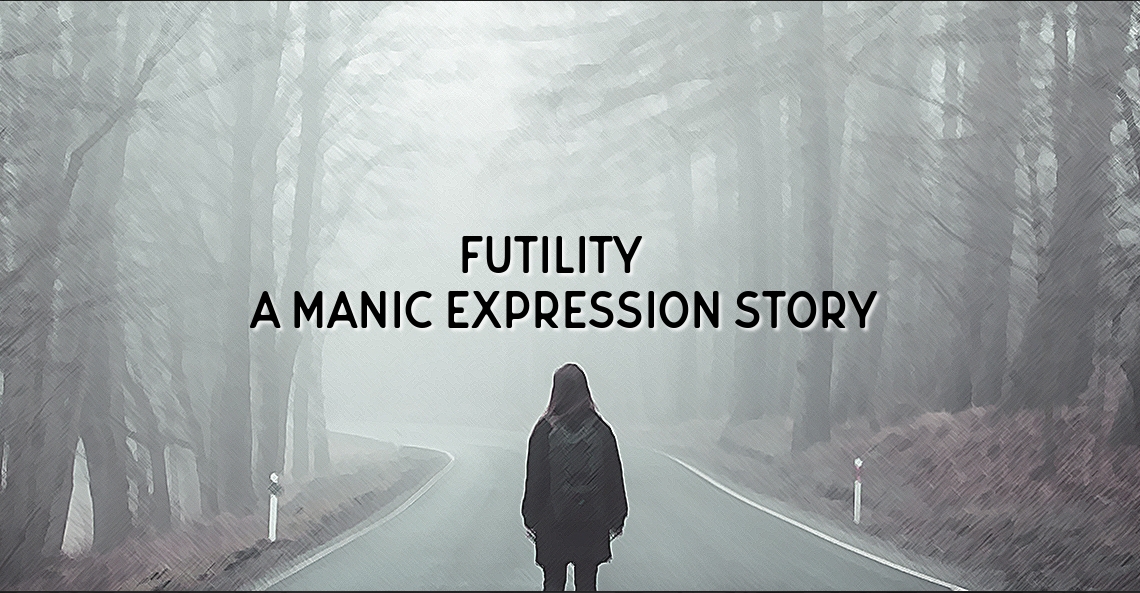
Futility: A Manic Expression Story
March 17, 2022 in James' Corner
“Futility”
James Daniel Walsh
TAPIO OPENED his eyes. There was only darkness, and the distant hum of a strange engine. He sat up on the hard metal slab he called a bed and rubbed his eyes. A yawn stretched his mouth, his jaw clicking painfully. He could taste his breath. His teeth were coated in his last ten thousand meals, the rotting bone slimy and soft. He ran his tongue over his teeth in a vein attempt to clean them, but his tongue was just as disgusting. Next time he was abducted by aliens he should remember to bring his tooth brush.
“What time is it?” he moaned, his voice swallowed up in the huge metallic room.
“There is no time in space.”
Tapio groaned in frustration. Every time. “Earth time,” he clarified. “Pacific Standard.”
“6:42 p.m.”
“Lovely,” he said with a further yawn. “Turn the lights on.”
The room was suddenly flooded with an intense illumination that blinded Tapio. The light cut through his eyes, seared his still drowsy mind. He hated this goddamn literal minded machine. No matter how many years passed in this cold metal room he never adapted to it’s way of thinking.
“Too bright!” he growled, and the strange buzzing light dimmed and quieted.
Tapio’s eyes adjusted to his all too familiar environment. Nothing had changed. Nothing ever changed, only the content of his food bowl. The creatures that kept him here never emptied his bowl until he had polished off every last morsel. The odd shaped metal bowl sat beside his bed, still half full. Flies buzzed around its contents, putting him off the thought of eating. How did flies get up here with him? Were they alien flies? Or perhaps distant descendants of an earth fly that may have been sucked up into the ship in the same beam of light that captured poor Tapio?
The rest of the room never changed. The walls were spherical, and surrounded him in a great circle that stretched for exactly nine-hundred-thirty-eight of his foot steps. The metal was not cold but radiated a low grade heat. The color was not one found on earth, nor did it even resemble one. One could not say the color was “greenish” or “reddish” or “brownish.” This was an entirely new color which defied description. There were no rivets in the walls, no scratches, no break from the monotony of shiny metal. There wasn’t even a door. The creatures, when they brought him his food, passed through the metal like ghosts. They too defied description, their forms utterly contradictory to his eyes. Tapio chose not to look at them any more when they entered, lest his mind reel from what he saw and slip away from him again.
“Are you hungry?”
“No,” Tapio said.
“You should eat something, you have not eaten in three days.”
Tapio gave a sideways glance to his food bowl. A bold fly was crawling across the rim, unsure about the contents inside.
“I’m not hungry,” he said with a curled lip.
“Your body requires sustenance for it’s survival,” the voice said, no hint of worry in it’s tinny voice, no inflection of emotion whatsoever. “If you do not eat you will perish prior to your arrival on Alpha Centauri Prime.”
“Yeah, what a goddamn shame that would be,” Tapio laughed. “I would hate it if you missed out on the chance to torture me to death.”
The voice did not respond. He supposed it didn’t see the logic in furthering the conversation. These beings, whatever they were, were oh so logical. Everything was literal for them, concepts like sarcasm escaped them no matter how long they observed him for. The first night they had him aboard the ship they poked and prodded him, drew blood and spinal fluid. Since then he spent every day like a bug in a jar, their eyes always on him, observing but never understanding.
Tapio hummed a tune he half remembered, tapping his fingers against the cold metal of his bed. “So,” he wondered out loud, “what’s on the agenda for today?”
“You have asked this every time you wake up for the last three-thousand-five-hundred-sixty days,” replied the cold, metallic voice. “My answer is always the same.”
“I know, I know,” Tapio sighed, then repeated back the same answer he always got from the formless voice. “Observation and study of human specimen while en route to Alpha Centauri Prime.”
“Correct.”
Tapio smirked. How could he ever hope to explain to his incorporeal friend why he asked this question every day? He didn’t even really know himself. Maybe it was just to remind himself that this blank, empty room he was kept in wasn’t, in reality, a padded cell in some hospital. Maybe it was. Maybe he was insane, talking to himself. Would’t that be a lucky twist of fate? A hospital would have no plans to experiment on him, to, as the voice referred to it, test the limits of human endurance. A hospital wouldn’t dissect him, leave him in pieces on a cold metal slab to be picked over by curious creatures from another world.
The voice once told him that he was not the first alien life form these beings had snatched up for study, simply the first human. Lucky him, he was the big winner. Of the seven billion people wandering around the planet earth, he gets the close encounter. He never even believed in aliens as a kid, never watched science fiction movies. That was always his younger brother, Juho. When they grew up in Finland it was Juho who ran around in his Star Trek uniform, quoting the opening lines of the show verbatim, much to Tapio’s embarrassment.
Mom moved them to the American midwest when Tapio was fourteen, relocating he and Juho so she could work in her firm’s main office. Life wasn’t easy, being the new kid not only in school but on the continent. Juho found it particularly difficult after he came out as bisexual. Tapio got into more fights with backwards Nebraska rednecks fond of the word “faggot” than he could remember. The two brothers had each others backs, never let the kids who giggled at their accents get to them. Well, not outwardly, any way. Inside Tapio’s confidence was shaken, and though he would never admit to it he doubted himself more than anyone could know.
That all changed when he met McKenzie. He joined a dating website when he was in his early twenties. She sent him a “wink.” The two spent the next week speaking all night till dawn would break up the conversation. He was never so tired in his entire life, yet never so energized. For their first date he went all out, buying tickets to see David Bowie, her favorite musician, in concert. They met up before the show, had coffee, made small talk that was far more awkward than anything they ever said on the phone together. Seeing each other face to face after such intimate conversations was like seeing each other naked. Yet sometime between coffee and Bowie’s second chorus on “Starman,” McKenzie worked up the courage to take his hand, and he worked up the courage to kiss her. That was the first greatest night of his life. Every night after that with the woman who became his wife and the mother of his child was better than the one before.
Tapio smiled and hung his head, looking at the tattered T-shirt he wore. McKenzie bought it for him at that concert. He asked her not to, a macho need to pay for everything on the date leading him to almost beg her to put her wallet away. She insisted. He rarely wore the shirt, wanting to preserve it as a memento. Thank God he ran out of clean clothes the day he was abducted. The image on the gray shirt, of a slick-haired Bowie with milky white eyes, was faded and old, but wearing it made him feel as if McKenzie wasn’t so far away.
The smile on Tapio’s face faded as a thought entered his mind. “Wait, go back a second,” he muttered. “How many days did you say I’ve been here?”
“Three-thousand-five-hundred-sixty.”
“Jesus Christ,” Tapio gasped, his poor math skills trying to add up those days into years. “How long is that?”
“Three-thousand-five-hundred-sixty days.”
“I mean in earth years,” Tapio demanded.
“Nine years, three months.”
The number hit Tapio in the stomach like a baseball bat. “Ten years,” he muttered in disbelief. “You’ve had me in this goddamn room for ten years.”
“Nine years, three months,” the voice corrected.
All this time, Tapio had no idea how long had passed since he was taken. His watch broke long ago. There was nothing to mark the time passing, and it never occurred to him to ask the computer what year it was. Maybe he was afraid to know the answer.
“I’m thirty-six-years-old, aren’t I?” he asked, more to himself than to the computer. “I don’t know what month it is.”
“On earth it would be January.”
“What day?”
“January 18.”
“January 18,” he repeated. “My birthday was just a couple of weeks ago. I’m thirty-six. That means my son is going to be ten next month. Ten-years-old.” Tapio chuckled and shook his head. “Jesus, when I was taken my wife was just three weeks till her due date. She was so big, always complaining, Get this kid out of me!”
Tapio laughed hard and loud. In mid laugh, with no warning whatsoever, a mighty sob over took him. He fell out of bed, hitting the hard metal floor with a thud. His eyes flooded and spilled down his face sideways, more tears than he knew it was possible to shed.
“Why are you doing this to me?” he wept, the words barely passing his lips. “Why can’t I just go home?”
The voice answered him with a familiar string of words. “Mission priority one: Observation and study of human species while en route to Alpha Centauri Prime. Mission priority two: Upon arrival on Alpha Centauri Prime test the the limits of human endurance. Mission priority three: Upon termination of human specimen, collect and preserve all vital organs, fluid, and bone marrow samples for further study.”
The words passed over Tapio like a cold gust of wind. No feeling in them. No remorse. His tears meant nothing to this computer, nor did they mean anything to his captors who were undoubtedly watching him. He suddenly felt more isolated than he knew he ever could, and all the more so because he was not alone.
“I want to go home,” he balled, the words almost lost to the choking tears. “Why won’t you let me go home?”
“Mission priority one: Observation and study of human specimen—”
“Shut up!” Tapio screamed, bolting up right, wet eyes suddenly ablaze. “Shut up! Shut the fuck up!”
The room was silent but for the slightest echo of Tapio’s rage. Tears fell down his trembling face, soaking his beard, but he did not make a sound. He just waited. Waited for the computer to say something. What was he expecting? An apology? Some sort of angry response? Nothing came. Nothing ever came.
“Ten years you’ve studied me,” Tapio growled, breaking the silence. “What have you learned? Nothing! Not a fucking thing! What, you know my sleep habits? You know how much of that flavorless paste you call food I can stomach? You know the consistency of my shit? What does that tell you about my species? You know nothing more about us than when you snatched me off that road.”
“Studying you has provided terabytes of data on humanity,” the computer replied. It was as close to an argument as Tapio was likely to get.
“I’m not a relative sample of the human race. No such thing exists. We’re each different.” The room was quiet again as Tapio’s breathing steadied, his mind racing for an example. He found one and spit it out like bullets from a tommy gun. “You know, most of the time parents find out the gender of their babies and give the kid a name before they’re ever born. Not me. I insisted that we not name the baby until we held him for the first time. McKenzie wanted to, but I kept saying, ‘No, we have to see him first, look into his eyes. We can’t just decide he’s a William or a David or a Michael, not without meeting him first.’”
Fond memories gave way to further bitterness. He was so fucking stupid. Ten years on and he didn’t know his son’s name. Bad enough he never got to see him, never got to hold him, but Tapio didn’t even know what to call him.
“My whole life,” he said, sniffing back tears, crawling back to the bed where he slumped down. “You took away my whole fucking life. I had a dog, he’s probably dead by now. McKenzie is probably re-married. After ten years why wouldn’t she be?”
The thought made Tapio blush with anger. Some other man lying in bed with McKenzie. What did she say to him? Did she say she loved him more than any other man? She used to laugh at Tapio’s dumb jokes, does she laugh for this new fella now? Does she say he’s the sweetest man? She used to call Tapio that. Is he better in bed? Does he make her cum the way Tapio did? Does he…?
Tapio beat his fists against his head, howling in hellish agony. The thought, once conjured up, was inescapable. McKenzie’s moans. Her taste. The way her nipples hardened at his touch. The way a kiss to just the right spot on the back of her neck was a sure fire way to get her in bed. All these intimacies and a thousand more, reserved, she promised, just for him. Was there someone else enjoying them now? Someone, perhaps, that she loved even more?
“You want to know what she said to me?” Tapio muttered in hushed tones. “She told me she would love me for the rest of her life. She told me she would die without me.” He laughed bitterly. “I’m sure she hasn’t. Here I am, hating myself for having the nerve to continue breathing without her, and I am willing to bet that she’s forgotten me completely. We always say shit like that on earth, that we love each other and could never love another and couldn’t live without one another. We say it because it’s pretty, because that’s what people say to each other in movies. Then we just move on and forget, as if those promises were never made.”
Tapio lowered himself back down onto the slab. His insides felt as if they were tearing, shredding, caught in the turbines of some great machine. Maybe he was wrong. Maybe McKenzie never gave up on him, and there was a candle burning in the window where his son watched and waited every night, hoping for his father’s return. Not likely though. That’s not how people work. If he was lucky McKenzie carried a scar from the loss of him—songs she still couldn’t listen to or places she avoided because they went together. Even that was wishful thinking. The two of them weren’t even together three years, they were now apart more than triple that time. While Tapio had nothing to move on to, McKenzie had work, friends, and their child. Why give a second thought to someone long gone?
“My boy probably has a new dad,” Tapio said to himself, then sighed bitterly. “What am I saying, new dad. The only dad he ever would have known. Probably even calls him dad. I wonder if McKenzie keeps a picture of me out. Probably not. Wouldn’t want to shatter the perfect little life they’ve built, where she’s mommy and he’s daddy. Better to just pretend I never existed. My son might not even know about me. Maybe McKenzie lied to him. Maybe she met this new guy right away and they raised my boy together and he was never even told about me.”
There was no response from the computer. What response could it offer? It had no idea what Tapio was feeling. This cold, uncaring, unfeeling thing. How could it ever understand him, or people? How could it ever understand that these thoughts he had, these truths he now believed with no other evidence than his jealous heart, could feel as real to him as whatever instruments of torture they planned to use on him when he reached their home world.
Tapio rolled onto his back and starred up at the ceiling. “Are you observing this?” he asked angrily. “Are you paying close fucking attention? Are you taking notes? This is people. This is humanity. We’re petty and jealous. We imagine the worst even when we have no reason to. You looking close? Look in my eyes and you’ll see what I’m all about. I’ve lost everything. Everything was taken from me, my whole life. Everything I loved, the future I had planned. All I have left is this ratty old Bowie shirt.”
No response, only his final words faintly echoing back to him. Ratty old Bowie shirt.
His mind suddenly ground to a halt, and he looked down at the ragged remains of McKenzie’s gift to him. “What will happen to this shirt once you’ve killed me?” he asked.
The voice responded, “We have no use for earth garments. It will be incinerated.”
Tapio swallowed hard. “No, wait, don’t do that,” he said desperately. “Look, this is my favorite shirt. I took my wife to see Bowie live on our first date. This shirt… This may be all that’s left of me. Please don’t burn it.”
The voice responded, “We have no use for earth garments. It will be incinerated.”
Tapio sat up, wrapping his arms around himself as if to protect the shirt. “You people must have museums. Maybe you could keep it there, like in a glass case. You could have my name on a little display card next to it. People could come see it, learn how earth people dressed.”
The voice responded, “We have no use for earth gar—”
“Stop! Wait!” Tapio interrupted, increasingly desperate. “I can’t just vanish! I can’t just disappear without a trace! Jesus Christ, please God, just don’t burn my shirt! Please! It’s the only proof I was ever here, it’s all I have left. You took my wife, you took my son, you’re going to take my life. Just don’t burn my shirt!”
The voice responded, “We have no use for earth garments. It will be incinerated.”
The rage returned, and Tapio was on his feet. “Fuck you!” he screamed, his fists balled up though there was no one to strike. “Fuck you! I fucking hate you! I fucking hate you! I fucking hate you!”
Just as suddenly as the rage seized him it melted away into further tears. He sank to his knees, head hung in submission, hands holding tightly to Bowie’s face.
“I fucking hate you,” he sobbed. “Please don’t burn my shirt. Please, God, I fucking hate you, please don’t burn my shirt, please.”
There was silence in the room but for Tapio’s sobs bouncing off the walls and washing over him. He waited for a response from the computer, some shred of mercy or compassion. However, as these things so often go in life, the simplest of wishes from one lonely man was ignored.
“You should eat something,” the voice said to him with utter indifference. “You have not eaten in three days.”
Look for this story and others in Manic Expression: A Collection – Ghosts now on sale.
Copyright © 2017 by James Daniel Walsh. Library of Congress Control Number: 2008903178 ISBN: 978-1-5215-0387-4 (Softcover)
All rights reserved. No part of this book may be reproduced or transmitted in any form or by any means, electronic or mechanical, including photocopying, recording, or by any information storage and retrieval system, without permission in writing from the copyright owner.
This is a work of fiction. Names, characters, places and incidents either are the product of the author’s imagination or are used fictitiously, and any resemblance to any actual persons, living or dead, events, or locales is entirely coincidental.
by James
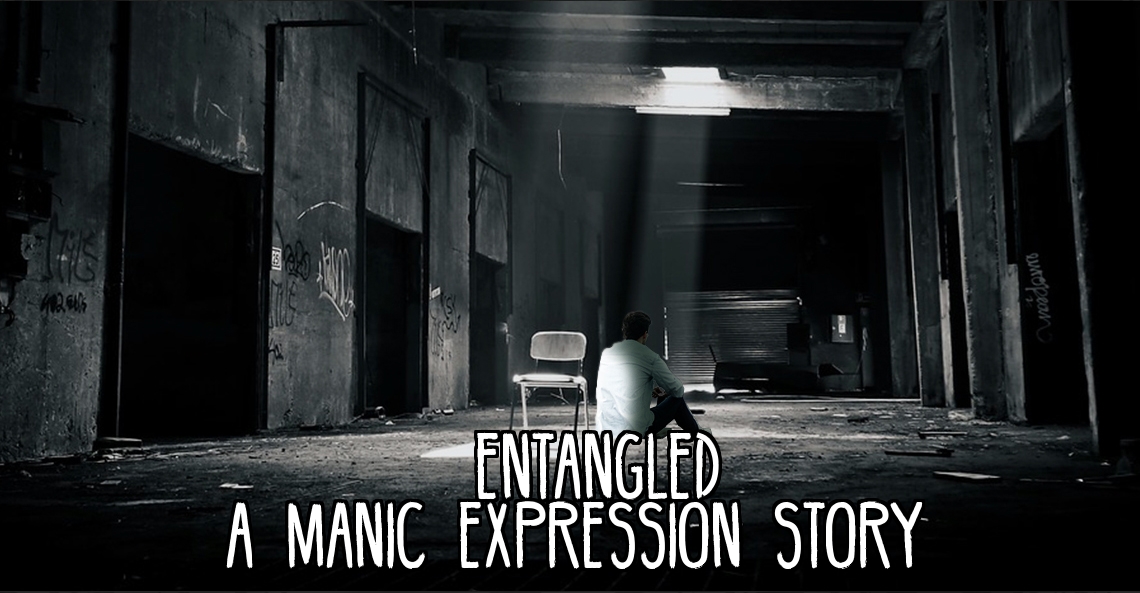
Entangled: A Manic Expression Story
February 24, 2022 in James' Corner
“Entangled”
by James Daniel Walsh
THE CONFESSIONAL is dark and quiet when I step inside. Every sound is magnified by the stillness of the cramped little room—the rustling of my jacket, the thud of my ass against the chair as I sit down, the breath in my lungs. The silence hangs in the air, the priest on the other side of the mesh screen waiting for me to speak. I know I’m supposed to say something, but I’m Jewish, and all I have to go by here in this, my first confession, are the second hand thoughts of a lapsed Catholic who hasn’t been to confession in years.
“I know you’re there,” the priest laughs. I don’t say anything. “Would you like to offer me your confession?”
I stare at the chipped black polish on my fingernails, waiting for the voice in my head to tell me what to say. “I’m Gina,” I finally mutter.
“Nice to meet you, Gina, I’m Father Vincent,” the priest says warmly. “Are you here to confess today?”
“No,” I admit. “I’m here to give exposition.”
“Excuse me?” Father Vincent asks with a chuckle.
“I’m here to tell you about myself, about the only two memories I have.”
The priest is silent for a moment. “Two memories?” he finally mutters. “You must have more than that.”
“You would think I would,” I agree. “But I’ve only been in two stories before this, so that’s all I remember.” There’s silence again, and I can’t help but laugh. “Oh, I have what some might call memories,” I explain. “I can remember my wedding, the birth of my children, stuff like that. I have a house down by the beach and a job. But those memories are vague, without any real shape. You see, those scenes were never written. Only my two memories were written.”
Father Vincent clears his throat. “Have you been drinking or using drugs today?” he asks me.
I lean back in the hard wooden chair and stare at the screen, unable to see the priest’s face through the clover leaf patterned screen. “Would you like to hear my two memories?” I ask. “We can call it a confession, if that makes you more comfortable.”
“Yes, of course.”
“Well, like I said, I remember a wedding,” I go on. “We had a whirlwind romance, my husband and I. He wanted to be a filmmaker. I don’t remember why I loved him, or if I even did. I don’t have that memory. No, the only real memory I have of my husband, if you can call it real, is of walking in on him in our bed with a whore.”
Father Vincent sighs sympathetically. “I’m so sorry,” he says, and I know he means it.
“Thanks,” I say, smiling. “I was pregnant with our daughter at the time. I don’t really remember the divorce, though I know we had one, and I don’t remember him abandoning our children, though he did. I just remember that one moment, standing in our bedroom, him not knowing I was there. Seeing my husband naked, fucking another woman, that was bad enough, but the things he was saying. He was so nasty, talking so dirty…”
My heart aches at the memory, even though I know that my husband and the whore don’t really exist. None of it was real, just like these walls aren’t real or the air I’m breathing. Still, the voice in my head tells me to feel betrayed, to feel pain, and so I do.
“Did you and your husband go to this church?” Father Vincent asks me. “If so, I might be able to help —”
“You wouldn’t know my ex.”
“I might. What was his name?”
“He didn’t have one.”
Silence invades the confessional again. “Excuse me?”
Father Vincent asks, confused. “He didn’t have one,” I repeat. “The writer never gave
him one.”
Another long pause, and then the million dollar question is asked. “What writer?”
I lean toward the screen, putting my hands up against the sheet metal window keeping Father Vincent from seeing my face. “How many memories do you have, Father?” I ask. “Real ones, I mean, not just vague recollections of high school, or of eating breakfast.” I don’t wait for an answer. “We’re fictional, Father. You and I, this place, this whole world… We only exist in the pages of a book.”
Father Vincent laughs, but his voice is further away and I know he’s as far the hell away from the screen as he can possibly be. “And how would you know this?” he asks me. “Assuming it’s true, why would you be the only one in the world to know the truth?”
“Because the writer wants me to,” I answer with a shrug. “This is his new story. He’s out there, somewhere, making this up as he goes along. I was a character in two previous stories he wrote, though only a minor one. When I caught my husband in bed, I didn’t even have any lines. He just wrote me, standing there, sobbing and watching.” Anger wells up in me; a hatred I know isn’t mine but instead is written into me, like a tattoo on my soul. “The bastard made me watch…” I whisper, shaking my head. Tears prick my eyes. I want them to be mine but I know that they aren’t.
“You sound like you’re talking about God,” Father Vincent whispers, almost to himself.
I laugh out loud. “He wishes!” I exclaim. “No, Father, in our world even God does what this guy wants. But in his world I’m sure he’s just a little man at a computer, taking his frustrations and failures out on us.”
“I see,” Father Vincent says. He doesn’t believe me, but he wants to help, or at least the writer wants me to think he does. “What was your second memory?” the priest asks. He’s humoring me, so I humor him back.
“Her name was Michelle,” I say, the name sticking in my throat. “Michelle Crews.”
“Michelle Crews?” Father Vincent says, surprised. “The author, the one that disappeared last month?”
I roll my eyes and rest my face in my hands. “Oh my God,” I sigh. “That was the clunkiest, most heavy handed expository line I’ve ever heard. I swear—this writer is a fucking hack! ‘Michelle Crews? The author, the one that disappeared last month?’ My God, what lazy writing!”
“I’m sorry,” Father Vincent apologizes.
“Not your fault, his,” I say. “He puts words in your mouth, he should think of a better way of informing the audience than to have you say something so obvious, something that no real person would ever say.” I raise my head up with a shake and sigh. “But if you think that’s bad, you should try being in my head. I’m constantly narrating. From the moment I stepped into this stupid booth my first-person narration has been feeding the audience everything they need to know. It’s driving me bat-shit.”
Silence again, and then an uncomfortable chuckle. “Maybe I should call a doc—”
“Oh, you asked me about Michelle,” I remember, cutting him off. “My only other memory is of her— slapping her face, telling her how much she hurt me. I suppose I made quite the scene. She disappeared soon after. I feel bad about the things I said to her, even if she did deserve them.”
“Did you…?” Father Vincent begins cautiously, and then thinks better.
“No,” I answer. “I didn’t kill Michelle. I loved her. I was more in love with her than with anyone I’ve ever known, or so my heart tells me. My only memory of her is that last moment, screaming at the top of my lungs that I hoped she suffered the way she made me suffer, but in my heart I hear sweet words that were never really spoken. I feel her touch, her flesh against mine, her lips against mine, and I miss her. No matter what she did to me, no matter how bad it hurt, I miss her still.”
Father Vincent is quiet, and I await a self-righteous sermon about how my love for Michelle is an abomination. “If none of this is real,” he says instead, “then why should it hurt? Any of it? What your husband did, what Michelle did, it’s all just ink on a piece of paper, the imaginings of a silly writer.”
I smile, and a tear falls down my cheek. “I hurt because he writes me to hurt,” I answer, my voice breaking. “I suppose we aren’t all that different from people out there in his real world, assuming of course his world is any more real than ours. Even though it never really happened, I remember my husband being there when I gave birth. He held my hand, told me he loved me. We kissed. He made a promise to me and to our children, and he broke it.” Another tear falls, and another, and finally my fragile voice cracks wide open and a sob escapes.
“Gina,” Father Vincent says tenderly. “Gina, I’m not saying you’re right—that this is all just fiction—but if it were than this man, this writer, is building toward something with you. What is it, Gina? Where do you see this story ending?”
A tentative smile appears on my lips, washed away by a flood of mascara dyed tears. “I don’t know,” I answer truthfully. “All I know is that a moment ago I stepped into this confessional, and for the first time I was aware of the truth. I’m going to stand up in a moment, walk out of here, and head downtown.”
“Downtown?” Father Vincent asks. “What’s downtown?”
“I don’t know,” I sob, resting my head against the screen. “Something to do with the switchblade in my pocket, I suppose.”
“Switchblade?” Father Vincent says, raising his voice for the first time in our conversation. “Gina, what on earth are you going to do with a switchblade?”
A sudden terror grips me. What am I going to do with the switchblade? The confessional feels suddenly claustrophobic, and I push the door open and take a breath of stale church air. Through the blur of my tears I see a line of people outside the booth. They’re here to confess their pedestrian sins and beg a faceless man for forgiveness, none of them aware that their sins aren’t even real.
I wipe the tears from my eyes and take another look at those waiting to speak to the priest. I clasp my hand over my mouth to stifle my scream, but the cry that escapes from my lips echoes throughout the church just the same. These extras, nameless characters in a story where I’m the star, are blanks. They have no faces, no clothes, no color. They are mannequins, without features, without genitals, without movement, all lined up outside the confessional. The writer didn’t deem them worthy of description, didn’t feel they needed action, and so they just stand there, staring at me without eyes in their heads, waiting for me to carry out the plot.
“You’re like them, you know,” a voice says, and I scream again in fright. Standing up on the altar is a handsome man in a black trench coat, his hair and goatee as dark as his eyes. He lights the cigarette in his mouth with a silver lighter, twin flames igniting the tip, and he smiles at me. “He gave you a face and a name, poured his pain into you, but you’re nothing, just like those fake people behind you. You’re just a half formed thought, without a last name or a purpose for being other than furthering the story. Let’s face it, sweetheart—you’re just a bit player.”
A door opens behind me and Father Vincent steps out, his hands reaching for me. I step back and look at him, eyes blurring with tears again.
“Gina,” he says, and I’m relieved to see lips and eyes and the collar of a priest. Father Vincent must appear in other stories too, why else would he have features while those waiting in line have none?
“He knows!” I cry out, pointing to the man on the altar. “He knows! He knows! He knows!”
“Who knows?” Father Vincent asks soothingly. “Knows what?”
“Ask him!” I demand, pointing my finger at the phantom. “Ask him, ask him what’s real and what’s not, he knows!”
Father Vincent follows my stabbing finger and looks right at the stranger standing below the crucified Christ. “Gina,” he says, shaking his head, “I don’t see anyone there.”
I turn my attention from Father Vincent to the phantom. He exhales a cloud of smoke, and a laugh escapes his lips. I recognize him now. He was there, in the room with me when I caught my husband with that whore. He was there when I slapped Michelle across her beautiful face. He was there, in that confessional with me, stabbing the truth into my spine. He is the messenger, the voice of the writer in my world. He is Fear.
I turn and run, as if in slow motion—more dramatic that way, I suppose. Fear’s laughter echoes in the rafters of the church, pushing me forward like the blast from an explosion. When I finally reach the doors of the church and push them open, escaping from under the sign of the Omega, Fear’s laughter has permeated the very core of my being. My feet are moving against my will, taking me to a destination I’m quite unaware of. None of this is within my power to control, none of it! Then who am I? What am I? I think, I feel, but only because someone else tells me to. What does he have planned for me?
I run passed plain, windowless houses and colorless trees, none of which the author has bothered to describe to me. I’m suddenly, terrifyingly aware that I don’t know what color the sky is, or what a car engine sounds like. The writer never gave me those memories, and so my eyes see a half finished landscape, devoid of reality and the basic structure of truth. I’m surrounded by fiction. I am fiction.
I reach downtown in what feels like seconds when the distance should have taken me all day to travel on foot. I’m standing on Pine Avenue, shaking, crying, breathing in air that isn’t really there. The crowd moves around me, more mannequins, silent but for the clump clump of their footfalls. I reach into my jeans pocket and feel the handle of the knife. The writer tells me it’s cold, that it’s hard, and that I’m afraid of what I might do with it. He tells me to watch the building across the street, the glass edifice shining in the morning light. I watch, waiting, knowing someone or something is going to carry the plot along in a moment. I wait so long it becomes obvious that I’m waiting for the star.
Then I see her emerge from the alley and come around the corner toward the building. My breath stops in my chest. She’s beautiful—shoulder length auburn hair frames her young, porcelain face. She wears all black, and her hazel eyes are heavy and sad. She enters the building, and my feet are already moving, my heart skipping a beat. I don’t know what’s about to happen. Is this, perhaps, a love story I’m in? Is this the woman of my dreams, and I’m here to sweep her off her feet? Is the writer benevolent after all?
I enter the alley my angel emerged from, certain she’ll come back this way when she leaves, and I duck into a dark corridor inside the neighboring parking structure. There I wait, eyes closed, heart hopeful. Maybe this beauty is my salvation. Maybe she can make this revelation vanish, and I can live my life never knowing that I’m little more than a bit of ink on paper. We can raise my children together, my angel and I, and the sky will have color and the people will have faces and the breeze will move the leaves. Maybe, maybe, maybe…
I hold my breath for the hour that she’s inside the building, and don’t exhale until I hear feet coming toward me. What will I do when she passes by? I don’t know—I just wait for the plot to unfold, as an eager reader might.
When I see her pass by, time stops, and my heart sinks. Now I know where this is all going. This is not a love story. My hand goes into my pocket and pulls out the switchblade, and my other hand reaches out and grabs my angel by her arm, pulling her into the darkness with me. I throw her hard against the concrete wall and push a button on the knife’s handle. The blade snaps out and my angel’s eyes go from confused to scared. I grab her throat with my free hand, put the blade to her jugular, and press my body against hers.
“I saw you go in,” I say to her, my voice trembling as I speak words that aren’t really mine. “You’re beautiful. You’re so beautiful. I knew it had to be you. I knew you were the one. So I waited.” Tears begin to fall again as I stare into the terrified face of this poor, innocent girl, her eyes shut from me as if I were some sort of monster. Perhaps I am. Perhaps that’s my role. “I waited so long,” I say, crying, shaking, trying to break free. I can’t. “I waited so long!”
The angel jumps at my sudden outburst and holds her purse up. I blink tears from my eyes and slap the offering from her hands. I reach up and caress her tear streaked cheek, and I want her to not be scared. I want to put this knife down and hold her, tell her everything will be okay and that I would never really hurt her. I struggle against my fingers, trying to force them open so that I might drop the blade, but they don’t move.
“Have you ever been scared and you didn’t know why?” I ask, and I press the knife a little harder against her skin to remind her of the taste of fear. “Scared when you woke up in the morning? Scared when you showered? Scared when you ate breakfast? Every second of every day there was a terror you couldn’t explain, gnawing at you like a dog with a bone, and you knew you would never get away from it. It would eat you alive. Even then there’d be the nightmares.”
The angel opens her eyes and looks at me. I can see in her eyes recognition, that she understands what I’m saying, and I feel a sudden surge of desire sweep through me. I lean in and kiss her on the lips, my free hand grabbing her breast and kneading it with a passion I’ve never known before. Am I free right now? Is this the will of the writer or is this real? I want this woman. I want to taste her and fuck her and be free from all of this goddamn fiction. Am I in control right now or is he? Is this my passion or his?
“We’ll fuck him away, you and me,” I whisper between kisses, and for once I recognize my words as my own. I kiss my angel harder, teasing her nipple underneath the padding of her bra, trying desperately to hold on to this freedom I suddenly feel. “He’ll never find us if we’re naked and cumming and free. He’ll never get his hands on us if we can just feel safe in each other’s arms.”
I move my hand because I can, taking the knife from her throat. I feel her pull away, and I put the knife back. I can’t let her go, not now. We’re free, she and I. Right now, in this moment, we’re free. She doesn’t know it; she doesn’t feel the writer’s cruel story unfolding around her. When this is over, when orgasm has freed our minds and bodies and liberated us from our master’s service, my angel will thank me. My angel will—
“Gina,” a familiar voice says from the alley outside, “why are you doing this?”
My angel and I both turn to find Fear standing there, silhouetted by the morning light, climbing the three stairs into the corridor with slow, deliberate steps.
“No!” I cry out. “Go away! You’re not really here!”
I still feel passion between my legs, still feel freedom in my limbs, and so I attack. I swipe the knife at him but my limbs suddenly revolt and the attack is meager at best. Fear grabs me by the wrist and spins me around, holding me by my throat and relieving me of my weapon.
He leans in close to my ear and whispers, “Don’t you love me any more?” with a mixture of rage and lust. I try to fight, but can only moan in despair.
The angel snatches up her purse and runs, out of the corridor and away from me. Fear pulls me from the corridor by my hair, and the writer tells me for the first time what pain feels like. I hate him for that. I hate him for all of this. Was I free back there, or did he just let me think I was free? The sick bastard! The lying monster! Why is he doing this to me? Is this his pain he’s taking out on me? Are these his feelings I’m feeling—his fear, his impotence, his rage? Do I hate him, or does he hate himself?
“Now you listen to me, you stupid bitch,” Fear yells at me over the screeching wheels of the Blue Line in the street outside the alley, “we all have our parts to play in this goddamn story. You think you’re special?” I see my angel out of the corner of my eye, watching this drama unfold from a safe distance. Fear pulls my hair again, and my cry of pain is drowned out by the breaking train. “She’s mine, Gina. Mine! You’re nothing to me. You’re just a day player, here to help introduce me to the audience. Now is my time, Gina—my time with our little friend over there. It’s time for you to go.”
“Please,” I beg, the word barely escaping my mouth. “Please tell me what I’m supposed to do. Tell me where I’m supposed to go. I want out of here, I want freedom, I want—”
Fear slaps the switchblade into my hand and pushes me away. “Cut,” he says with a finger pointed in my face. “Cut until you find freedom.”
My eyes grow wide, and my feet move before he can explain his words. I run away, down the alley and behind a white van sitting there, waiting for me. I stare at the knife in my trembling hand, and then my free hand moves against my will and rolls up my sleeve. I stare at my wrist, the vein throbbing under the skin, and I open my mouth to scream. I have no voice. I’m not a part of the story any more.
Look for this story and others in Manic Expression: A Collection – Apocalypse, now on sale.
Copyright © 2017 by James Daniel Walsh. Library of Congress Control Number: 2008903178 ISBN: 978-1-5215-0387-4 (Softcover)
All rights reserved. No part of this book may be reproduced or transmitted in any form or by any means, electronic or mechanical, including photocopying, recording, or by any information storage and retrieval system, without permission in writing from the copyright owner.
This is a work of fiction. Names, characters, places and incidents either are the product of the author’s imagination or are used fictitiously, and any resemblance to any actual persons, living or dead, events, or locales is entirely coincidental.
by James
by James
by James

by James
by James

by James
by James

by James
by James