@curiosity-inc

Movie Curiosities: The Kid Who Would Be King
January 27, 2019 in Blogs, Curiosity Inc.
Well, folks, this is it. In all probability, this could be the very last year in which we see a movie open with the iconic searchlights and trumpet fanfare of the 20th Century Fox logo. Raise a glass for the end of an era.
A couple years back, Warner Bros. hired Guy Ritchie to direct an adaptation of King Arthur and they tried to spin it into a franchise. King Arthur: Legend of the Sword turned out to be an embarrassing mess by any standard, among the worst commercial flops and most infamous critical failures of the year. But while the movie was quickly banished to obscurity, remembered only as a terrible mistake never to be thought or spoken of again, it’s not like the movie itself was a bad idea. The tale of King Arthur is a perennial legend for a reason, and we could certainly use a fresh retelling right now.
Why? Well, The Kid Who Would Be King makes a compelling argument from pretty much the word go.
Here we have a modern reworking of the King Arthur myth, set against the backdrop of the modern day. At a time when Britain is tearing itself apart, falling into confusion and turmoil over Brexit. To say nothing of political divisions, rampant bigotry, and fearmongering tyrants taking power all over the world. What better time for a hero to rise among us, turn enemies into allies, unite us all, and lead us forward?
Thus we have this new retelling in which Alexander Elliot (played by Louis Ashbourne Serkis, son of Andy) learns to take his place as the unlikely heir to Excalibur and successor of King Arthur. Unlikely because he’s twelve years old, you see. It’s a strong thematic point that our main characters are kids, because they’ll be the ones who inherit our world, and they’ll be responsible for fixing the messes their parents and grandparents have made. So why the hell are we teaching our kids to be just as callous, greedy, and dishonest as we are?!
Repeatedly, Alexander and his friends are told that the world is cruel and tough and unfair, like that’s the way things have always been and there’s no point in trying to change it. The filmmakers issue a full-throated rejection of that notion. The world needs those with courage — who will always fight for truth and do the right thing — because they’re not just capable of building a better world, they’re also the only ones who can!
This is truly an empowering and uplifting movie, especially for kids, precisely because the filmmakers are so damn passionate about fighting to build a better world. Moreover, the movie makes absolutely no apology or excuse about being a movie in which modern-day kids wield actual swords and armor against demons and magic. The filmmakers are so committed to the premise, leaning so hard into this fantasy/comedy/adventure that the silliness goes right back around to being awesome.
Of course, our cast and characters are a huge factor. Alexander is your preteen everyman, struggling for a reason to believe — against his better judgment — that all of this is real and he truly is capable of more than everyone says he is. We’ve also got Bedders (Dean Chaumoo), a cowardly bully target who learns how to grow a spine. Then there’s Lance (Tom Taylor), an unrepentant bully dead-set on looking out for number one until he learns to set his ego aside and fight for something greater. Last but not least is Kaye (Rhianna Dorris), Lance’s partner in bullying until she finally learns that she doesn’t have to be as cruel as she was told the world is.
(Side note: Guinevere never gets so much as a single mention. I wonder if Kaye might have been Guinevere in an earlier draft, with a kind of love triangle going on between Alex and Lance. Thinking through the implications of two kids knowing that they’re fated to be together because of similarities with the established myth, it’s probably for the best that she was omitted altogether.)
Yes, these arcs are all predictable and cliched. Even so, they’re written, performed, and paced so beautifully that every single arc works. It really was a joy to watch these kids grow into characters worth cheering for. And again, it works because the cast and crew are fully and totally committed to every last story beat.
Another fine example is Rebecca Ferguson as Morgana, our chief antagonist. She plays a dark sorceress trapped under the earth until she can take over the world with her undead soldiers and her skill at exploiting the weaknesses and insecurities of others. If Ferguson had tried to underplay a role like that, it would’ve been disastrous. So instead, she swings for the fences and goes full-on camp, resulting in a genuinely imposing villain who’s a lot of fun to hate. Then again, it bears mentioning that Ferguson was pretty much entirely absent through the action scenes, replaced by a CGI monstrosity that Morgana transforms into. Waste of a perfectly good Mission: Impossible star, if you ask me.
Likewise, I was disappointed to see that Sir Patrick Stewart shares the role of Merlin with a teenager named Angus Imrie. Not that Imrie is awful or anything — indeed, he’s perfectly fine as a centuries-old wizard in the body of a teenaged boy, and that’s no mean feat. Even so… come on. This is Sir Patrick Stewart playing Merlin. Do I even need to explain why we need a whole movie of that?
(Side note: I’m amused upon the recollection that Stewart had a small role in Excalibur before playing the big mentor role here. That’s kind of like when Bryan Cranston got to play Zordon in 2017.)
Speaking of which, I was rather fond of Merlin’s magic. Basically, he weaves spells through lots of complicated hand gestures, waving, and finger-snapping. It looks really cool in action. Even so, I didn’t like how the rules of this particular universe were so arbitrary. Merlin is a teenager, except when he changes back for whatever reason. Merlin can’t show himself at night, for whatever reason. Only Alex and his knights can fight Morgana, for whatever reason. There are other examples. Still, while the rules may be arbitrary, they are at least consistent, so this isn’t really a dealbreaker so much as it’s a persistent annoyance.
Then we have the action scenes. I’m glad that the filmmakers found some neat variety in the fight scenes, and some genuinely clever moments in places. The “training montage” against mobile trees was a particular favorite. It also helps that while our fiery undead soldiers are imposing and great in numbers, they’re still made of centuries-old dessicated bones and are appropriately brittle. Thus our disposable foot soldiers are badass enough to make tangible threats, yet fragile enough that teenagers could plausibly defeat them, and they explode real nice when they’re defeated. I approve.
On a final miscellaneous note, I’d be remiss if I didn’t mention Denise Gough as Alex’s mother. She provides a grounded and sensible counterpoint to all the madness going on, while also serving as a kind and loving mother to Alex. It’s a sweet performance of a nice character, helping to give the movie heart without subtracting from the high fantasy madness.
All told, I had a wonderful time with The Kid Who Would Be King. It’s a straightforward fantasy romp that pays loving tribute to the legends of old, while also stressing the importance of why legends need to be updated and told anew. It’s an exciting, creative, uplifting movie with a strong beating heart. It’s great to see a movie so unapologetically silly and fun, both engaging and inspirational. Definitely check this one out.
For more Movie Curiosities, check out my blog. I’m also on Facebook and Twitter.
Movie Curiosities: Mary Poppins Returns
December 25, 2018 in Blogs, Curiosity Inc.
I didn’t like Saving Mr. Banks. I know I’m in the minority, but I found Emma Thompson’s portrayal of P.L. Travers to be completely insufferable. Yes, I know the real Travers was a total bitch to work with, and it’s hard (even with all of Emma Thompson’s talent) to make such a consistently unlikeable character into a protagonist worth following. Even so, I don’t feel that the character developed enough to make her into anything tolerable. Also, no way am I getting on board with a lead character who deliberately and unapologetically insults a wounded WWII veteran for his war injury. But I digress.
I bring up Saving Mr. Banks because it was a high-profile awards season Disney release that showed the mainstream public what massive drama happened behind the scenes of Mary Poppins. Walt Disney Pictures itself came out and admitted to everyone that P.L. Travers was vehemently reluctant to surrender any degree of control over her creation. We know why Mary Poppins meant so much to Travers, we know that she considered Mary Poppins to be the embodiment of tough love in a world that coddles children with sweet lies (like those the Disney empire was built on, for example), we know she hated the thought of musical numbers in any film adaptation, and she went to her grave with a violent loathing of those animated penguins.
But with all respect, God rest her soul, Travers lost that battle decades ago. Mary Poppins is still an immortal classic. For over 50 years, the movie and its namesake character have enchanted countless children of all ages, and every scene is overflowing with cinematic magic that hasn’t faded in the slightest. The music, the animation, the effects, the characters, everything about the movie has brightened countless childhoods and helped so many through dark times.
On the other hand, the movie is also a cash cow used for the cynical purpose of churning out untold millions of dollars, even as Walt Disney himself and P.L. Travers (under protest) used the film to sort through their own respective daddy issues. And that’s not me saying that, that’s the Walt Disney Company saying that. That is exactly the narrative they themselves crafted in a big-budget wide release (starring Tom freaking Hanks as the first man with Disney’s blessing to ever portray Walt Disney himself!) that came out only five years ago. And they based it — however loosely — on settled historical record!
But of course, that’s all ancient history. And without P.L. Travers or her son to raise any kind of objection (for they are both safely dead), it looks like the time has finally come for Disney to turn toward Mary Poppins in their relentless mad quest for the established property they can recycle into an Alice in Underland-level hit.
(Reminder: Alice in Underland was eight goddamn years ago.)
The good news is that Disney didn’t come out with a direct remake. Instead, Mary Poppins Returns is a sequel that picks up several years after the original, when the kids of the first movie have grown into adults (played by Ben Whishaw and Emily Mortimer). Christopher Robin tried something similar, and that worked out all right.
The bad news is… come on, it was right there in the title of Saving Mr. Banks. Mary Poppins wasn’t there to save the kids, she was there to save their father. And by the end of the last movie, he had been well and truly redeemed. So what are we doing for the sequel? Why does Mary Poppins come back? Are we really just rehashing the same old story, with Mary Poppins saving Jane and Michael Banks as she redeemed their father before them?
Well… yes and no.
Yes, Jane Banks is following in her mother’s footsteps as a revolutionary for the underrepresented, this time spreading flyers and holding protests for the labor unions. As for Michael Banks, he’s gone to work for the same Fidelity Fiduciary Bank that employed his father (and his father before him) and he’s become too caught up in his own work to properly look after his kids. So of course Mary Poppins (now played by an incandescent Emily Blunt) comes in to look after Michael’s children, giving them the wisdom and confidence to help save their father from himself.
So the superficial details are all still there, but with significant differences. To start with, of course the interplay between the two Banks siblings is nothing like the relationship between their two married parents. Additionally, while Jane and Michael have convinced themselves that the more fantastic events of the previous film never really happened (flights of childhood fantasy and all that), they still have fond memories of Mary Poppins and they put up with way more of her crap than Mr. Banks ever would have.
But easily the most important difference is this: At the start of the original film, Mr. Banks was happy. Banks was thoroughly and totally convinced that his life was perfect and everything was in place, never realizing that everything he had was built on a house of cards until Mary Poppins came in and toppled it all. By comparison, this movie opens with the crystal clear message that Michael is only barely hanging on by a thread.
Michael’s wife died about a year ago (Disney movie, duh), and he’s still deep in mourning. Additionally, Michael’s all but completely given up his true passion as a painter as he buries himself in work at the bank to make ends meet. So his children (John, Annabel, and Georgie; respectively played by Nathanael Saleh, Pixie Davies, and Joel Dawson) have had to learn how to take care of themselves in place of their absent parents, thus prematurely growing up (though Georgie is quite noticeably less mature than his two siblings, thus leading to a conflict that was never there between Jane and Michael as kids). In spite of all this, Michael is no longer able to pay a loan he had to take out and is thus in danger of losing his house unless he can find the necessary money in a few short days.
In summary, Michael and his family need help far more badly than Mr. Banks and his family ever did in the first movie. The dead wife brings more pathos, the potential loss of the house means higher stakes, and the deadline for paying off the loan is a ticking clock — something the original movie never had, aside from a vague mention of changing winds. We’ve even got a villain in this movie: the bank president, gamely played by Colin Firth.
This movie has a plot and it has dramatic tension, far more so than the previous film did. It makes total sense for the sequel to do that, if the intention was to go bigger and better. Unfortunately, it’s also probably the biggest mistake this movie made.
Think back to the first movie. Did we really need that tea party on the ceiling? Was the whole animated sequence really crucial to the plot? Why was Admiral Boom even there? When you get right down to it, so much of the original movie was made of songs and sequences that go nowhere and accomplish nothing, but they impart a sense of childlike whimsy that was central to the film’s message and its appeal.
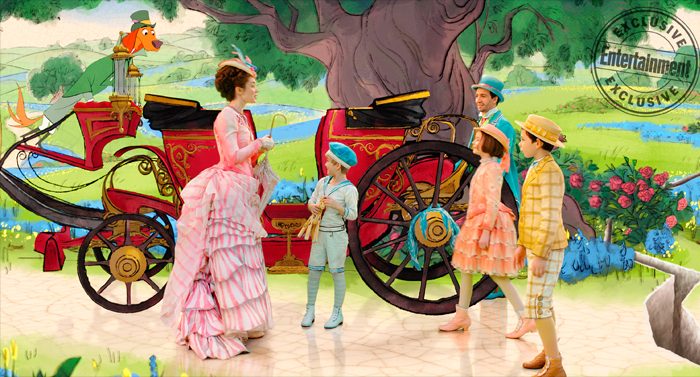
This movie does something similar. In fact, it does a lot of things similar. In place of telekinetically cleaning up their room, the kids are introduced to Mary Poppins through a bath that takes them to the bottom of the ocean. In place of an animated tea party and horse race, we get an animated carriage ride and a full-on circus, followed by a harrowing nightmarish chase sequence. In place of Uncle Albert and his floating tea party on the ceiling, we get Mary Poppins’ eccentric cousin (Topsy, played by Meryl Streep) whose house rotates upside down once a month. Instead of Bert leading his fellow chimney sweeps in a massive rendition of “Step In Time”; we’ve got Jack (Lin-Manuel Miranda) and his fellow lamplighters in a gigantic, sprawling, epically scaled number called “Trip a Little Light Fantastic”. Where the previous film had an old lady feeding the birds, we’ve got freaking Angela Lansbury playing a balloon vendor and singing the film’s closing number.
This is a conundrum we’re seeing all too often in cinema nowadays: How to stay close enough to the source material that it’s recognizably within the same universe, but distant enough to work as its own movie and not a shameless ripoff. It’s a tough needle to thread, but honestly, the filmmakers managed it quite well. While each individual scene was clearly and recognizably inspired by the prequel, the filmmakers did a solid job of making it their own. As far as impossible situations go, the solution presented here is not bad at all.
Likewise, there’s the matter of the music. The Sherman Brothers were grandmasters, responsible for some of the most iconic songs in pop culture, many of which came directly from the original classic Mary Poppins soundtrack. Nobody could ever hope to exceed or even match that level of quality.
I’ve seen Pete’s Dragon (the crappy original, I mean — not the criminally underrated remake), so I know what a third-rate imitation of the Sherman Brothers looks and sounds like. This isn’t it. This is a second-rate imitation, brought to us by the Tony-winning team that wrote the Broadway musical adaptation of Hairspray, clearly written with all the effort and passion and talent they could bring to bear. These songs may not be perfect, but they’re the best we could’ve possibly hoped for.
(Side note: What are the contenders for Best Original Song this year? Could Marc Shaiman win an Oscar and get the full EGOT with this one? Come on, let him have it.)
But here’s the problem: The original movie could get away with so many pointless yet fantastic sequences because we didn’t have anything better to do. We never had a ticking clock to worry about. In this movie, I’d see the characters standing on their heads with Meryl Streep or watching ten thousand leeries a-leaping and I’d think “Yeah, this is fun. Isn’t your house about to get repossessed? You should get on that.” Conversely, I’d see the kids in a life-or-death chase sequence or the daring climactic stunt sequence and wonder if I was still watching a Mary Poppins movie.
(Side note: To repeat, Christopher Robin is proof that the filmmakers could have given us a fantastic movie that gracefully honors its source material while keeping the stakes low and intimate. It’s a shame the two movies came out in the same year, or Rob Marshall and company could’ve taken some great notes.)
Speaking of which, Emily Blunt absolutely nails this role. She crushes it hard. I mean that as no small amount of praise, given how universally known and beloved Julie Andrews was in the role, but Blunt takes the mantle and wears it like it’s nothing. The costume design, alas, is much less consistent.
To be clear, the costumes in this movie all look amazing. Sandy Powell is a costume designer par excellence and every single piece of her work here is utterly superlative. In the case of Mary Poppins, her work outfits are instantly iconic and perfectly representative of the character. But in the more fantastic segments, well…
I’ll put it to you this way. Exhibit A: This is ______ on a jolly holiday. Exhibit B: This is _____ singing underwater. Exhibit C: This is _____ on her way to the Royal Doulton Music Hall. Exhibit D: This is _____ in her splashy musical number about first impressions. Now, imagine seeing these pictures removed from all other context. Which of them look like prim and proper Mary Poppins, and which of them look like Emily Blunt in a glamorous outfit? Which ones would have looked out of place and out of character if Julie Andrews had worn them in the original film?
Then we have Lin-Manuel Miranda. To be clear, I love Lin-Manuel Miranda. Who doesn’t? It’s like every word written and spoken from his genius mind is another reason to stay optimistic in this crappy, depressing world. He can act, he can sing, he can dance, he can rap, he can tell a joke, he can break your heart… pretty much the only thing he can’t do is pretend to be anything other than Puerto Rican.
I know Dick Van Dyke’s Cockney accent was famously awful, but to see it on Lin-Manuel Miranda… seriously, why? The minute Disney brought him on this project (as they damn well should have, and the movie as a whole is better for it), they should’ve rebuilt the whole character to play to his strengths and not try to shoehorn him into some contrived, watered-down Bert rerun.
As for the child actors, they get full marks across the board. It is so incredibly rare to find even one actor that young with that much talent, I have no idea how the filmmakers were able to find three. Kudos are also due to Ben Whishaw and Emily Mortimer, who turn in solid work as the Banks children all grown up.
Julie Walters is perfectly fine taking over the role of Ellen, ditto for David Warner as Admiral Boom. Colin Firth and Meryl Streep are having the time of their lives playing to the cheap seats. Then we’ve got Dick Van Dyke as the deus ex machina and the aforementioned Angela Lansbury, both of whom prove conclusively that they haven’t lost a step. The filmmakers even brought in Karen Dotrice — the original Jane Banks herself! — for a sweet blink-and-you’ll-miss-it cameo appearance.
I only have one real problem with Mary Poppins Returns, but it’s a doozy: The filmmakers didn’t have the guts to try and scale back the plot. The original movie did fine without a cartoonishly evil villain or any outlandish action sequences, and there’s no reason this movie needed them either. If the goal was to go bigger, they already had the dead mother and the ticking clock to provide that, to say nothing of how huge and elaborate the rest of the film was.
The performances are all great fun, the production design is extraordinary, the effects are seamless, the dance sequences are beautifully elaborate, the songs are all perfectly fine, and the themes of the original film are even more focused and better utilized here. We’re never going to get a film as timeless and iconic as the original, but the cast and crew put so much passion and effort and talent into this movie that the end result is close enough for now.
But here’s the big question: In such a massively crowded moviegoing season — with Spider-Man: Enter the Spider-Verse, Bumblebee, Aquaman, and so many huge crowd-pleasing blockbusters in theaters right now, to say nothing of Welcome to Marwen, Vice, Mary Queen of Scots, and all the other awards contenders out right now or coming in the next few days — is this movie really worth your time and money? Is this really worth a big screen viewing, against all the others competing for your time and money right now?
Well… yes. I’d say yes. Especially if you’ve already seen all those others, then hell yes.
For more Movie Curiosities, check out my blog. I’m also on Facebook and Twitter.
Movie Curiosities: The Grinch (2018)
November 18, 2018 in Blogs, Curiosity Inc.
In How the Grinch Stole Christmas (2000), there’s a scene in which the Grinch (as played by Jim Carrey) takes off his socks and throws them away. Upon hitting the ground, we see the socks crawl away in search of cover, squeaking in fear. That five-second shot perfectly encapsulates all the reasons why the live-action Grinch is still the best feature-length adaptation of Dr. Seuss’ written works to date.
Yes, the movie is loaded with crass humor, hammy overacting, and exposition that was neither wanted nor needed. Yes, the film owes much of its staying power to the novelty of being the first live-action Seuss adaptation. And of course it helps that holiday films and songs (particularly that insipid Faith Hill song from the soundtrack) are guaranteed constant round-the-clock ubiquity every December.
But I can’t bring myself to hate the movie because of all the effort and passion that so clearly went into it. The production design is gleaming with polish from first to last, and every effort was clearly made to present a Chuck Jones cartoon come to life. It had a vision of clarity and tone that was very distinct, or at least more consistent and true to the source material than all the subsequent Seuss adaptations we’ve had so far.
Still, the film was hardly perfect, which brings us to The Grinch, this year’s animated effort at expanding the classic children’s book to feature length.
Right off the bat, the 2018 film clocks in at 86 minutes, while the 2000 film ran for 105 minutes. Those 20 minutes make a hell of a difference, as the animated film is much more streamlined. There’s significantly less padding, and the padding that we get makes a lot more sense. There’s no massive backstory given to the Grinch, and no time wasted on arbitrary Cheermeister nonsense, thank Geisel. Instead, the movie stays focused on the Whos’ preparations for Christmas and the Grinch’s preparations to steal Christmas, which is exactly where the filmmakers should have been focused.
What’s even better, the Whos aren’t materialistic assholes as they were in the Ron Howard film. Instead, they’re just incredibly cheerful people who want to express their being happy, want everybody else to be happy as well, and worry about anyone who isn’t happy like something must be wrong with them. As for the Grinch himself (voiced this time by an unrecognizable Benedict Cumberbatch), we get just enough backstory to see that he grew up in an orphanage, and he never got to spend a happy Christmas with his family as so many other children did. Thus we have a vicious cycle in which the Grinch has so many negative associations of Christmas, so the Whos try harder to cheer him up, which only has the opposite effect. This is most plainly seen when the Grinch is relentlessly pursued by a band of aggressively happy carolers.
Another great example comes when the Whos partake in a massive tree lighting ceremony, with a tree the size of a skyscraper and enough lights to be visible from outer space. The Grinch is upset that the Whos are putting up this enormous blazing eyesore without any warning to or input from the guy living in the cave next door, and can you blame the Grinch for being upset about that? So he tries to stop the ceremony, the tree gets lit anyway, and it’s this huge extended sequence. Then the Grinch is done stealing Christmas and we can plainly see the tree is left standing. That seems to me like a pretty glaring oversight, but whatever.
The point is, what we’ve got here is someone who associates Christmas with bad and painful memories. So of course he’s upset by all the forced holiday cheer, ostracizing himself so he doesn’t have to deal with the social pressure to be happy. That’s sadly not an uncommon attitude toward the holiday season, and it gives the Grinch a sympathetic reason to hate Christmas.
On the other hand, while the Whos are wrong to try and make everybody as happy as they are, the Grinch is even more wrong to try and make everyone as miserable as he is. At least the Whos have good intentions, and they’re trying to spread more of the love and kindness that the world so desperately needs. Plus, while being lonely can be healthy every now and then, we all need friends and loved ones as well. If nothing else, maybe Christmas serves as a time when we can try a little bit harder to be nice to our fellow human beings, and open doors that might otherwise stay closed. That’s a very sweet message for a Christmas movie, and one that serves as a natural extension to the source material.
That said, I am a little disappointed that the Grinch never directly asks the Whos to be a little more considerate about the Grinch’s unorthodox feelings and negative associations toward the holiday. Say what you will about Carrey’s portrayal, at least he called the Whos out on their shit.
While I appreciate the film’s efforts at showing the Grinch in his planning and preparation for the big heist, it does fall short in a couple of ways. For one thing, the Grinch makes extensive use of gadgets and gizmos more advanced than that of your average Gotham supervillain. I’ll remind you that in the live-action version, Carrey’s rendition of the character lived in the Whoville dump, and we could clearly see that he was well-practiced at cobbling together all sorts of devices from random junk. Without any setup so elaborate or subtle, it doesn’t make nearly as much sense that the Grinch could invent all of this stuff offscreen in a matter of days.
Yes, I realize that I’m talking about sense in a Dr. Seuss movie, but I hope you get my point.
The other noteworthy addition is Fred, the reindeer that joins the Grinch in his heist. Of course it makes total sense that the Grinch would at least try to find an actual reindeer. Moreover, I’ll admit that Fred’s inclusion does pay off in a few crucial and satisfying ways. But getting through the setup to those payoffs was exhausting. I found Fred to be a useless and unfunny inclusion, especially since — by virtue of the source material — we know perfectly well that he won’t be there for the actual heist in any event.
Oh, and whomever came up with that “screaming goat” gag, I hope they got fired. If not for this, then for something else.
Then we have Cindy Lou Who, voiced by Cameron Seely. I am so overwhelmingly grateful that the filmmakers didn’t even try to make Cindy Lou a saint. (Looking at you, Ron.) That said, Cindy Lou is deeply concerned about her mother (inexplicably named “Donna”, and voiced by Rashida Jones), who’s overworked as the single mother of three kids. Again, it’s a very sweet commentary about the stresses of the holiday season, especially given the sentiment that Donna doesn’t even mind all the work because she loves her kids so much. All well and good.
Anyway, being a young child, of course Cindy Lou’s first thought is to ask Santa for help. Long story short (too late!), Cindy Lou gets it into her head that the best way to ask Santa for help is to meet him on Christmas Eve and ask in person. I’m paraphrasing and dancing around spoilers here, but I promise it makes more sense in context. More importantly, it’s a neatly clever way of putting Cindy Lou Who directly into the Grinch’s path, forcing the Grinch to put more effort into his ruse as an impostor Santa. It also puts an unexpected burden on Cindy Lou, as she faces the possibility that maybe her antics upset Santa and she’s the reason why he stole Christmas.
It’s not a bad idea. It’s just a shame that we had to go through so many asinine setups in getting to the payoff.
Moving on to the cast, of course Benedict Cumberbatch hams it up in the main role. I’m not going to give him shit for that, and I’m done giving shit to Jim Carrey about it. Seriously, think about it: How could anyone underplay the Grinch? How could anyone bring any kind of nuance to that role? What would that even look like? Would you want to see it?
Rashida Jones does perfectly well as the loving yet overworked matriarch, and Kenan Thompson turns in some memorable work as a comic relief character. We get a cameo appearance from freaking Angela Lansbury, and of course it’s a delight to hear her voice. Then we have Pharrell Williams as the narrator. While he’s got a wonderful voice, the storytelling leans on voice-over narration to an unhealthy degree, and I’d be amazed if even two-thirds of his lines were anything that Dr. Seuss wrote.
This is something else I have to give the live-action film: At least they actually used the source text. I’m pretty sure every word from the book made it into that script verbatim. Compare that to the animated film, in which copious lines from the book are only paraphrased and several words are altered. For an 86-minute film adapting a 69-page picture book known for the author’s distinctive language, how in the nine hells do you fuck that up?!
Then we have the music. Grandmaster Danny Elfman is on hand to write the score, making effective use of the iconic songs from the Chuck Jones cartoon. Hiring the man who gave us the unimpeachably classic Nightmare Before Christmas soundtrack was an inspired move for this particular film, and he turns in a suitably impressive score. And of course we have a wide variety of Christmas tracks on hand, running the gamut from “Deck the Halls” to “Christmas in Hollis”.
But then the filmmakers went and hired Tyler the Creator to cover the classic “You’re a Mean One, Mr. Grinch,” in what has to be the worst choice I’ve ever seen since Fall Out Boy butchered the Ghostbusters theme. What, was R. Kelly unavailable? Chris Brown wouldn’t pick up the phone? Seriously, with all respect to Tyler the Creator, he was so obviously the wrong choice for this, and his godawful cover of this iconic song is proof. I have to assume that the filmmakers made a list of the recording artists who were most clearly and obviously wrong to cover this track, then ran down the list until they could find one who was available.
With all of that said, I can honestly say that I didn’t hate The Grinch (2018). There were some good ideas here, with a lot of genuinely funny sight gags. I appreciate that the filmmakers didn’t go too far off-base in finding new material to pad the film, and the themes of the book are expanded upon in relevant ways while staying true to the source material.
There are really only two big problems. The first is that it’s an Illumination film, which means that it’s loud, fast, stupid, noisy, and scrubbed of all personality. The second is that it’s an adaptation of “How the Grinch Stole Christmas!”, which means that it’s entirely useless. We already have the classic timeless book, and we already have the classic timeless Chuck Jones cartoon short. Nobody was asking for the 2000 live-action film, and nobody was asking for the 2018 animated film.
I expect that the 2000 film will last longer in the public consciousness, if only because of inertia. Plus, that one cloying Faith Hill song is damn well guaranteed to get more radio play in December than Tyler the Creator’s entire collected discography all year. Still, the 2018 attempt is a harmless bit of fun, and it’s bound to be inescapable by virtue of being a holiday film. So when the movie inevitably comes to a TV near you, go ahead and give it a look.
For more Movie Curiosities, check out my blog. I’m also on Facebook and Twitter.
Movie Curiosities: Venom
October 4, 2018 in Blogs, Curiosity Inc.
The Venom Symbiote is a sentient black goo from outer space, first introduced when it bonded to Peter Parker in 1984’s “Secret Wars” crossover extravaganza. Not only did the Symbiote give Spider-Man a new costume, but it could change its appearance into any costume Spidey wanted. The Symbiote could also shoot out tendrils, obviating the need for Peter’s web fluid and shooters, while greatly enhancing his strength and endurance as well. Unfortunately, the Symbiote would often hijack Peter’s body while he was sleeping, and also turn him into a cocky and callous dickbag. So it was that Spidey tore himself from the Symbiote, which promptly turned back into a helpless mass of black snot, only now it held a grudge against the host who threw him away.
Eddie Brock was a journalist who thought he had unmasked a serial killer, only to find that Spider-Man had caught the same killer previously, and Brock had just erroneously accused someone of being a supervillain. This front-page faux pas cost Brock his job, his wife, and his apartment. Then Brock and the Symbiote found each other. Two poor souls disgraced and cast aside, with nothing left to live for but their mutual bloodthirsty hatred of Spider-Man. Thus the creation of Venom.
Venom has all of Spider-Man’s powers and abilities, amplified to degrees that Peter could never reach, and they’re immune to the Spider-Sense. What’s more, they literally know Spider-Man inside and out, with intimate knowledge of Peter’s true identity, his loved ones, and everything else Peter has worked so hard to keep the bad guys from knowing (in the comics, anyway). Perhaps most importantly, Venom is a living representation of a time when Peter was corrupted by his own power. He used his abilities irresponsibly, and it will always come back to bite him so long as Venom runs free.
Venom was such an instantly successful character that of course Marvel has tried to capitalize on them at every opportunity, introducing numerous other Symbiotes and even rebranding Venom as an antihero for a time. None of these efforts (with the notable exception of Carnage) ever took off. Little wonder, considering what made Venom so popular. Everything that makes Venom interesting — hell, everything that makes Venom who and what they are — is all about being a foil to Spider-Man. The character was built so specifically for that role and works so perfectly in that role that Venom could never work nearly so well as anything else.
Yet so many keep on trying. The latest attempt is Venom, a Sony picture completely separate from the greater MCU, in which the filmmakers were legally prevented from even so much as mentioning Spider-Man. So it’s a Venom origin story with absolutely zero input from the Webhead, and you can already tell we’re in trouble.
To be clear, I’m not against the principle of other studios making Marvel films. Even the exorbitant resources of Marvel Studios are bound to be spread thin if they’re the only ones committing the vast Marvel Comics stable to film. And anyway, we don’t want Disney and Warner Bros. to be so massive and unimpeachable that there’s nobody else making superhero movies — just look at what the Marvel/DC duopoly has done to the comics industry.
The problem is that with very few exceptions (Looking at you, Deadpool.), pretty much all of the third-party Marvel films have been cash-grabs without any passion or creativity. Even worse, they’re creations of spite against the fans and Marvel alike, made solely to keep the rights from Marvel for that much longer. By all appearances, Venom looked like something similar. Not that there’s anything wrong with making a stand-alone movie about a fan-favorite uber-violent anti-hero (especially one so famously botched in a previous film), but making such a film into a PG-13 venture was a pretty big red flag.
Of course, we can’t ignore the talent involved. Tom Hardy, Michelle Williams, Riz Ahmad, and Jenny Slate are all rock-solid talents with long and respectable work histories. We’ve also got Ruben Fleischer in the director’s seat, and the guy who made Zombieland and 30 Minutes or Less looks like a fantastic choice on paper. But in practice… well, those movies were both rated R, we’ll put it that way.
As for the writers… yikes. We’ve got Kelly Marcel, late of Saving Mr. Banks, Fifty Shades of Grey, and the ill-fated “Terra Nova” show. We’ve got Scott Rosenberg, one of the writers on the first of Sam Raimi’s Spider-Man films… before he helped write the abominations of Kangaroo Jack and Jumanji: Welcome to the Jungle. Which brings us to the third writer and the shittiest one of the bunch: Jeff Pinkner, who helped write The Amazing Spider-Man 2, The 5th Wave, The Dark Tower, and Jumanji: Welcome to the Jungle.
(Side note: Seriously, Roberto Orci and Alex Kurtzman lost their careers over less than this. What the fuck is Jeff Pinkner still doing in movies, and who keeps giving him work?!)
Put it all together and what do we get? Predictably, a mess.
To be fair, things start out well enough. Our stage is set in San Francisco — a neat little nod to the comics, as that’s where Venom’s less villainous endeavors took place in the source material. The premise begins with Carlton Drake (Riz Ahmad) the hotshot billionaire genius philanthropist behind the Life Corporation. This is the guy who’s been sending rockets into space to try and find new planets to colonize. Naturally, when he finds alien life, he introduces them to human subjects with the intent of finding a way for human life to survive outside of Earth.
Enter Eddie Brock (Tom Hardy), an investigative journalist with a lovely fiancee (Anne Weying, played by Michelle Williams). Brock catches wind of the shady pharmaceutical testing that Drake has been up to. Long story short, Brock pushes the billionaire too hard, going to unethical lengths in a failed attempt at finding out the truth about Life Corporation. Brock loses his job, his fiancee leaves him, and he’s reduced to being a pariah in a run-down apartment.
Cut to six months later, when Brock is approached by a whistleblower in the Life Corporation (Dr. Dora Skirth, played by Jenny Slate). She gets him into the laboratory at Life Corporation, Brock ends up with his very own symbiote, Drake wants his property back, and we’re off to the races.
With this premise, the filmmakers came so very, very close to getting it right.
Basically, what we have here is a riff on the classic Venom origin, swapping out our heroic Spider-Man for a maniacally evil conglomerate bent on world domination. This could have been a super-powered beatdown of Bad versus Evil, with Anne and/or Dr. Skirth acting as moral arbiters, and that could have been fucking awesome. If only Brock had been motivated by revenge against the billionaire asshole who destroyed his life, and the Symbiote had been motivated by revenge against the lowly humans who kept him in a glass jar for so many months.
But that’s not what we have here.
Instead, Brock is a character with close to zero agency in his own story. From the lab accident onward, Brock is effectively powerless to do anything but hang on for dear life, hope that nobody gets terribly hurt, and do whatever the Symbiote wants. The Symbiote is in full and absolute control from start to finish, and that’s problematic when his motivations are all over the place. When he isn’t acting out of hunger or self-preservation, the Symbiote acts in ways that are totally irrational, and he wants to save the world for no better reason than because he likes it here. For no decently-explained reason. Also, he’s considered a “loser” among his species and no further explanation is given.
Again, the filmmakers had it so close and yet so very, very far.
In this movie, the Symbiote is basically presented as Eddie Brock’s id. But in the source material, the Symbiote is absolute power that corrupts absolutely. The Symbiote represents the power to act without consequences, immune to injury or repercussions, acting on pain and anger in a destructive and infinitely satisfying way. It’s an alluring and addictive power trip that even wanting to get rid of it is insanely tough. In the source material, Eddie Brock and the Symbiote are well and truly one. In the movie, they’re constantly at odds with each other. And it’s not like the latter “Jekyll and Hyde” approach couldn’t have worked, it’s just that… well, the source material’s approach worked perfectly fine. And also, this kind of inner conflict between “mild-mannered human” and “rage-powered superhuman” is one we’ve already seen before.
We’ve already seen this kind of dynamic twice with the Hulk in his own standalone movies. We’ve even seen something like it with Ghost Rider in his two movies. And it doesn’t work because the whole time the main character is trying not to freak out, the audience knows it’s going to happen and is in fact actively clamoring for it to happen. No filmmaker in a comic book movie is ever going to put in the time or effort necessary to make the internal conflict more exciting than the apocalyptic external conflict, and until that happens, this is never going to work.
Incidentally, this is why Hulk and Ghost Rider both hit their respective strides as supporting characters (in Avengers and “Agents of SHIELD” respectively), because they’re so much more interesting when we’re not privy to their internal dialogues and we have no idea which way they’re going to go. Compare that to this movie, in which we know absolutely everything about Brock/Venom and we always know exactly where they’re going to fall on the good/bad spectrum. Don’t believe the tagline, folks — the filmmakers leave absolutely zero doubt that Venom is supposed to be a hero in this.
Which brings me to the action. It sucks. All of it. The motorcycle chase scene got cut to ribbons in the editing room, while Drake repeatedly screams at his henchmen not to let Brock get away. The climax looks like a bunch of black CGI pixels slamming into grey CGI pixels until nobody has any idea what’s going on and we have to pretend that Riz Ahmad could plausibly hold his own in a fistfight against freaking Tom Hardy. And then we have the shootout, which holds absolutely zero tension because we know for damned sure that Venom is going to plow through so many armed SWAT officers without a scratch on him. We don’t even get a visceral thrill out of the moment because there’s too much fog to see anything and there’s not even a drop of blood anywhere.
(Side note: Oh, and the scene includes an annoying and uninspired use of the Wilhelm Scream, which is never a plus. The Wilhelm Scream is just like a Stan Lee cameo or any other cliche at this point: If you’re going to use it, you had damn well better be creative about it.)
Speaking of which, the lack of an R rating is a serious detriment. In this iteration, the Symbiotes are clearly presented as beings who constantly need to eat fresh organs to stay alive — if they don’t eat the organs and tissues of other live beings, they’ll eat those of their hosts. With a plot point like that, and a premise like this, and a main character like this, it’s a massive goddamn disservice to see peoples’ heads getting eaten off and it’s presented as a perfectly clean kill. It’s nothing short of laughable to see Venom about to maul a guy, the camera cuts away, and the bad guy is gone without so much as a single speck of blood anywhere on set to show that he was ever there. I don’t mean to come off as someone who insists on a ton of blood and gore in my movies, but I’m not the guy who promised a movie about a famously violent anti-hero who eats people’s viscera to stay alive. I’m just saying, if you’re gonna go there, nobody gets to turn back.
Moving onto the cast. Jenny Slate and Michelle Williams are sadly wasted, but they both put in a noble effort at earning their paychecks, if nothing else. Riz Ahmad is suitably charismatic as our villain, very nicely playing a persuasive snake who shouldn’t be trusted under any circumstances, though things definitely go downhill when he goes for chewing scenery in the back half. As for Tom Hardy… well, it looks like he’s having fun if nothing else. He definitely seems to relish the Brock/Symbiote interplay, and God bless the man, Hardy never does anything halfway.
Oh, and there’s a cameo appearance in the mid-credits stinger to set up a prospective sequel. I knew exactly what was coming, and I’m sorry to say that I came away disappointed. I didn’t see any of the unhinged lunacy I was looking for, but I fear I’ve said too much already.
As for miscellaneous notes, it’s worth repeating that the plot is predictable, the characters get progressively thinner as the plot unfolds, and there are giant gaping holes in the plot. Also, while Venom was superbly designed and beautifully animated, the CGI as a whole was sadly uneven.
To sum up: We already have Deadpool as our uber-violent comic book antihero and this year’s Upgrade as our superpowered “Jekyll and Hyde”, both of which delivered with far more clarity of vision and R-rated commitment. We’ve also got the upcoming Spider-Man: Enter the Spider-Verse to give us a more creative and reverent spin on Webhead outside of the MCU, and that’s another Sony joint like this one is. The title character isn’t nearly as interesting as he is in the source material, so fans won’t be impressed. And anyone who isn’t a fan will be left with this uneven, uninspired, homogenous mess of a film not nearly as transgressive or edgy as promised.
Put all of this together, and I can’t figure out who Venom was made for, or who could possibly need it. Not recommended.
For more Movie Curiosities, check out my blog. I’m also on Facebook and Twitter.
Movie Curiosities: Jurassic World: Fallen Kingdom
June 23, 2018 in Blogs, Curiosity Inc.
At the time of its release, Jurassic World quickly became the most controversial film of that summer. Everyone either really loved it or really hated it, with not much in the way of middle ground. I personally came down on the side of enjoying it, though I was eventually worn down in the months that followed.
In the face of so many complaints about the plot holes, faulty logic, and iffy CGI, it seems like there are relatively few left who will stand up for Jurassic World. Of course, it doesn’t help that director Colin Trevorrow effectively torpedoed his own career, between his growing reputation as a pompous asshole and the catastrophic trainwreck that was The Book of Henry. Trevorrow sank himself so hard that even his good films look worse in retrospect, which of course did no favors to Jurassic World.
While Trevorrow stepped in to co-write Jurassic World: Fallen Kingdom, directing duties were handled this time by J.A. Bayona. This is the same up-and-comer who previously directed a horror film (The Orphanage), a drama centered around a natural disaster (The Impossible), and an effects-heavy fantasy in which a kid interacts with a CGI monster (A Monster Calls). So on paper, it’s easy to see why putting Bayona in the director’s chair seemed like a good bet.
Sure enough, Bayona is easily the most powerful talent behind this movie. The camerawork and editing are solid, the action is breathtaking, and there are some new horror elements that are beautifully crafted. I could point to several set pieces and sequences that are so much more effective for Bayona’s work behind the camera, but the benefits of a more talented director are most plainly visible in our newest Big Bad dinosaur. I won’t go into spoilers, but suffice to say that this new apex predator puts the Indominus Rex to shame. This one has a much better design, she’s way more imposing and dangerous, she has so much more personality, she doesn’t have to pull any bullshit superpowers out of her ass, and her reveal is an inspired work of glory.
The only problem is that this particular dino tends to suddenly and inexplicably get Nerfed when it suits the plot. Which leads me to the overarching problem with this movie.
The script is thin. That’s all there is to it. The plot is thin, the characters are thin, the motivations are thin, the setups and payoffs are thin. It’s like the filmmakers knew what had to happen at certain points, but had no idea how to connect the dots in a plausible or compelling manner. This is how we get a whole movie full of characters who spontaneously appear exactly where they’re needed, able to get away with whatever until they suddenly can’t, and acting as they do for no better reason than “because the plot said so.”
This is most plainly visible in the basic premise of the film: Isla Nublar is about to blow up in a giant volcanic eruption, and all the dinosaurs on the island are about to be re-extinct. And so the bulk of the plot concerns Claire Dearing and Owen Grady (played once again by Bryce Dallas Howard and Chris Pratt) as they try to save the dinosaurs.
Owen is primarily motivated by saving Blue, the raptor he raised from birth and developed a deep emotional bond with. And Claire is motivated by… um… well, she thinks that dinosaurs are really cool, I guess. That’s seriously her strongest argument: Who wants to live in a world without dinosaurs? And then of course we have the rich douchebags who want to save the dinosaurs to make a profit off them, because it’s a Jurassic Park movie.
More than anything else, however, it seems like the filmmakers want to use the dinosaurs as an allegory for endangered species. There are two reasons why this doesn’t work. First of all, it’s not like this is some preventable tragedy. The dinosaurs aren’t in danger of extinction from poaching or climate change or any other man-made cause, they’re in danger from a freaking volcano. And even if the dinosaurs are wiped out, there’s nothing to keep us from making more.
This brings me to the second reason why this “endangered species” allegory doesn’t work: In the world of this franchise, ENDANGERED SPECIES DON’T EXIST!!! The most basic and central premise of this whole franchise is that we’re capable of resurrecting dinosaurs — fucking dinosaurs! — of umpteen completely different species that have been extinct for upwards of 65 million years. If we can do that, what’s to stop us from bringing back the dodo, the black rhino, the aurochs, or literally any species in the history of our planet?!
Far more importantly, we’ve been at this for 25 years. This is the fifth movie, for God’s sake. Massive fortunes have been lost in research, development, and collateral damage. Thousands, maybe even millions of people are dead. It’s been repeatedly proven that dinosaurs and human beings are not compatible. All the times we’ve tried and failed to contain these beasts, with catastrophic results for each and every attempt, and we still have someone greedy and stupid enough to keep trying. Fuck outta here.
The motivations to save the dinosaurs aren’t nearly strong enough to justify the actions taken by the characters in this film, especially in the face of all the near-certain drawbacks. Of course, there’s also the inescapable fact that the characters themselves aren’t nearly strong enough in their own right.
Claire is still an archetypical example of a “strong, independent woman” as interpreted by men without any idea for what an empowered and inspiring woman actually looks like. Owen still has no personality of his own, aside from being Chris Pratt. The two of them are assisted by newcomer Franklin Webb (Justice Smith), such a whiny and annoying coward that he couldn’t die fast enough for my liking. There’s also Daniella Pineda in the role of Dr. Zia Rodriguez, who deserved to be the lead in a much better movie instead of a supporting player here.
Elsewhere, Rafe Spall and Toby Jones play such transparently two-dimensional money-grubbing douchebags that I’m not even going to pretend it’s a spoiler. Ted Levine plays the obligatory trigger-happy asshole with no regard for life — reptile or otherwise — but at least it looks like he’s having fun. James Cromwell appears as an eccentric old billionaire who’s idealistic to the point of naivete (read: the stand-in for Dr. Hammond), but it works because God knows Cromwell has done more with a lot less.
BD Wong appears just long enough to remind us that he’s still in the franchise. Jeff Goldblum gets even less screen time, but at least he serves an important purpose as the movie’s resident prophet of doom.
I’d be remiss if I didn’t mention Isabella Sermon, here making a solid film debut as Maisie, the resident child of the movie. Aside from Sermon’s surprisingly good performance, Maisie is most notable for a sadly predictable plot twist that I still won’t spoil here. I’ll only say that the plot twist kicks up a MASSIVE hornet’s nest that could potentially take the franchise in a terrifying new direction if anything is ever actually done with it. The filmmakers are most likely setting something up for the next movie, but I wouldn’t bet on any kind of satisfying resolution.
Jurassic World: Fallen Kingdom is clearly trying to be an intellectual sci-fi movie that asks huge questions while also serving as a fantastic CGI action spectacular, but these filmmakers are woefully and pathetically incapable of striking that balance. Instead, we got a movie that delivers mindless entertainment in spectacular abundance, but falls flat on its face with every attempt at character development or plot.
While I appreciate mindless popcorn fun as much as the next guy, it’s not enough when we already have plenty of movies that offer that and so much more. There’s no way I can recommend this while Avengers: Infinity War and Incredibles 2 are still in theaters, unless you’ve already seen them both and you’re not interested in waiting a couple of weeks for Ant-Man and the Wasp. Though I would still recommend it over Solo.
For more Movie Curiosities, check out my blog. I’m also on Facebook and Twitter.
Movie Curiosities: Incredibles 2
June 16, 2018 in Blogs, Curiosity Inc.
Fourteen years, folks. We’re getting a sequel to The Incredibles after fourteen goddamn years, yet the story is picking back up as if literally no time at all has passed. That’s a pretty big ask, considering how much time has passed and how much has changed in the intervening years.
We thought superhero cinema was everywhere back in 2004, following the massive successes of X-Men and Spider-Man. Little did we know that X-Men would go on to become the longest-running superhero film franchise in history, and Spider-Man would go through another two reboots in the following years. That isn’t even getting started on the Great Marvel Experiment — Iron Man had been given up for lost in development hell back in 2004, and nobody dared to dream of anything on the scale of the Marvel Cinematic Universe. This is back when a Justice League movie or a World’s Finest movie still sounded like a good idea, for God’s sake.
Animation technology and cinema are light-years ahead of where they were back then. The entire Kung Fu Panda franchise has come and gone in the time since. How to Train Your Dragon didn’t come out until a good six years after The Incredibles, and that franchise is wrapping up in just a few months. Despicable Me and those ubiquitous goddamn Minions took over the world in less time than it took for us to get an Incredibles sequel. Ditto for Disney Animation with Frozen, and those guys were in the gutter during the Pixar heyday of 2004. Pixar is doing pretty well now, but not after a slump that yielded its first-ever indisputable flop. (Does anyone even remember The Good Dinosaur?) To say nothing of Pixar mastermind John Lasseter’s ouster, following a wave of sexual harassment scandals throughout Hollywood.
Barack Obama wasn’t even a US Senator when the first movie came out. Donald Trump was still nothing more than a pop culture punchline. The phrase “One Percent” was effectively meaningless. The Great Recession, the housing crash, the bank bailouts, the auto bailouts, Hurricane Katrina… these were all well beyond the visible horizon back in 2004. But they’ve shaped the world in a way that has dated The Incredibles in some sadly unfortunate ways.
After Captain America: Civil War, the film adaptation of Watchmen, and pretty much the entire failed DCEU attempt, the concept of bringing accountability to superpowered individuals is no longer a novel concept in mainstream cinema — in fact, the ground has been well and deeply tread by this point. The difference is that these other movies were framed in the context of metahumans who wanted the trust and freedom to save people and make the world a better place as only they could. By contrast, The Incredibles was about superhumans who wanted to use their powers openly and freely just because. It’s a subtle difference, but an important one.
The distinction becomes even more crucial upon consideration of the “villain”, whose grand plan was nothing more than to help ordinary people achieve superhuman feats. Granted, achieving those ends through staging a citywide disaster to make himself look like a hero was a total dick move, and killing superheroes one by one didn’t help his case at all. But when Syndrome talked about releasing gadgets and cures to make it so anyone with any disability could be superhuman, making it so humanity as a species could be so incredibly powerful that “supers” would become obsolete, and that monologue is framed as a “villain speech”, it raises a few red flags.
Equality is a huge, HUGE issue in a way that it wasn’t in the mid-aughts. Seriously, just try and count how many post-2004 movies were about divides in class, race, sexuality, etc. Just look at the headlines and the protests we’ve seen in the time since. A lot of ink has been spilled about the Objectivist overtones in The Incredibles, and that’s never going to fly in today’s climate. To wit: Brad Bird’s Tomorrowland — released only three years ago — was basically a retro sci-fi reimagining of Galt’s Gulch, and that movie bombed.
Even so, The Incredibles is still listed among Toy Story, Finding Nemo, and Monsters Inc. among the instant classics in Pixar’s Golden Age. In spite of the iffy thematic material, it’s still a fun and stylish movie centered around a beautifully authentic family dynamic.
The good news is that everything that was great in the first movie is even better in Incredibles 2. First and foremost, the family dynamic between the Parrs is still beautifully authentic, with squabbling, struggles, and means of support that ring perfectly true. Even without the superpowers involved — which automatically raise the stakes and make the characters more interesting — the scenes of family dinner bickering, sibling rivalry, adolescent rebellion, and parenting struggles are presented with so much humor and heart that the characters would still be instantly compelling. It speaks to Brad Bird’s immense talent as a storyteller that through clever writing, staging, and film editing, he could take something so mundane and make it so consistently entertaining. Seriously, who else could put so much everyday family drama into a multimillion-dollar tentpole summer action blockbuster and get away with it?
Naturally, this comes part and parcel with the perennial Pixar theme of male obsolescence. You see, The Incredibles’ recent activities have inspired a hotshot billionaire (Winston Deavor, voiced by Bob Odenkirk) and his sister/business partner (Evelyn Deavor, voiced by Catherine Keener) to launch a massive PR campaign that will revitalize the image of superheroes and make supers legal again. The catch is that such an ambitious campaign has to start small, and it’s better to put all the focus on one superhero instead of spreading efforts and attention too thin. Since Helen “Elastigirl” Parr (voiced once again by Holly Hunter, who clearly sounds a decade too old for the part) is the most photogenic of the available supers, and her power set tends to create the least collateral damage, she’s the natural choice to go out crimefighting.
The catch, of course, is that she’s out doing her job and saving the world while Bob Parr (Craig T. Nelson, once again) is stuck at home watching the kids. It’s a reversal of the status quo that was long in place at the time of the first movie, and it’s tough for the two parents to adapt. Helen is still quite visibly struggling to balance work and family, constantly worrying about her kids and dealing with ill-timed phone calls from home while she’s on the job. But Bob is having a much harder time of it. While he wants to be proud of his wife, he wants to be out there saving people in a world that quite possibly may have outgrown him. It also doesn’t help that Bob doesn’t really know how to be a single father, and the job is wiping him out.
The man used to work as an insurance adjuster — with an encyclopedic knowledge of the bureaucracy and how to destroy it — but he can’t figure out his son’s math homework the way Dashiell’s teachers are trying to teach it. Violet (Sarah Vowell, who still voices a surprisingly convincing teenager) is acting out because her superpowered life has impacted her love life in too many ways for me to get into here, and Bob doesn’t know how to fix the damage. That isn’t even getting started on Jack-Jack and Bob’s many sleepless nights dealing with the baby, but we’ll come back to that.
(Side note: Dashiell Parr is voiced this time by Huck Milner. Apparently, Spencer Fox aged out and Pixar didn’t even give him a voice-over cameo like they did for Alexander Gould in Finding Dory. Shame.)
Then we have the action scenes, which were definitely a highlight of the original movie, and those of the sequel are no less impressive. The pacing is wonderful, the fight scenes are stellar, and the chase scenes are phenomenal. I was particularly fond of the Elasticycle, which separates into two independently moving parts, using Elastigirl’s power in beautifully creative ways. But even that’s only part of what will instantly endear me to any superhero movie: The sight of so many different power sets coordinating and conflicting in new and unexpected ways.
The sequel introduces a sizable host of other superpowered people, all driven underground by the law and encouraged by Elastigirl to come out. Easily the most prominent example is Voyd (voiced by Sophia Bush), who can make portals — like in the Steam game, but without the gun. Other highlights include Krushauer (Phil LaMarr), who can telekinetically crush things; and Helectrix (LaMarr again), who can create electric shocks. There are many other newcomers, and of course we still have Frozone (Samuel L. Jackson) back in the mix.
The Incredibles, Frozone, and all these new additions have creative power sets utilized in jaw-dropping ways. Watching the different power sets aiding, counter-acting, and counter-counter-acting each other made for some of the greatest scenes in the whole movie. But then there’s Jack-Jack.
As the previous movie and the “Jack-Jack Attack” short film established, Jack-Jack is catastrophically unpredictable as to which powers he can use and when. On the one hand, this helps explain Bob Parr’s deteriorating health and mental state, as he stays up all night trying and failing to keep up with an infant son who doesn’t know his own powers or how to control them. This unpredictability also makes for some highly entertaining scenes — his fight with a raccoon is great fun, and his interplay with Edna Mode (voiced once again by Brad Bird himself) is a showstopper.
(Side note: Keep an ear out for Bird’s sons, Michael and Nicholas — the former reprises his role as Violet’s love interest while the latter voices “Monster Jack-Jack”.)
The downside, of course, is that Jack-Jack has the miraculous ability to conjure whatever superpower he needs in the moment. He is an all-purpose plot device, capable of slowing the characters down or helping them in whatever way is necessary at the time. This wasn’t exactly a problem in the first movie, as he was offscreen through most of the runtime and his powers didn’t manifest until the movie was practically over anyway, but here? It’s really hard to ignore how Jack-Jack is miraculously able to do whatever the plot needs him to at any given time, with no defined limits or consequences.
The Incredicar is a similar case in point. After a brief but amusing setup, Mr. Incredible’s old car resurfaces with the ability to be anywhere the characters need it to be, and instantly do anything it needs them to. As with Jack-Jack, the Incredicar may not be a deus ex machina in the strict technical definition of the phrase, but even one such infinitely useful plot device would look like lazy storytelling. Two in the same movie is just plain sloppy.
Then we have our villain. The Screenslaver is a mysterious figure who uses televisions, cell phones, computers… basically, he can hack anything with a screen and use it to broadcast hypnotic commands. A mind-controlling supervillain in a world full of superpowered people is a wonderfully sinister concept, and one that takes actual brains to defeat instead of simply punching something really hard. The possibility of superheroes under villainous mind control opens up all sorts of exciting possibilities, and it’s immensely satisfying how the movie utilizes that. Also, the Screenslaver’s various methods of hypnosis are surprisingly inventive and dazzling to watch.
The obvious drawback is that there are really two Screenslavers: Before and after the unmasking. Initially, the Screenslaver has a lot to say about how we act and consume through mass media, but there’s no reason to pay attention when we all know it’s an act and it won’t mean jack shit when the villain’s true identity and motives are revealed. Sure enough, the reveal happens, and it’s such a disappointment.
(Side note: I suppose there’s a third villain, as John Ratzenberger returns to voice the Underminer in the opening action scene. Unfortunately, the Underminer escapes to places unknown and he’s never heard from again. Way to botch the lead-in, guys.)
Setting aside how lamely predictable the big reveal was, it raises the point that superheroes could potentially make people complacent. If supers were made legal, what’s to stop non-supers from depending on them for every little thing? It’s a legitimately interesting point that the movie does absolutely nothing to address. Any kind of deeper argument is limited to “the villain believes this and the villain is bad, so this must be bad.” Sorry, but that’s just not enough.
Oh, and one of the heroes takes a shot that absolutely should have left the villain stone fucking dead, but the villain somehow miraculously survives. Okay. Whatever.
The franchise’s recurring theme of conflict between the individual and the collective is put into much sharper focus here, but the filmmakers sadly have no idea what to do with it. Every time the characters raised some point about politicians with more ego than sense or whether unjust laws should be changed or broken, the filmmakers promptly dropped the argument without making a point. It got to be deeply frustrating.
Also, the Incredibles are a family of superheroes working with the Deavor siblings. Two families working together to try and save the world, and this family-centric movie never comments on that once. What a massive waste.
(Side note: Speaking of non-super supporting characters, we don’t even get a passing mention of Mirage, voiced by Elizabeth Pena in the previous film. Pity — I thought she was a solid character and I would’ve liked to know more about what happened to her.)
For miscellaneous notes, I’d be remiss if I didn’t mention the production design. The 1960s “Jetsons-esque” sci-fi aesthetic was just a neat little touch in the first movie, but it reaches dizzying heights in the sequel. Every single set is bursting with personality, and many have moving parts that contribute to jokes or fight scenes. The whole movie looks jaw-dropping from start to finish, with creative camera movements and pitch-perfect editing on top of the fluid animation and sensational design work. And I can’t possibly overstate the impact that Michael Giacchino had — he hasn’t composed a score this mind-blowingly awesome in a very long time.
(Side note: I suppose I should address Bao, the new Pixar short that screens before the movie proper. The film is about an old woman who cooks up some bao, and as soon as she bites into one, it starts screaming like a baby. When that happened, I checked out so hard that I spent ten minutes trying to drown out everything with a constant unbroken stream of “WHATTHEFUCK WHATTHEFUCK WHATTHEFUCK WHATTHEFUCK WHATTHEFUCK WHATTHEFUCK–“)
Incredibles 2 suffers from some lazy storytelling, and the franchise’s elitist streak is questionable for being wishy-washy instead of being definitive. Otherwise, this is a fantastic sequel that successfully builds on the humor, heart, and thrills of the first movie. I love the world-building, the new superheroes are all wonderful, every single action scene is breathtaking from start to finish, the central Parr family dynamics give the movie a strong beating heart, and the retro flair lends the movie a great deal of personality. The dialogue is aces, the visuals are sterling, and the score is insanely good.
There is so much comedy and heartfelt drama here that the film is always entertaining, even in its weakest moments. This is absolutely worth a big-screen watch.
For more Movie Curiosities, check out my blog. I’m also on Facebook and Twitter.
Movie Curiosities: Avengers: Infinity War
April 2, 2018 in Blogs, Curiosity Inc.
For this movie, I decided to try something new: Before going to see it, I went to the film’s Wikipedia page and read the entire plot synopsis, deliberately spoiling the whole movie for myself before I saw it. Don’t worry, I won’t spoil the movie in this review any more than I have to. I know this approach is unorthodox and I wouldn’t recommend it for everyone.
So why did I do this? Mostly, it was a way of killing the hype for myself.
I very firmly believe that hype and publicity cease to matter the second a film is released. From that moment onward, the movie is no longer some nebulous collection of conflicting fan expectations and vague promises from the filmmakers. It’s set in stone, out in the open, and forced to live or die on its own merits.
I’ve heard it said that this isn’t seeing the movie as the filmmakers intended. My correspondents have also told me that watching the film with a more detached perspective, knowing in advance what plot twists and big reveals to expect, is what the second viewing is for. I have no interest in refuting either point, even if I could. Though if a movie is still every bit as enjoyable even with full knowledge of what’s going to happen, I should consider that in itself a sign of the film’s quality. Which brings me back to the point.
While I’m certainly interested in which plot threads get resolved, who gets teamed up with whom, and what cameos/references/Easter eggs are included, I don’t want to let hype and novelty distract from the far more important question: Is Avengers: Infinity War a good movie? I’d say that it is… in the same way that The Lord of the Rings: The Two Towers is a good movie.
Yes, this latest Avengers movie is two and a half hours of superhero cinema spectacle on an impossibly epic scale. The filmmakers promised us a movie that paid off ten years of buildup, fully utilizing every corner of the massive sprawling universe built over so many cinematic franchises, and that’s pretty much exactly what they’ve delivered. However, it bears mentioning that — as with Two Towers — this is a movie very specifically designed without a beginning or ending.
Because we have so much to get through, the movie doesn’t waste any time with buildup. We get a recap on what the Infinity Stones are, though it’s nothing we didn’t already know after Guardians of the Galaxy and Age of Ultron. Also, after six years of buildup and six minutes of screentime, we finally get to know everything about Thanos (Josh Brolin) in great detail. But with everything else, you’re on your own. If you haven’t been watching these past ten years to know who these characters are, how they (don’t) know each other, and how they got to be where they are, you’re SOL.
(PLEASE NOTE: By necessity, this means that I will likely have to spoil other movies in the MCU. While I will do my best to avoid unnecessary spoilers for this one movie, I make no promises for any other film. You’ve been warned.)
(Side note: I’ve frequently heard about huge crossover events in comic books that don’t make a lot of sense on their own unless you’ve also read the multiple tie-ins and miniseries associated with that crossover. This is very much the same deal.)
Perhaps most importantly, this is a movie that doesn’t have an ending. When Avengers: Infinity War was first announced, it was announced as Infinity War, Part I coming out in 2018, with Infinity War, Part II coming out in 2019. The “Part I” was later removed from the title, and the fourth Avengers movie is currently without an official title. The implication was that this story was somehow going to be compressed into the space of a single film, and this turned out to be a filthy stinking lie. It’s not just that the movie ends in a cliffhanger — it’s that the movie ends in a cliffhanger that can’t possibly stick.
(Side note: Another aspect of huge comic book crossovers is that they take place over multiple issues. Which means that as the comics unfold — so to speak — the readers are stuck waiting on a cliffhanger between issues to see what happens next. Again, it’s much the same deal here.)
As you may have guessed (again, no big spoilers here, I promise), this has a lot to do with which characters get killed off. The filmmakers have said early and often that this movie would mark a tremendous change in the MCU and a lot of major characters would finally die. This was a huge deal, considering that the MCU so far has been rather ginger with death. Yes, Agent Coulson and Elektra were both killed and resurrected, but those were the TV shows — after Marvel’s television department got sectioned off from its cinematic department, nobody’s even pretending anymore that the two exist in the same universe. Where the movies are concerned, we’ve never really seen anybody die and come back. (Even T’Challa was only comatose that one time.) But then, we’ve never seen anyone in the MCU with the kind of power Thanos is after.
In comics, omnipotence is a classic means of hitting the reset button without putting in any time or effort. Marvel and DC are both repeatedly guilty of this, but the Infinity Gauntlet storyline is a textbook example. Yes, this movie features mass destruction on an inconceivable scale, and a shit-ton of people get killed. But it’s hard to tell how much of that will stick, how many deaths will be reversed, and what the MCU will look like when all is finally resolved in the next film. Especially when we see characters die in this one whom we know for an absolute incontrovertible fact will be part of future movies.
(Side note: Doctor Strange took pains to point out that using the Time Stone had grave consequences, though it was frustratingly vague about what those consequences actually were. If there was ever a time for clarification, it’s now.)
Moreover, Guardians of the Galaxy, Vol. 2 introduced whole armies that could be deployed against Thanos, to say nothing of a certain celestial character every bit as synonymous with the Infinity Gauntlet as Thanos himself. I was very disappointed to see that none of that plays any part in this movie. Though we do get a neatly surprising resolution to a plot thread left dangling since all the way back in Phase I. I’d given up hope that we’d ever be seeing the character again, but this particular inclusion was nicely welcome and helped to spice up what would otherwise be a terribly dull bit of exposition.
But let’s get back to the subject of death. All throughout the MCU, there’s been an underlying theme that finally crystallizes in this movie, when Steve “Don’t Call Me Captain America” Rogers (Chris Evans, of course) says that the Avengers don’t trade lives. The counter-argument is that Cap himself once tried to sacrifice his own life to save thousands, maybe millions. To say nothing of the time when Thor offered up his own life so that Loki would leave Earth alone. Or when Iron Man took on what was ostensibly a suicide run so he could deliver a nuke to the invading Chitauri forces.
On the opposite end of the spectrum, we have Project Insight, in which HYDRA tried to make the world safer by killing millions of people deemed to be a threat. We’ve also got Ultron, Killmonger, and goddamn Ronan the Accuser out to commit genocide for ostensibly good intentions. Hell, even Tony Stark himself has gone to impossibly misguided lengths (the Iron Legion, the Sokovia Accords, etc.) trying to create a world peaceful enough and well-protected enough that the Avengers wouldn’t be necessary.
It’s easy to say that no innocent life should be taken for the protection of others, but that gets a lot more hazy when it’s quite literally one death against the destruction of the entire universe. Conversely, it’s easy to say that one villain should die so potential innocent deaths can be avoided, but that got tricky enough when HYDRA took it to the extremes of Project Insight. Now, Thanos has taken it even further, reasoning that either half the universe lives or the entire overpopulated universe dies.
All throughout the movie, in various ways and at various times, the concept of sacrifice keeps coming up. Probably the best example concerns Vision and Wanda Maximoff, respectively played once again by Paul Bettany and Elizabeth Olsen. You may recall that the two were on opposing sides of the Civil War, but now they’re playing hooky from their respective teams so they can be romantically involved together. It’s every bit as sudden and left-field as the Banner/Romanoff relationship in Age of Ultron (only barely mentioned here, natch), though at least this relationship has a basis in the source material, so there’s that.
Anyway, Vision gets his powers and his sentience from the Mind Stone, so of course we all know that Thanos is coming for him. However, Vision himself theorizes that because Wanda’s powers were also derived from the Infinity Stones, she could potentially destroy the Mind Stone and make sure Thanos never gets it. (Remember how one Infinity Stone worked against another to close the portal in the climax of the first Avengers? I assume this is the same basic principle.) Though of course this means that Vision himself would have to die for the sake of the universe, and Wanda would have to be the one to kill him. Even if Vision himself is perfectly willing to make the sacrifice, that’s a lot to ask of him and of Wanda. Major kudos to the filmmakers for developing this into such a multi-layered conundrum, and to Bettany and Olsen for making it work so well. That said, the relationship and potential act of sacrifice carry a lot less weight because so much of the romance happened offscreen between movies.
Elsewhere, Doctor Strange (Benedict Cumberbatch) also derives a ton of power from an Infinity Stone, so of course he also gets a hard choice about when or if giving up the Stone would benefit the greater good. He’s also one of the heaviest hitters in the MCU lineup and his possession of an Infinity Stone puts him in direct conflict with Thanos — their fight scenes together are some of the most epically dazzling in the entire movie, which is saying one fuck of a lot. And of course I’d be remiss if I didn’t mention Benedict Wong, who appears once again to fantastic effect as a character also named Wong.
Still, it’s the Guardians of the Galaxy who are easily the most directly tied to Thanos himself. Gamora (Zoe Saldana) is by far the most prominent case in point, as her complicated father/daughter relationship with Thanos provides the most deep and poignant insights into either character. Ditto for Nebula (Karen Gillan), though she and Thanos are far more open about how much they mortally despise each other. Incidentally, Gamora and Peter “Star-Lord” Quill (Chris Pratt) move forward with their tenuous and ill-advised romance, leading Quill to do some insanely bone-headed things in this movie. No joke, Quill is so incredibly stupid that he pretty much single-handedly dooms the universe for no good reason at all.
Elsewhere, Drax (Dave Bautista) is obsessed with killing Thanos more than ever before, and their fight scenes together go about as well as you’d expect. Rocket Raccoon (Bradley Cooper) is still a raging egomaniac with a foul sense of humor and a ginormous chip on his shoulder, while Groot (Vin Diesel) has grown into a teenager so moody and withdrawn that the movie is practically over before he does anything useful. But oh, is it glorious when he finally does. And once again, Mantis (Pom Klementieff) is primarily useful for her hit-or-miss attempts at making the Bad Guy go to sleep.
It should come as no surprise that the Guardians of the Galaxy are the film’s main source of comic relief, and I’m sorry to say that they go way overboard. If you ever doubted how much of the Guardians’ success is due to James Gunn, wait until you see these characters flounder for minutes on end, in dire need of Gunn’s irreverent wit and comic timing.
The other big comic relief character is Peter Parker (Tom Holland), who fares much better. His interplay with Stark is still adorable, he’s still the good-hearted kid who wants to prove himself and do the right thing, and he proves himself more than smart and capable enough to stand with the rest of Earth’s Mightiest Heroes. And we finally — FINALLY! — get a glimpse of the Spider-Sense, which is a huge plus.
Then we have the Asgardians. You may recall that Thor: Ragnarok ended with Thanos’ spaceship intercepting a vessel with Thor, Loki, Hulk, (Chris Hemsworth, Tom Hiddleston, and Mark Ruffalo, respectively) and all surviving Asgardians on board. Of course you know that Thanos is after the Space Stone that Loki took with him off Asgard, and nobody’s giving it to him without a fight. So I’m sorry, this isn’t a spoiler, this is putting two and two together: The movie opens with the wholesale slaughter of Asgard. I’ll remind you that even common Asgardians are just as strong and invulnerable as Thor himself (but without the lightning powers, obviously), and hundreds of them get killed by Thanos and his forces. The motherfucking Hulk was on that ship, and even he’s not enough to stop Thanos. Not only is this a great motivation for Thor (who, remember, is now the last of his species until someone figures out where the hell Sif went), but it’s one hell of an introduction for Thanos. If ever we needed a reason to be afraid of Thanos after six years of watching him sit on a chair doing nothing, there it is.
That said, it’s worth observing that Thanos has the Power Stone at the beginning of the movie, which naturally means that he destroyed Xandar offscreen at some point. Why the Guardians of the Galaxy never heard about that, your guess is as good as mine. Also, I feel a bit cheated that we never got to see that destruction for ourselves. It would have made a far better end-credits stinger for Age of Ultron than the one we got. Just saying.
Getting back to Thor, I’m glad to say that he earns a massively upgraded weapon on top of the massive power upgrade he already got at the end of Ragnarok. I’m loathe to say much more, but you should definitely look up the weapon’s name at some point — it drops some pretty big implications regarding Thor’s future. Oh, and also: When Thor finally takes part in the action scenes, he’s a legit force of nature. It’s staggering.
As for Hulk, well… we don’t know. For reasons unknown even to Banner, Hulk refuses to materialize when he’s most needed. Yes, he finds a way to get involved in the climax, though alas, he still spends most of that time getting his ass kicked. Even in his Bruce Banner scientist persona, the character is mostly ineffectual. It’s a damn shame.
Incidentally, as long as I’m recapping characters, you may be wondering where Ant-Man and Hawkeye are in all this. Well, if you’ve seen the trailer for Ant-Man and the Wasp — and if you see this movie, you assuredly will — you already know that Scott Lang was sent home with a tracking anklet after his arrest at the end of Civil War. Apparently, he and Clint Barton cut a deal so they could go home to their families. Which is why Ant-Man is getting his own standalone movie in a couple of months and Hawkeye is… not? I don’t know.
Let’s move on to Tony Stark (Robert Downey Jr.), though I scarcely know where to begin. He’s still trying to figure out his mentor/father figure/whatever relationship with Spider-Man, and still trying to find a way toward his Happily Ever After with new fiancee Pepper Potts (Gwyneth Paltrow). Given the all-encompassing stakes of the story, with the real possibility that he or Spider-Man or anyone else could be killed, these personal journeys reach new levels like never before.
Most importantly, this is the ultimate culmination of the journey that Tony started at the climax of Avengers, when Tony first realized just how massive the universe was, and how many beings out there are so much more powerful than he is. He’s spent every waking moment trying to square that with his mammoth ego, working to make himself into more than an insignificant speck in a metal suit. Every day for the last six years, he’s been struggling toward and dreading the day when he’d finally have to take on what he saw when he went through that portal. Now that day is finally here, he still doesn’t know what to do, and that scares him shitless.
What makes it worse is that he’s a very materialistic man used to getting his way, and he’s dealing with mystical forces beyond mortal comprehension that couldn’t give less of a shit about what he thinks. This is perfectly expressed in his interplay with Doctor Strange, and it’s fantastic to watch RDJ go back and forth with Cumberbatch. The two match each other pound-for-pound, which says a lot about Cumberbatch and his talent — one of these men is playing the signature role he’s inhabited for a decade, and the other has only played his character for two years in one movie and change.
Getting back to Stark, it must be mentioned that he goes into this with the single greatest Iron Man suit he may ever create. This is a nanotechnological wonder, capable of pulling blasters, shields, blades, and anything else out of thin air. It’s insanely cool to watch, the apotheosis of everything that Stark has done to try and make himself a superhero to rival the most powerful beings in the universe. It’s a perfect representation of Stark’s intelligence and tenacity, and it makes Thanos look that much more powerful because he can stand up to it. That said, it’s exactly the kind of thing that could only be introduced after ten years of buildup and development. If Stark had come out with this thing back in Iron Man, the filmmakers never would have gotten away with it.
Then of course we have Steve Rogers. Sadly, he doesn’t have nearly as much development here. He mostly serves as the general of the Avengers who are still on Earth. He coordinates the troops, determines the strategies, serves as the moral compass, etc. And of course he’s right there kicking ass on the front lines when the shit hits the fan. It’s nothing new for his character, which is rather disappointing as no one ever goes into how he’s not Captain America anymore. Still, while Steve does more of the same here, there’s no one who does it better.
Speaking of the front lines, let’s move on to Wakanda. While T’Challa (Chadwick Boseman) appears alongside many of our favorite characters from Black Panther, none of them make much of an impression as individuals. Collectively as the great nation of Wakanda, they leave a far greater impact on the plot, as Thanos and his forces are baited into a sprawling and bloody battle with the most technologically advanced military the world has ever seen. Alas, those waiting for Shuri (Letitia Wright) to share the screen with Tony Stark will have to keep waiting.
All that’s left among the heroes are War Machine, Falcon, and Black Widow (Don Cheadle, Anthony Mackie, and Scarlett Johansson, respectively). Alas, all three of them are little more than support characters. Even when they kick ass in the action scenes, they don’t really do much except follow Steve’s orders. There is a brief moment when it seems like Rhodey finally looks like he’s going to take charge and show some autonomy, until Steve comes in and Rhodey fades into the background from whence he came. Pity.
Which brings us, at last, to the real star of the show.
Thanos was created in 1973 by Jim Starlin, who had spent the ’60s with the U.S. Navy in Vietnam. His status as a veteran is important here, given that Thanos’ entire character was built around the concept of nihilism. Thanos is a character who worships death, who sees the end of all life as the end of all suffering. This is taken to a very literal extreme in the comics, as Thanos is madly in unrequited love with the actual living personification of Death itself, and kills half the universe to try and impress her. Obviously, this motivation would have been too silly even for the MCU. So instead, movie Thanos wants to kill half the universe to restore balance, freeing up more resources and living space for those left alive.
On the one hand, I don’t like how the filmmakers completely and totally dispensed with Thanos’ obsession over death. His nihilism is what defines the character and makes him so iconic. And even if they couldn’t make Death an actual character for Thanos to fawn over, they could’ve found some other motivation.
On the other hand, I can see how it’s hard to justify leaving anyone alive if Thanos is really so obsessed with death as perfection. And as I’ve already pointed out, this theme of balance — some must die so others can live — is more closely tied to the MCU as a whole. Then again, refuting Thanos by rejecting the loss of life and hope wouldve also been in keeping with the greater MCU.
What it all comes down to is that this new version of Thanos is markedly different (and less interesting, in my opinion), but he still works. That’s due in large part to Josh Brolin’s performance, but it also helps a great deal that even though Thanos is a massive universal superbeing with planet-destroying armies at his command, we still see vulnerability in him. Thanos has worked for so long and given up so much, all in pursuit of what he believes to be a noble goal. We see for ourselves precisely how and why he justifies his actions, and we see the deeper emotional toll his efforts have taken on him. He’s a fantastic villain, it’s just a shame the previous movies didn’t do more to build him up. In particular, there’s a Thanos/Gamora flashback that would’ve been SO much more effective if it was put in Guardians of the Galaxy 2, to draw out the setups and payoffs a bit more.
Thanos has four generals to act on his behalf, but I won’t bother recapping them here. They’re scowling lackeys without personality or backstory, nothing more than dispensible sub-bosses. We don’t even know where they came from, though they are introduced as “Children of Thanos”, so I assume that they’re adoptive siblings to Nebula and Gamora. Likewise, Thanos sends several thousand weird alien beasts to attack Wakanda, and we’re left with no idea of what they are or where they came from. Does Thanos command them like he does the Chitauri? How did he ever command the Chitauri anyway? What are they, where did they come from, and perhaps most importantly, does it even matter?
Rounding out the cast, Peter Dinklage makes a fantastic supporting turn that I don’t dare spoil here. Suffice to say that he plays a totally new character. Also, major kudos to Ross Marquand, who seamlessly takes a character from an actor no longer willing to return to the MCU.
On the technical notes, I had a fantastic time watching the movie in 3D. It would probably be fine in 2D, but the 3D was definitely an improvement. Otherwise, the visuals are more of the Marvel house style. The CGI is breathtaking throughout, and even the weaker effects were far from dealbreakers. The camera movements and editing — with a few overwrought exceptions — were very clearly designed to be as unobtrusive as possible, the better to see the action onscreen. Even so, the film tries to juggle so many plotlines that the editing has to interrupt climactic action scenes by cutting from one end of the galaxy to the other. It’s a tall order to try and do that without wreaking havoc on the pacing, but this movie does it. Barely.
I was also thrilled to see Alan Silvestri return to compose the score, though the use of his Avengers theme was sadly excessive. I was disappointed to see it used as the de facto theme of Steve Rogers, rather than a theme used to represent the Avengers at their peak. Then again, since we never see all the Avengers together onscreen at any one time, I guess that was never an option.
So should you see Avengers: Infinity War? Well, that really comes down to two questions: Have you already seen every other movie in the MCU to date; and are you okay leaving the movie on a massive fucking cliffhanger? If you think you need a refresher on the other movies before you see this one, then you should probably wait until you’ve gotten that refresher. If you don’t like the thought of being left hanging, you can wait a year for Avengers 4 comes out. And if you’re not the kind of person who spent the last decade sitting through every movie and waiting for the end-credits stinger… well, this movie wasn’t made for you.
From start to finish, this movie was very clearly made as a reward for the fans who kept watching and supporting this historic experiment in cinema franchising. This is what the filmmakers have been working for, and it’s what we’ve been waiting for. So if you’ve stuck with the MCU this far, you should absolutely go see this movie as soon as possible. You’ve earned it, and I think you’ll be very happy with the end result. Even if the Guardians of the Galaxy are overused in their capacity as comic relief, everything about this movie is just as epic and entertaining as we were promised.
But we should definitely put a pin in that until we see how everything shakes out. It’s entirely possible that the next movie could come along and ruin so much good will. So let’s enjoy what we have while we have it, shall we?
For more Movie Curiosities, check out my blog. I’m also on Facebook and Twitter.
Movie Curiosities: Thor: Ragnarok
November 4, 2017 in Blogs, Curiosity Inc.
I’ve really come to hate reviewing Marvel films. It’s not that I hate the films themselves, you understand, and I certainly don’t hate watching them. I just hate reviewing them.
It’s like I’m somehow obligated to cover the movie and publish my opinion, even if my opinion means jack shit. I type up a positive review and I’m just another voice among millions, I type up a negative review and I’m a lunatic baiting so many frothing comments, and do you really give a fuck either way? Is it really going to make a difference whether you see this movie or not?
I mean, the last blog entry I wrote was for Tragedy Girls, a brilliant and demented little indie gem that you probably never would’ve heard of otherwise. Right now, I could be spending time writing up a piece on why you should totally give your time and money to one of the many underappreciated arthouse movies in my rapidly growing backlog. But no, I’m here typing up a review about a movie that you already know whether or not you’re going to see, and it’s going to make several hundred million dollars either way.
Well, for what it’s worth, I’m quite confident that you’ll have a good time with Thor: Ragnarok. I certainly did, though the movie had some seriously crippling flaws.
For those just tuning in, Thor: The Dark World ended with Loki (Tom Hiddleston) faking his death and taking over the throne of Asgard while disguised as Odin (Anthony Hopkins). Shortly afterward, following the events of Avengers: Age of Ultron, Thor (Chris Hemsworth) went out exploring the cosmos in a wild goose chase for the Infinity Stones. So with the queen dead (again, see Thor: The Dark World), the king replaced by an impostor, one prince (assumed) dead and the other MIA, Asgard has fallen into disrepair. Which means in turn that chaos has been widespread throughout the nine realms.
Thor sees through Loki’s charade so quickly that it begs the question of why this farce went on for as long as it did. So the two of them set out to retrieve Odin (with some help from an extended Benedict Cumberbatch cameo, paying off the end-credits stinger of Doctor Strange), who promptly dies before he can be taken back to Asgard.
And that’s when things really go wrong. Because it turns out that Odin was the only thing keeping away the banished first-born daughter that nobody knew he had. Whoops.
Hela (Cate Blanchett) is the goddess of death, and she really is a deeply impressive villain. By the thirty-minute mark, Hela has succeeded in destroying Mjolnir, casting Loki and Thor deep into the cosmos, killing the Warriors Three, and slaughtering the entire Asgardian army. On her own. With her bare hands. Like a boss. Uneven CGI aside, it’s a terrifying and glorious thing to watch. It certainly helps that Blanchett makes a meal of this role, chewing scenery in such a way that it somehow makes her more legitimately threatening and so much more fun to hate. Compare that to Skurge (Karl Urban), who’s only ever a sniveling and cowardly ineffectual idiot, far more of a comic relief than a plausible threat. What a waste.
So, Hela has pretty much taken over Asgard. From there, she can use the Bifrost Bridge to reach across all of creation, waging unholy war to expand her dominion to all nine realms and beyond. Problem: Of course the all-seeing Heimdall (Idris Elba) knew that Odin was replaced with an imposter and Hela was on her way. So he went into hiding, took the key to the Bifrost Bridge, and he’s been leading a resistance ever since. If the rumors are true that Elba was asking for a bigger role to play in this franchise, he damn well got it here and made it count.
As for Loki and Thor (who, you’ll remember, doesn’t have Mjolnir anymore), they’ve wound up on the planet of Sakaar, which is apparently the Great Garbage Patch where all the cast-off debris in the universe washes up. So, does that mean Loki wound up here after the end of the first Thor movie? Is Red Skull hanging around here somewhere? No answers are given.
And what of our female leads? Well, we’re informed in a throwaway line that Jane and Thor broke it off at some point between movies. Good riddance. Natalie Portman was wasted in the role and the whole romance was misguided from the first. But what about Lady Sif?
“It’s been in the works for many years, right, since we finished Dark World. What has Loki been doing on that throne in guise of Odin? […] And the idea that he would have to get rid of Heimdall, because Heimdall can see everything. That was an idea – and probably the Warriors Three, to discount them… which is probably an answer to a question I’ve been asked a few times today: Sif was probably banished. She’s off somewhere.” — Kevin Feige
…
…FUCK YOU, FEIGE!!!
Seriously, the most instantly memorable female character in this franchise. Thor’s equal in banter and in combat. The warrior who damn well should have been his love interest from the start (as she was in the original Norse mythology, by the way). She could potentially have done so much for the Asgardian storyline in this movie, and her death beside the Warriors Three (if she died at all) could have been a powerful heartbreaking moment. But no, she was simply shuffled out of the franchise without so much as a throwaway line of dialogue, like she was never there in the first place. Bull. Fucking. Shit.
On the bright side, at least we get a capable female lead in Valkyrie (Tessa Thompson), a fallen Asgardian warrior gone to bury her PTSD in booze. She’s the one who takes Thor to the Grandmaster (Jeff Goldblum), who runs the planet and keeps the masses happy by staging gladiator matches. And the current champion is none other than Hulk (Mark Ruffalo), who somehow washed up onto this planet after Avengers: Age of Ultron.
What’s interesting about Hulk in this movie is that here on Sakaar, the Jade Giant has been given carte blanche to be as angry and destructive as he wants for as long as he wants, while Bruce Banner is stranded on an alien planet ideally suited to stress him out. Thus Hulk has taken over the driver’s seat completely, and Bruce Banner has to put unprecedented effort into keeping his weapons-grade id under control. It makes the conflict between these two personalities far more visible than ever before, with stakes higher than they’ve ever been.
Moreover, this dovetails neatly with Thor’s development arc, as the both of them must learn how to focus their power and resist the urge to act rashly in the face of mortal peril. In turn, this nicely echoes what Thor went through when we first met him. Thor gets stuck without Mjolnir in both movies, but at least he had a prayer of getting it back in the first movie. This time, Thor has to find a way of rediscovering his inner strength, proving himself a capable King of Asgard worthy of his godly powers, all without the possibility of ever retrieving his trusted weapon. As he comes full circle, Thor has to remember that he’s not a badass because he has the magic hammer — he has the magic hammer because he’s a badass. Granted, the execution here comes within a hair’s breadth of deus ex machina, but it works very nicely in the context of the franchise at large.
It should go without saying at this point that Hemsworth, Hiddleston, and Hopkins are all marvelous to watch in roles that they’ve been playing for nearly a decade by now. And of course you won’t be surprised to hear that there are numerous cameos. I’ve already mentioned Doctor Strange’s appearance, which was totally forced and unnecessary but nonetheless entertaining. Scarlett Johansson gets a brief cameo as well, and man oh man the Stan Lee cameo this time is pure gold. Oh, and I suppose Clancy Brown counts as a returning player, following his bit part in season two of Daredevil — here, he puts that extraordinary voice to work as a demon.
Then we have a show-stopping three-fer in which Sam Neill, Luke Hemsworth, and freaking Matt Damon all share a cameo appearance together. I don’t dare say anything more than that.
This brings me to the one aspect that simultaneously makes and breaks this movie: the comedy. To be clear, it’s not the least bit unsurprising that this movie turned out to be a comedy, especially since the jokes and humor all bear the unmistakable fingerprints of director Taika Waititi (who also plays a timid rock monster named Korg). What’s more, several of the comical moments are among the movie’s high points: Loki’s reaction to seeing Hulk again for the first time was worth the price of admission by itself.
We expect our superhero movies to be fun, and this movie in particular was always going to need some degree of comic relief. But a little goes a long way. And therein lies the problem.
Remember, this is a movie about the literal apocalypse. It’s right there in the title. Asgard — Thor’s homeworld — is being torn to shreds by a pissed-off goddess of death, and she’s closing in on the means to either destroy or enslave the entire universe. Thor is enslaved on an alien planet, stripped of his powers, desperate to return to his kingdom before his entire race is hunted to extinction. Moreover, this is the capstone to a central trilogy within the MCU — one of the last stepping stones on the path to Avengers: Infinity War and the conclusion of Thor’s arc as the hero of his own standalone series.
Even though all of this is absolutely present in the movie, I couldn’t take any of it seriously. How could I, when nearly every single dramatic scene is undercut by a joke? Hell, Thor seems to be the only one who’s the least bit concerned about Hela and her reign of terror — if everyone else would rather banter with Thor, complaining about their own problems while making fun of him, how bad could this whole crisis really be?
We’ve already seen what can happen when a superhero movie doesn’t have enough levity (just ask DC/WB), but this movie has the opposite problem. The movie is so thoroughly drenched in comic relief, deploying jokes and gags with such predictable regularity, so constantly making fun of itself that we have no reason to treat the film itself as anything but a joke. There’s no weight to the dramatic moments and character development checkpoints because we know someone will say or do something stupid and completely deflate the scene. We never have to wonder what any character will do in any situation, because we know they’ll always go with the funnier option. There honestly came a point at the climax when I knew a hero would make his entrance falling flat on his face, resulting in a moment so predictable that it didn’t work as a joke or as a hero moment.
But when all is said and done, is that a dealbreaker? I don’t think so. Thor: Ragnarok decided to err on the side of being funny, which resulted in a far more enjoyable movie than the opposite choice would have yielded. Plus, the movie definitely has a strong sense of personality that sets itself above and apart from the two previous Thor pictures. It also helps that the movie looks great, the action scenes are a lot of fun, the actors all do solid work with what they’re given, and the score is nicely impressive. Plus, while the more deathly serious stuff has been watered down to an unhealthy degree, it’s unmistakably there nonetheless.
If you’re going to see the movie, go with adjusted expectations. And the whole film is so overblown that I’m sure the 3D would be way too much.
For more Movie Curiosities, check out my blog. I’m also on Facebook and Twitter.
Movie Curiosities: Tragedy Girls
October 30, 2017 in Blogs, Curiosity Inc.
This is one of those crazy times when the multiplex is loaded with duds and the arthouse is hopping. There are so many fascinating indie films out right now, it was hard picking out just one. So I went with the most obscure choice that was most likely to be gone by next week. It was a great choice.
Tragedy Girls is set in the sleepy Midwest town of Rosedale, where a serial killer has been running loose. But this is not your average slasher flick, as immediately becomes apparent when the sexually promiscuous high school girl kidnaps the slasher. Then she ties him up, locks him in a closet, and proceeds to finish dismembering her date.
The girl in question is Sadie Cunningham, alongside BFF McKayla Hooper (respectively played by veteran mutant badasses Brianna Hildebrand and Alexandra Shipp). These are the namesake Tragedy Girls, who’ve been chasing social media infamy through chronicling our Rosedale Ripper (Kevin Durand, fully committed to Sparkle Motion and loving every minute). And they’ve captured the Ripper not because they want to stop him — they want to help him.
Our two young ladies are bona fide psychopaths who want to learn the fine art of serial murder from our homicidal maniac. When he politely responds with a threat to skull-fuck these girls in front of their parents (that’s pretty much a direct quotation, no joke), they switch to Plan B: Carry out the murders themselves, pin it on the genuine article, and milk the tragedy for all the fame and attention they can get.
Now, I know what you’re thinking: “WHY?!” Well, to start with, we’re talking about high school girls. They need attention, they feel like nothing they do matters, the adults are all useless, the town is boring… you know, the typical teenage ennui. Taken to the most criminally insane conclusion possible.
So naturally they set up a Twitter account and post videos about the Rosedale Ripper, confident that conspiracy theories are great for generating comments and everybody loves a news story with lots of gore and violence. But then a funny thing happens: It turns out that people would actually prefer to live calm and peaceful lives. Everyone is only too eager to ignore anything dangerous or unusual, happy to disregard murder while there’s still a remote possibility that someone was killed by accident. And the local law enforcement are clearly trying to sweep everything under the rug, ostensibly so there won’t be any panicked citizens tampering with the investigation but really because nobody up top wants to rock the boat.
So Sadie and McKayla put more effort into murders that couldn’t possibly be anything else. They set everything up so they’re the center of attention and everyone’s going to @TragedyGirls for all the latest news. And it’s not like anyone can do anything about that — just ask any parent or teacher how easy it is to control what their kids say and do online. Thus they stir up mob rule to act against the complacent sheriff’s department, insisting that action must be taken to find the killer.
You can see how this all starts to go wrong.
For one thing, while the whole “mass paranoia” effect is great for moving traffic in cyberspace, it has serious effects in real space that could be dangerous beyond anyone’s power to control. For another thing, the real Rosedale Ripper is locked up in a closet somewhere, and there’s no telling how he could screw things up for the two girls who knocked him out. Which brings me to the third point: Our protagonists are self-absorbed, myopic, and sociopathic, on top of being teenaged girls. Sure, they’re loving best friends now, but what happens when their individual need for attention spirals out of control, and ego takes a backseat to friendship? And they could both implicate each other — or even kill each other — for their involvement in a murder spree?
To the film’s credit, we’re never expected to sympathize with these girls for even a second. The movie never lets us forget that families are grieving and a community is in shambles because flesh-and-blood people are getting killed. Which only makes our protagonists look even more awful, because they don’t care about any of this so long as they keep trending and it doesn’t affect them personally. As we know it eventually has to, and that’s when things really get fun.
In case it isn’t already clear, this movie is bananas. Its sick and twisted sense of humor makes it an uproarious horror send-up while also serving as an incisive social media satire. And what’s really impressive is that this movie genuinely seems to know what it’s talking about, which puts it at a distinct advantage over such ignorant failures as Nerve and The Circle. In terms of intelligence, this is easily on par with Ingrid Goes West, and a great deal funnier to boot.
Hildebrand and Shipp do a phenomenal job anchoring this movie. They are so much fun to hate individually, and their chemistry together is incredibly good. We’ve also got brief yet memorable turns from such comedic talents as Josh Hutcherson and Craig Robinson. Kevin Durand is tremendous fun to watch, and Timothy Murphy does surprisingly good work as the local sheriff.
There’s really only one weak link in the cast, but goddamn is it a doozy. Jack Quaid plays Jordan, who’s all at once the sheriff’s son, the best friend/love interest for Sadie, the editor who puts together the Tragedy Girls’ videos, and the straight man commenting on all the madness happening around him. This character has a lot of crucial roles in the story, and he fails at most of them because Quaid’s chemistry with Hildebrand is nil. She’s doing the best she can to salvage this whole thing, but her efforts only go so far. Even worse, Quaid is older than everyone else in the cast by a good four years. That makes a HUGE difference when he’s playing a high schooler next to actors who are barely out of their teens. I don’t care if they put in some throwaway line about how Jordan was held back a year, he still looks too old by half to be in this picture.
Otherwise, this is a solid movie. Yes, it’s obsessed with cliches from teen movies, horror films, rom-coms, and so on; but the filmmakers are clever enough to put their own spin on these cliches. The film is more than self-aware enough that it’s a movie about the characters’ superficiality, rather than a superficial movie. The characters’ transparent nature can get obnoxious at times, but it helps that there are so many different checks and balances in place for the characters to call each other out on their bullshit. This makes for enough dramatic tension to sustain the movie, and often results in some neat social commentary.
Put simply, it’s a horror film made for those young whippersnappers who can reference the Saw films and Final Destination at the drop of a hat, but don’t know Dario Argento from George Romero. And it makes fun of such people for that.
Tragedy Girls is intelligent, subversive, hip, stylish, comical fun. It’s a decent cinematic commentary on social media, succeeding where so many others have failed and not nearly enough have tried. The comedic timing is on point, the characters (with one wretched, horrible exception) are all wonderfully cast, and the 21st-century self-aware sensibility is fantastic.
I would happily recommend this, especially as a companion piece to Detention. Both are wickedly intelligent, shockingly funny, modern and subversive horror/comedies that skewer established teen movie tropes with gleeful abandon. Watch either one first, but definitely watch both.
For more Movie Curiosities, check out my blog. I’m also on Facebook and Twitter.
Movie Curiosities: Guardians of the Galaxy Vol. 2
May 7, 2017 in Curiosity Inc.
Comic books are weird. Over so many decades of history, we’ve got characters of all species across all dimensions and planets and timelines, all going on convoluted adventures that get retconned to pieces later on. This has of course created storylines and properties so bizarre that they would seem impossible to adapt into a mainstream motion picture, and so obscure (even among comics fans!) that they didn’t seem worth the effort.
And then James Gunn came along.
Guardians of the Galaxy was a massive game-changer to a degree that can hardly be overstated. We weren’t talking about household names like Captain America or The Hulk. We weren’t even talking about B-listers like Iron Man or Nick Fury (prior to their respective film adaptations, of course). We were talking about a rotating roster of Z-listers, every one so obscure and outlandish that precious few knew the first thing about any of them.
Yet Gunn chose a handful of those characters, bringing them to the screen with style and wit in abundance. And he didn’t even stop with the Guardians — he introduced the world at large to Yondu, Ronan, the Nova Corps, the Collector, Cosmo the Space Dog, and freaking Howard the Duck. (No, that old LucasFilm bomb doesn’t count and you know it.)
All of this served as a reminder that the world of comic books (Marvel in this particular case, but it applies to DC as well) is so much greater than anyone in the mainstream could realize. It humbled the newcomers and gave them a reason to take an interest in the comics they never knew about. Moreover, it emboldened the fans — the ones who knew about all of this minutiae before it was cool — letting them know that the filmmakers hadn’t forgotten them. It was a reminder that these films are being made by people who know and love the comics just as much as the most seasoned fanatic.
Perhaps most importantly, it gave filmmakers a greater license to go outside the norm, proving that they could be rewarded for defying formula and adapting deeper cuts if the work was done with sincerity and the resulting film was a quality product. To wit, it’s hard to believe that Marvel would have gone ahead with their take on Doctor Strange without Guardians under their belt first. And over at Fox, Guardians finally gave them the confidence to shut up, get out of the way, and give us the Deadpool film we always wanted. As for DC? Shit, they’ve already given us parademons, mother boxes, and a looming showdown with Darkseid by way of Steppenwolf. If they plan on going any deeper into the utterly bonkers New Gods lore, they’re only going to succeed by standing on the shoulders of James Gunn.
So here’s Guardians of the Galaxy Vol. 2, which pretty much doubles down on many of the aspects that made its predecessor such a massive hit. And for that, while the film is admittedly far from perfect, I’d say it makes for a perfectly worthy sequel.
To start with, the theme of family is still very much present. This is admittedly not a new concept in cinema: For instance, Fast and Furious (another franchise featuring Vin Diesel and Kurt Russell) talks about family like they get paid by the f-word. But there’s a crucial difference: The grating comic relief aside, the characters of Fast and Furious are all insanely attractive, an impeccably cohesive team, and consistently smooth. Compare that to the team of fuckups, assholes, and criminal scoundrels that are the Guardians of the Galaxy.
It’s easy to be part of something greater when you’re socially acceptable. It’s something far more special — and more difficult — for misfits and outcasts to come together and stay together and be part of something greater. That’s what this franchise has always been about, and it makes for a specially innovative hook in a cinematic genre built on demigods. Though mercifully, the theme is expressed in ways more varied and interesting than the blunt repetition we got in the first film.
To that end, we’ve got a wide array of antagonists who are all far and away more interesting than Ronan (easily one of the weakest villains in the MCU to date, which is saying something). My personal favorite is Ayesha (Elizabeth Debicki), the head priestess of a species calling themselves The Sovereign. The whole species strives for perfection in all things, holding themselves to the highest possible standards of beauty and grace. They’re insufferably proud and the film loves to take the piss out of them at every opportunity.
The other big highlight is of course Ego, played by Kurt Russell. The trailers have already spoiled that he’s the father to Peter “Star-Lord” Quill, and Marvel’s flawless de-aging technology is once again used to show as much in a flashback. And while Ego was not Peter’s dad in the comic (which makes for a better film, in my opinion), longtime fans went crazy over Ego’s inclusion for a totally different reason.
See… Ego is a planet. He’s a sentient living planet, with control over every rock and blade of grass on his surface. In this case, he uses that degree of precise control to create a human body and go visiting other planets for a time. Even so, Ego is a case study in why it sucks to be immortal. There’s nothing else like him out there, and he’s lived longer than any other life form in the universe. His loneliness drives him to do terrible things, it contrasts beautifully with our heroes’ concept of togetherness (especially given Peter’s blood ties to Ego), and it makes him a more compelling villain. Of course, it certainly helps that Ego’s involvement is a satisfying payoff to a lot of setups in the first film, and Russell’s delightful performance is another big help.
(Side note: Such a damn shame we’ll never get a big-screen showdown between Ego and Galactus.)
The other big contingent of antagonists comes by way of the Ravagers. In the first film, we only knew the Ravagers as a crew of space pirates led by Yondu (Michael Rooker once again). In this film, we learn that there are actually a hundred Ravager factions, and Yondu’s crew was excommunicated from all the rest over a violation of their code. And Yondu has to deal with a mutiny as the plot unfolds.
(Side note: This is also the movie in which Yondu gets a bitchin’ new head fin that’s slightly more in keeping with his look in the comics.)
So the Guardians are a team of outcasts fighting against a team of outcasts. The difference is that while both teams are mercenary assholes, there’s something the Guardians have that Yondu’s team doesn’t. More specifically, while the Guardians may bicker to an unhealthy degree, there’s still an undercurrent of genuine compassion between them that simply isn’t there with the Ravagers.
Time and again, the movie portrays how people within a unit can love each other and always be there for each other, even as they hate each other and fight over petty differences. Thus we have an examination of bonds between “siblings”, which builds on the established relationships to bring us something that could never have been possible in the previous film.
Though to be fair, the previous film did have a heavy emphasis on parents (Peter’s parents, Thanos and his daughters, Drax with his dead wife and daughter, etc.) and that is still definitely present here. The matter of Peter’s parentage is obviously central to the plot, ditto for his relationship to adoptive “father” Yondu. Drax’s wife and daughter get a few mentions, and there’s a neat scene about Rocket’s origins as well (even if that scene really should have gone to Peter instead of who it actually went to, but I guess Peter had enough to do as it is). And while Thanos never actually appears, his shadow looms heavy over Gamora and Nebula (once again respectively played by Zoe Saldana and Karen Gillan).
Incidentally, Nebula makes for a powerful wild card in this movie. After alienating herself from her father and everyone else in the galaxy, everybody’s kept guessing as to what her endgame is. Suffice to say that it involves a lot of fighting with Gamora, which brings us back to the “sibling rivalry” theme.
As for the Guardians themselves, they’re basically the same eccentric squabbling A-holes we all know and love from the first film. Peter (Chris Pratt) is still grappling for position as the de facto leader, though I’m sorry to say that he doesn’t pull any of the double-crosses or sleight of hand that made him so memorable in the previous film. His comic timing is still wonderful, however, even if he isn’t quite the trickster of before.
Rocket (Bradley Cooper) is shown on multiple occasions to be his own worst enemy. While he does show some wicked skills with technology and piloting, he consistently proves himself to be a “professional asshole” above all else. Rockets comes to the realization that he keeps deliberately driving people away and acting in a self-destructive manner, and it’s actually a sweet little development arc.
Drax (Dave Bautista) was easily my least favorite character from the previous film, and I got no small amount of flak for that from my correspondents. Luckily, Bautista’s comedic talent has greatly improved since the last film. Plus, Drax’s socially inept shtick is so much funnier when it’s bouncing off of people who know and expect it from him but still don’t know what he’s going to say or do at any given moment. Also, now that his obsession with revenge has passed (for now, anyways), Drax can instead obsess over doing right by his friends, which is far more endearing.
Something else that helps Drax is the inclusion of Mantis, here played by Pom Klementieff. She was raised alone, as Ego’s pet empath. (It’s a long story.) So she can read emotions and even affect them to some degree, but she doesn’t know very much about how to deal with people. She and Drax get along famously. Unfortunately, while it was refreshing to have someone with such a radically different power set join the team, she sadly proves rather ineffectual during the climax.
Getting back to the returning Guardians, Groot (Vin Diesel) is easily the one who took the biggest step backwards. Now a mere toddler after the events of the first film, Groot is little more than comic relief this time, and his plant-based powers are barely utilized. Then again, given how insanely overpowered Groot was in the previous film, hitting him with a Nerf bat was probably the right call. Moreover, the character’s charm and good humor are 100 percent intact, and that’s really what people know and love about Groot anyway. Also, Vin Diesel doesn’t get nearly enough appreciation for how insanely talented he is as a voice actor.
Last but not least, Gamora is the unwitting mother figure for these boys running around. This makes for effective comedy, as she plays the “straight man” for all the petty bickering going on around her. It’s also — I suspect — a huge part of why a romance arc between her and Peter will never ever work. And while it never goes beyond teasing in this movie, I hope it’s dropped for good and all after this one. Little chance, but a guy can hope.
Moving on, the action scenes are suitably epic, with more than enough space battles and shootouts to keep anyone happy. It also helps that the plot had so much more at stake than some MacGuffin and a political conflict we never had any reason to care about. What’s more, this movie carries over the previous film’s deft touch for comic relief breaks in the middle of the action without slowing anything down too much. For the most part. Yes, we do get another emotional scene that grinds everything to a dead stop for far too long, but at least this one happens at the very end instead of mid-climax.
Then we have the humor. Gunn’s comic timing is pitch-perfect, with an uncanny skill for knowing precisely when to cut the tension and which character to make fun of. Additionally, while the first movie had plenty of pop culture references, this one goes all out. The jokes and references are so random, flying in so quickly from so many different directions, that the element of surprise is in full effect. Even when we’re hit with product placement, it comes off as just another random sight gag.
Regarding the visuals, I deeply regret seeing the picture in 2D. The filmmakers so obviously crafted every last detail to be seen in 3D that I wish I could’ve seen if their grasp met their reach. The music is of course another huge factor — especially given the popularity of the previous film’s soundtrack — and this film’s playlist is more retro goodness. In fact, one song is quoted at length to make a prominent thematic point.
We’ve also got the aforementioned Ravager factions all throughout the cosmos. And they’re led by such talents as Sylvester Stallone, Ving Rhames, Michael Rosenbaum, Michelle Yeoh, and freaking Miley Cyrus. Either all of these actors were brought in for a quick one-off cameo, or these characters and their armies will be serving as troops in the Infinity War. Could go either way, but I’d bet on the latter.
(Side note: Speaking of random cameos, Seth Green appears briefly to reprise Howard the Duck, opposite a blink-and-you’ll-miss-her appearance from Molly Quinn. And of course I’d be remiss if I didn’t at least mention the David Hasselhoff gag. As with pretty much all of Gunn’s films, there are way too many other cameos for me to list here.)
Last but not least, one of the credits stingers (there are no less than five of them this time, swear to God) heralds the imminent arrival of a character central to the Infinity War. This introduction has been a long time coming — anyone who knows anything about the comic storyline has spent the past decade wondering how this character could be adapted to the MCU, or how the storyline could be adapted without such a bizarre and obscure construct. And it’s characters like him who are precisely why we and the MCU need this franchise.
Guardians of the Galaxy Vol. 2 is perfectly serviceable as its own film and as a sequel. It’s random and bizarre — often too much so for its own good — but at least the characters are interesting and the humor is effective. I also appreciate how the filmmakers aren’t afraid to let their characters be assholes — the characters are so much more compelling and their bonds are so much more meaningful precisely because they’re so deeply flawed. More than that, I am sincerely grateful that we have someone who’s willing to dredge up the most outlandish concepts that the MCU has to offer and make them accessible to the mainstream while also keeping the fans happy.
This is definitely a film worth seeing, and worth seeing in 3D.
Movie Curiosities: Logan
March 4, 2017 in Curiosity Inc.
Seventeen long years ago, Hugh Jackman came out of absolutely nowhere to play Wolverine. It was a starmaking performance in an iconic role in a massive hit movie. The movie then began the longest-running superhero film series in history (While it isn’t the longest-running continuous film series of any kind in history, I’m sure it’s up there.), solidifying the nascent superhero film craze that would go on to define a generation. The franchise, the character, and the actor all owe so much of their respective success and cultural impact to each other.
So here we are at the end of an era, with Jackman’s final turn in his signature role. And he decided to go out with a bang, taking a pay cut so the studio would agree to an R-rating. Which should have been a given this whole time — after all, Wolverine is a character whose superpower is the ability to shred his way through countless hordes of faceless bad guys while instantly healing from any damage dealt. If ever there was a premise for a hard-R action thrill ride, there it is.
What’s more, this film marks another crucial departure: The great Sir Patrick Stewart, taking his final bow as Professor Charles Xavier. While Stewart was always the perfect actor for the role and his absence will be keenly felt going forward, he at least has a capable replacement in James McAvoy. He even got to pass the torch in Days of Future Past. But there’s been nobody else to play Wolverine, and it’s hard to imagine anyone else playing the role so well. And anyway, it’s his name that’s the title.
So with all of these sky-high expectations and sentimental goodbyes after two decades of history (Seriously, there are people of voting age right now who never knew a world before X-Men changed everything!), how did Logan turn out? To put it simply, this film was everything I had been led to expect. Almost.
Our stage is set in the year 2029. Mutants are now all but extinct and a new one hasn’t been born in 25 years. The details are sketchy — in large part due to the clumsy exposition in this film and the FUBAR timeline of the series as a whole — but I assume that the events of X-Men: The Last Stand somehow played a part.
The important thing is that with two exceptions — whom I’ll get to in a minute — all of Logan’s friends are dead. Anyone he might have considered family is dead. Hell, even Logan’s enemies are all dead. Granted, Wolverine has always been sort of a loner who kept everyone else at arm’s length, but at least he knew everyone else was still there when he needed them or vice versa. Here and now, he’s just alone with nothing but the memories of his friends as they all slipped into obscurity. Such is the price of immortality. And even that’s starting to fade.
From the very start of the movie, we can see that Logan is visibly older. And more importantly, he’s feeling it. He’s not as strong, he’s not as fast, his eyesight is going, and his healing factor isn’t nearly as efficient as it used to be. He still has his unbreakable skeleton, of course, but even that’s developing some side effects I won’t get into here. That said, this is still Wolverine we’re talking about. He doesn’t know how to stop. He’s clinically incapable of backing down from a fight. He was never destined to die quietly in his sleep. So he’s going to keep on running and fighting even if — especially if — it ends up killing him.
Anyway, Logan is one of the last few mutants remaining, his exploits with the X-Men have been turned into a bunch of hokey overblown comic books (Which turns into a pretty sweet tribute for the source material, by the way.), and his own body is finally turning against him. If ever there was a time for the character’s trademark cynicism to be at an all-time high, this is it. Normally, the counter for this would be Professor Xavier. Normally.
Unfortunately, time has been every bit as harsh on Professor X’s body and mind, and he was an older paraplegic to begin with. Plus, we’re talking about Alzheimer’s and/or ALS degenerating the mental stability of the world’s most powerful telepath. The potential dangers are catastrophic, and even that’s putting it mildly. Yet Charles still has his moments of clarity, just enough to show that the old mentor of the X-Men is still in there somewhere. He might look and act like a grumpy old invalid all out of fucks to give, but in his better moments, he’s still the teacher and the beacon of hope who can inspire greatness and optimism in the world, mutantkind, and Logan.
The other mutant worthy of note is Caliban (Stephen Merchant), who’s been taking care of Professor Xavier. For those who don’t remember the character in X-Men: Apocalypse (back when he was played by Tómas Lemarquis in a blink-and-you’ll-miss-it performance), he had the ability to track down other mutants, though that’s been faltering due to his own advancing age and the overall lack of other mutants. Basically, Caliban is a plot device and little more.
Oh, right. The plot. I should probably get to that at some point.
At the start of the film, Logan has been dividing his time between sides of the U.S./Mexico border. In Mexico, he looks after Professor Xavier, who’s been holed up in some abandoned factory in the middle of nowhere. In the States, he works as a limo driver, saving up his money to buy a boat so he and Professor Xavier can live out their days in the middle of an ocean somewhere. Then along comes X-23, otherwise known as Laura.
For those who aren’t up on their comic book history… well, X-23 didn’t actually get her start in a comic book. She was created for the “X-Men: Evolution” animated TV show in 2003, and immediately became such a fan favorite that she debuted in the comics a year later. She even took on the mantle of Wolverine herself in 2015. Long story short, she’s the result of an attempt at cloning Wolverine from a DNA sample with a damaged Y chromosome. After 22 failed attempts at creating a duplicate X chromosome, a female clone of Wolverine was finally born. Because science.
(Side note: Her name is also an obvious reference to the 23 chromosome pairs of the human genome. Just wanted to point that out.)
In the film backstory, however, Laura was borne of some mad science project to try and create new mutants for whatever nefarious purpose. Through experiments with cloning mutant tissue, 23 children were cloned with mutant abilities. Then the 24th experiment happened, and it was deemed so perfect that the other 23 subjects were deemed obsolete. Not wanting to leave any loose ends or potential dangers unattended, our evil corporate head (Dr. Rice, played by Richard Grant) decreed that the 23 young artificial mutants be disposed of.
The young mutants’ handlers took issue with this, disobeying orders so they could release their charges and flee with them to safe haven in Canada. (Did I mention that this all takes place in a lab in Mexico?) So it is that young Laura is put into the charge of her extremely reluctant clone-daddy, who takes Professor X so they can all go on the run across the country in pursuit of asylum that might not even exist.
At this point, I’d like to say a few words about Dafne Keen, the young actress here making her film debut in the role of Laura. It would be an understatement to say that this is a daunting role, as Laura is a feral child who slowly learns how to be slightly less feral. It’s an arc she plays beautifully, often while going from innocent and unassuming to pants-shittingly dangerous on a dime. Moreover, Laura is silent through most of the running time, and it’s genuinely impressive how much emotion Keen is able to convey without the use of dialogue.
It’s also interesting to note that Laura doesn’t quite have the baggage that Wolverine does, and I’m not just talking about how X-23 has a considerably shorter comic book history with far less impact (and therefore fewer expectations) in the mainstream. I’m talking about how she — unlike Logan — was born into this. Logan was always chasing after knowledge of who he was before Wolverine, but everybody knows that there was never a Laura before X-23. That’s just not a thing she has to worry about. But at the same time, she doesn’t yet know what terrors and disappointments and wonders wait for her in the greater world, and she doesn’t really know what it means to take a life. Wolverine sees all of that, and however much he may hate to be anyone’s surrogate father, it does at least give him reason to think that maybe she won’t be as messed up as he was. Provided, of course, that he lends whatever wisdom and patience he’s capable of.
There’s also the matter of combat. Logan has decades of experience, but he’s not nearly as fast or flexible as the preteen girl. Yet for all of her abilities, Laura still has the size and muscle mass of your typical preteen girl. So it turns out that the two of them complement each other in battle very nicely.
As for Hugh Jackman and Patrick Stewart, what do I even have to say? These actors have been living with their characters for two decades, and they both go at it like this really was the last time for both of them. The villains, alas, are considerably weaker.
Richard Grant and Boyd Holbrook (as Pierce, the henchman to Grant’s character) both chew the scenery well enough to get by, but not enough to make for anything engaging or memorable. Pierce only has one gimmick — a cybernetic arm — but that means very little when all of his goons have the same prostheses, and Grant’s character doesn’t even get that much. They’re just bland, generic villains who contribute nothing aside from moving the plot along.
What makes this especially disappointing is the stinger at the end of X-Men: Apocalypse, in which (SPOILERS) Wolverine’s DNA was put into a briefcase clearly marked “Essex Corporation” in big bold letters so we’d be sure to read it. Except that the corporation behind all of this is under a different name entirely, and nobody named Essex is even remotely involved. This means that instead of Nathaniel Essex — otherwise known as the classic X-Men villain Mister Sinister — we get some generic unremarkable mad scientist. What a load.
But that’s ultimately not much of a drawback, because those aren’t the only antagonists in this movie. In fact, the biggest immediate threat is the so-called X-24, who I’m quite sure went by a very different name in the comics. And that’s all I dare say about that, no matter how badly I want to talk for several paragraphs about how beautifully realized the character is, how ingenious its inclusion was, and how much that inclusion brings to the film as a whole.
Yet the chief antagonist of this film, far and away above all others, is time. More specifically, it’s mortality. Because even if X-23 had never been made and nothing in the plot ever came to pass, Logan and Charles would still both have to deal with the fact that they are slowly but surely dying, and all of mutantkind would die with them. It’s about how even Professor X and Wolverine — two seemingly unshakeable pillars of mutantkind’s resistance against oppression and extermination (not to mention the franchise as a whole) — are not immune to the effects of time and physical degradation. Through every second of runtime, there’s always the implicit understanding that we’re witnessing the final moments of these characters, and possibly their entire species. Thus there’s always the question of what they’re going to do with that time, what they leave behind, and how they make those moments count.
I’d also be remiss if I didn’t mention the more subtle theme of scientific enhancement. Through various implicit and explicit methods — mostly through talk of food, corn syrup, genetically modified crops, etc. — there’s quite a bit of lip service given to crooked scientists and greedy corporate execs who seek to improve humanity for exorbitant prices through artificial means developed through unethical measures. It’s a potentially interesting extension of the “mutant” angle, as humanity seeks to destroy what nature created so it can be duplicated in a controlled and monetized way.
Getting back to the issue of mortality, it’s a tall order that the theme should be so potent in a genre where characters are known for returning to life on a regular basis with no consequences. But this film totally makes it work. A huge part of that is in the basic premise, as Logan and Charles are tasked with safeguarding the first (and last, if they fail) generation of mutants in over 20 years. Thus the movie is all about passing the torch, creating the very real sense that a new era is beginning just as the old era ends. Moreover, there’s the simple fact that every single person involved with this film — on both sides of the camera — quite clearly went all-out. It feels like a last movie because everyone pulled out all the stops and worked like they’d never get another shot at this. And of course, all the nods to previous entries in the franchise — from the climactic Statue of Liberty battle to the goddamn adamantium bullet — help to close the circle.
Speaking of going all-out, the filmmakers really got their money’s worth out of that R rating. This is the promise of an unleashed Wolverine truly realized, as blood and body parts go flying all over the place in some genuinely gruesome kills. Even if Logan isn’t quite the fast healer he used to be, that only adds to the satisfaction of watching our feral antihero overcome his own limitations to deliver some serious hurt on anyone foolish enough to go asking for it. In addition, we’ve got tons of hard swearing and even a brief gratuitous topless shot. With all of that said, the climax is somewhat underwhelming — given the presence of so many young mutants with so many different powers between them, it felt like a lot more could have and should have been done.
On a technical level, the film has a distinctly gritty feel to it. Director James Mangold drew clear inspiration from a ton of old westerns, which is little surprise coming from the guy who remade 3:10 to Yuma. The CGI looks seamless, even as the movie bears a distinctly “shot on film” look to it. A great majority of the film takes place in the deserts of the midwest, which adds to the western flavor. The sound design is effective, and maestro Marco Beltrami works wonders with the score.
Logan is a perfectly worthy send-off to two of the most enduring and iconic superhero portrayals in modern cinema. The cast is going at it like no tomorrow (because in a way, there isn’t), the action is beautifully visceral, and the central themes of aging and mortality are somehow made genuinely powerful in a fucking comic book movie. I wasn’t terribly impressed with the villains, but there’s so much else here to love and our main characters are up against so many more powerful forces — such as time and senescence themselves — that it doesn’t drag things down too much.
This feels like such a definitive end to the franchise as we know it that it almost feels like a disappointment going back to whatever’s happening in the First Class timeline. If ever there was a time for Fox to either call it good and let the rights revert to Marvel, or finally give the franchise the hard reboot it’s needed for at least seven years, this would be the time. In any case, don’t go into this one expecting the same old PG-13 VFX-heavy fare. But definitely go see it, ready to have your mind blown and your heart broken.
P.S. In the interest of full disclosure, I suppose I should mention the X-Men fanfic script I co-wrote with a colleague some time ago, describing the franchise reboot we wished that Fox would make. You’re welcome to read it on the co-author’s DeviantArt page here.
Movie Curiosities: Moana
November 26, 2016 in Curiosity Inc.
I remember when the Disney execs thought that nobody would go see an animated movie with a supposedly feminine title. Because who in the preteen male demographic would care about princesses, right? So it was that Rapunzel was renamed Tangled and The Snow Queen was renamed Frozen, and both were given virtually nothing in terms of promotion. In spite of this self-sabotage, Tangled has steadily grown in popularity and Frozen was an instant world-conquering smash. After so many billions of dollars and a couple of Oscars won, it seems that Disney Animation has finally — FINALLY — gotten the hint that we really do want to see empowered female protagonists in our movies.
Given this history, it’s kind of a big deal that Disney Animation released Moana, a movie named after its female lead. And in keeping with Disney Animation’s recent winning streak, it’s quite a good (albeit flawed) picture.
An expository prologue introduces us to Maui (Dwayne Johnson), a trickster demigod who stole a magic stone containing the essence of Te Fiti, the mother island. With this stone, he had stolen the goddess’ ability to create life, and had hoped to impart this knowledge unto mortals. Unfortunately, such a powerful artifact was highly sought after, and Maui was waylaid by the lava demon Te Ka. In the ensuing battle, the heart of Te Fiti and Maui’s magical fishing hook (the source of his own godlike powers) were both lost, and Maui went missing.
Flash forward a thousand years, to the island paradise of Motunui. Here we meet Moana (newcomer Auli’i Cravalho), daughter of the island chieftain (Tui, voiced by Temuera Morrison). The two of them have a relationship that’s basically Finding Nemo by way of Pocahontas: “You’re the daughter of the chief and you have responsibilities, so don’t you dare leave the island and go out sailing where it’s not safe.” Clichéd, to be sure, but there are a number of reasons why it works.
First of all, we see that Moana was actually befriended by the ocean itself back when she was just a child. You may have seen it in the trailers, how the ocean sort of plays with her. But then Moana actually tries her hand at sailing and she just about nearly dies. So there’s the question about just how friendly the ocean really is to her, and whether she merely dreamed the whole thing.
Additionally, there’s the question of why Moana would ever dream of leaving Motunui when we can clearly see for ourselves that it’s a Pacific Island utopia. More importantly, Moana herself is shown to be a naturally competent leader, and the villagers very clearly need her. Especially when things inevitably start going south.
(Side note: Tui also has a tragic backstory to explain his insistence that nobody go out into the open ocean, but it’s lame and tacked-on and so pointless that I don’t know why they bothered.)
Quickly, we learn that the islands are all dying out because the mother island won’t sustain them. Nothing will grow or survive unless Te Fiti’s heart is restored. And because Maui is the one who took it out, he’s apparently the one who has to put it back.
To accomplish this extraordinary feat, the ocean has seemingly chosen Moana. It even gave her Te Fiti’s heart at the outset. Why? We never get a definitive answer, but Maui offers a speculative reason that’s actually quite clever. And anyway, if it means that we don’t have to suffer through another narrative in which the protagonist is simply chosen just because, I’ll take it.
But then there’s the matter of the ocean itself. It’s so very tempting to mention all the millions of plot holes that may crop up, considering that our protagonist has 75 percent of the world’s surface on her side. That said, it bears remembering that Moana doesn’t command the ocean. Moreover, the ocean itself never said anything about being friends with Moana or even what it’s really doing with her. (The ocean never speaks at all, in point of fact.) We’re talking about a force of nature, one that’s always been notoriously capricious and mysterious. The ocean can be playful just as it can be dangerous, and go from one to the other on a dime — this much we all know already. I know that sounds like a cop-out, but in context, the filmmakers totally make it work.
Unfortunately, the other sidekicks don’t fare nearly so well. Moana has a pet pig named Pua, but it’s left on the island and barely has any screen time at all. The far more prominent animal comic relief is Heihei, Moana’s other pet. While the rooster doesn’t talk, his bucks and screeches are provided by Disney Animation favorite Alan Tudyk. And this comic relief is thoroughly unfunny and useless. He is indubitably the dumbest character in the history of Disney. And that’s not me saying that, that’s co-director Ron Clements saying that. Luckily, they’re all more or less pushed out of the picture by Maui’s tattoos, which comically serve to communicate what he’s really thinking and act as his conscience.
This brings us to Maui, who’s voiced to perfection by Dwayne Johnson. Here’s a character who’s completely full of himself, but he has the strength and accomplishments to back up his ego. His heart’s in the right place, even if his good intentions lead him to act stupidly and contribute to his arrogance. He’s a sincerely charismatic character who comes to learn humility and remember what made him a hero by way of our protagonist. That may not be anything new, but Johnson totally sells this role and his interplay with Cravalho is fantastic.
Oh, and Maui also lampshades a couple of Disney Princess tropes, so there’s that.
This brings me to Moana, who’s definitely more of the same empowered female protagonist we’ve seen in recent Disney Animation pictures. She’s smart but headstrong, independent yet brash, and she complements the male lead without being entirely dependent on him. And she doesn’t have a romantic interest, which is a plus.
So much of what makes this character work is due to Cravalho, who does a fantastic job of bringing this character to life. She’s also a huge factor in how effective the songs are — when Cravalho sings “How Far I’ll Go” (the centerpiece “I Want” song of the soundtrack), it soars. When Alessia Cara (whomever the hell that is) sings it over the end credits, it falls apart. The songs are all sadly subpar, and not a one of them stuck with me after leaving the theater. The presence of Lin-Manuel Miranda is very keenly felt, and I’d hate to have seen the state of this soundtrack before he came on.
(Side note: He’s still gonna win an Oscar and EGOT this motherfucker. Just you wait — just you wait.)
Another welcome presence is that of Jemaine Clement, who briefly appears as a comical minor villain and composed a song for the character. It’s an awkward kind of dogleg in the story, and the character’s illustration of the “beauty is only skin-deep” cliche is terribly blunt, but Clement is more than entertaining enough to make it work.
That’s really what it all comes down to with this movie: It’s cliched, but it works. The plot is predictable, hitting every single prescribed story beat like clockwork, and there’s nothing here in terms of theme that we haven’t already seen in a million other family pictures. Yet the pedestrian plot somehow makes the legitimately funny jokes and the genuinely surprising moments that much more effective. A fine example concerns Te Ka — he looked and acted for all the world like some two-dimensional uberdemon without any motivation to speak of, until a twist in the climax that was really quite ingenious.
Moreover, even as predictable as this film was, it still managed to create a palpable sense of tension in places. There were times when I was honestly quite eager to suspend disbelief and entertain the possibility that something awful could potentially happen. And that’s pretty much entirely due to our two lead characters, their delightful voice work, and the sterling animation.
(Side note: A quick word is due to “Inner Workings”, the short film that preceded this one. It’s more or less a different take on the premise of Inside Out, in which we see a literal conflict of mind and heart. It’s okay, but inviting comparisons to Inside Out would be kind of a stupid move for anyone.)
Moana gets by on the strength of its presentation. The story is pretty threadbare in places, but the lead characters are interesting, the setting is vibrant, the animation is gorgeous, the action is satisfying, and the comedy is effective. Damn shame about the uneven soundtrack and the useless animal sidekicks, though.
This won’t be the next Frozen, but it’s not like we needed more than one. For better or worse, there’s very little risk of hearing anything from this movie ad nauseam like we’re still hearing “Let it Go” in our nightmares. But if kids get another animated role model like Moana, I’d be perfectly fine with that. This is definitely a film worth seeing, but your mileage may vary on whether the 3D premium is worth it.
For more Movie Curiosities, check out my blog. I’m also on Facebook and Twitter.