
 The following blog is written for Red Ribbon Reviews, an annual project dedicated to spreading AIDS and HIV awareness online. This year RRR is working to raise funds for the Trevor Project, a nonprofit group dedicated to helping queer and trans youth by providing family guidance, crisis intervention, and suicide prevention. Please consider donating to this worthy endeavor if possible: https://www.thetrevorproject.org/
2024 has not been a good year for the Power Rangers fandom. Following last year’s 30th anniversary series Cosmic Fury, Hasbro has announced no plans for any future seasons, either based on an existing Super Sentai or an original idea. Furthermore, the company isn’t even producing new toys or action figures, granting the license to Playmates as it wasn’t making a profit. And in a decision that felt like a slap in the face to many fans and cast members, decades worth of suits and props from the series’ run were sold off in a mass auction in November. To many in the Ranger community, it appears as though Hasbro has no respect for the IP anymore and is merely content to strip it for parts before letting it die out. Should this be the case, it would be a very disappointing end to a once beloved franchise.
That being said, Power Rangers isn’t dead yet. The fandom, while disappointed with the brand’s current owners, are still doing what they can to show their love for the franchise, be it through fan projects like art, stories, even films. Two video games were released in 2024 to considerable success – Rita’s Rewind, which delivers a unique spin on MMPR nostalgia, and Mighty Force, a mobile game that’s been positively received for its sharp writing and focus on just about every season since MMPR. And then there are the comics from Boom! Studios. While still sticking mostly to the Mighty Morphin‘ era, these comics have been praised as some of the best Power Rangers entries of the past decade for the unique spins they’ve put on established characters and their ability to tackle more serious themes the show has tended to shy away from since its 2011 revival. While the main series run recently came to an end it still continues with the upcoming Power Rangers Prime, various crossovers with other franchises such as Godzilla and the Teenage Mutant Ninja Turtles, and the subject of today’s review, Power Rangers Infinity, an unconventional but entertaining one-shot written by Sam Humphries which serves not necessarily as a love letter to the franchise, but to the fandom.

Lola Navarro has a dream of creating her own Power Rangers comic series, but her own insecurities are hindering her. While pitching her portfolio at a comic convention, she panics and bails before she can sell her vision. Humiliation is the least of her concerns, though, as she is soon confronted by what looks to be someone cosplaying the villain Poisandra from Dino Charge, who insists that Lola is going to help her permanently destroy the Power Rangers. But this isn’t just some fan in character – it actually is Poisandra, as she demonstrates by wreaking havoc in the convention center with energy blasts from her staff. Lola is saved from harm by a strange motley crew of Rangers reflecting odd motifs: a pirate, a noblewoman, a cheerleader, a senior citizen, and a hockey playing polar bear. After driving the psychotic alien off, the ragtag team departs to their own temporary hole, a small dilapidated pocket dimension on the edge of reality, and Lola follows, compelled by curiosity. There she learns this team is made up of the surviving members of Ranger squads that Poisandra herself created, looking for a team weak and cowardly enough that she can easily destroy them. These five are determined to avenge their fallen comrades and stop Poisandra from slaughtering any more Rangers, and they need Lola’s help, even if she doesn’t believe herself up to the task.
When I first saw the cover to Infinity I, like others, assumed it was going to be some very light-hearted fair, a goofy one off that would probably be filled with a lot of in-jokes and meta humor for the long time fans. It ended up being much more complex than that. While there’s still a few humorous moments (such as Poisandra’s escape being aided by the sudden appearance of her fan club, the themes of some of the alternate Ranger teams Poisandra creates, Pink Ranger Lady Penelope stopping to flirt with an attractive woman during a fight), the serious scenes have more weight as they’re treated with respect and dignity.. Parts that stood out the most were the Rangers mourning the members of their teams that Poisandra killed, or when the evil alien tries to break Lola with a machine that makes her envision a life where she abandons her artistic pursuits and just becomes another sad corporate slave, something that touches too close to home for creatives. Even the post-battle discussion where Lola has to say farewell to the team gets surprisingly heartfelt, though I won’t spoil the reason why. One would think these scenes would clash with the more absurd nature of the Ranger teams that have been created, but the clever writing keeps it from feeling tonally dissonant. Fittingly enough, this has also been demonstrated in Sentai and other tokusatsu series that have premises which western audiences might initially dismiss as too silly (consider the current Kamen Rider series, Gavv, which has compelling, dramatic stories despite the hero being themed around candy and sweets.)
Infinity’s story touches upon the fantasies shared by many in the Ranger fandom. As kids we all dreamed about being Power Rangers ourselves, fighting off evil monsters and protecting the innocent alongside our favorite multicolored spandex-clad heroes. But as some of us got older we retained that passion and redirected it, hoping to become a part of the creative side of the series, possibly even writing or acting in it to bring our own unique visions to the show we loved in our youth. Regretfully, many of us never got that chance, but that passion can still be channeled into other projects. It’s a reminder that just because a dream may not seem attainable at the moment, there’s no reason to abandon it, because you never know when the chance will arise in the future.

Regarding Lola, she reminds me a bit of Luz Noceda from The Owl House. She’s deeply passionate about her interests, mainly art, cosplay, and Power Rangers. But she’s also held back by crippling insecurities that her work will never be good enough, either as an artist when she’s pitching her submission to a representative from a comic publisher, or as a Ranger when the others insist that they need her help to defeat Poisandra. These personal fears are emphasized when her mind is manipulated as part of Poisandra’s scheme. And while it’s predictable that she eventually finds the inner courage needed to break free and truly become a Ranger, it’s still satisfying to see. We haven’t really seen a lot of flawed Rangers in the Neo-Saban and Hasbro era, so it’s refreshing to see a more relatable, more human protagonist in Lola.
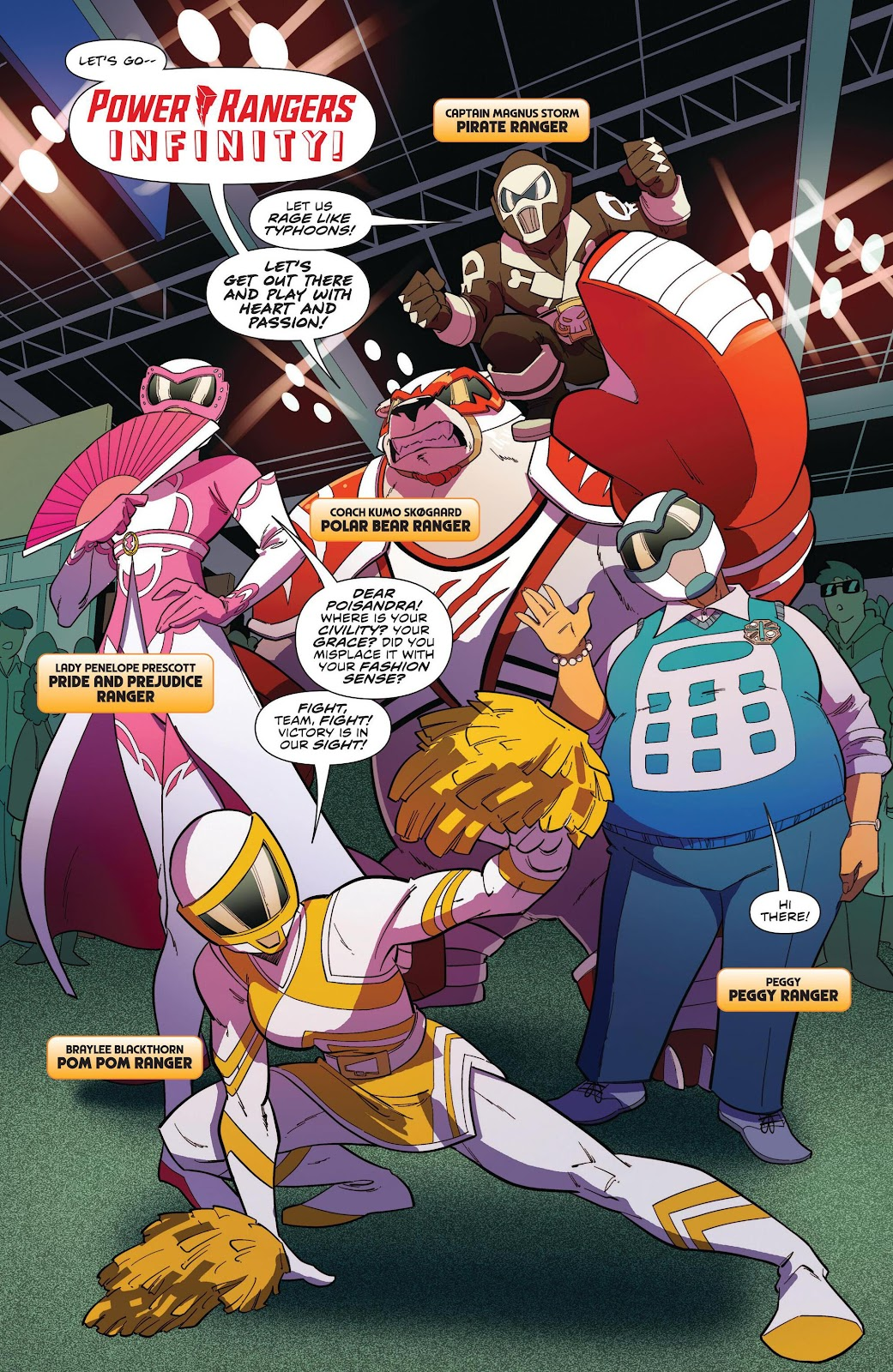
The rest of the Infinity Rangers don’t really have much of an opportunity to stand out as this is Lola’s story. They mostly conform to stereotypes: Black Ranger Magnus’ dialogue is peppered with cliched pirate speech, Lady Penelope is overly sophisticated and somewhat haughty, Blue Ranger Peggy comes across as a grandmotherly figure, etc. Most of them don’t get a lot of in-depth focus either, aside from Kumo, the determined, stoic leader befitting his status as the Red Ranger, and coming back to Peggy, a kind, caring older mentor who helps Lola focus on finding her courage. As mentioned earlier, they are far from one-off joke characters. They express genuine sorrow over the loss of their teammates and friends, as well as rage when finally given the chance to avenge them. While I do wish each of them could have received equal time to shine and learn more about them individually, they still function as an effective team, and a reminder that even ludicrous premises can serve as a vehicle for serious stories.

On that note, Poisandra is another fine example of how a character seen as a joke can be elevated, in this case as a legitimate threat. While in Dino Charge she didn’t really serve much of a purpose other than planning her wedding to Sledge and doing trivial things with Curio, now she’s a full blown psychopath leaving hundreds of dead Rangers in her wake to find a team weak enough to defeat. Her motivation isn’t the clearest, aside from some brief dialogue which implies she’s doing it to prove she could do better than her ex-fiance at destroying the Rangers, nor is it explained how she came into possession of the device that lets her create and wipe out new Ranger teams, but putting aside those minor plot issues she really does come into her own as a powerful antagonist driven mad by obsession. And while I haven’t given much discussion to the art in this issue, special credit has to be given to illustrators Brandt & Stein for finally making Poisandra expressive, showing the full range of her mania in a way that could never be achieved on the show with the fixed face on her costume (which could also be counted as another argument against anyone who says that Power Rangers couldn’t work as an animated series.)
Power Rangers Infinity is how you show fan appreciation without relying too heavily on fan service. While I don’t know if Sam Humphries heard the concerns of the Ranger community on social media about the future of the franchise, his story reminds us all that even if things seem bleak when it comes to corporate matters, the appreciation this series will never die as long as we continue to nurture it. As long as we keep pursuing our ideas and supporting those of others, building up the fandom and expanding our boundaries, we can ensure a bright future for Power Rangers, even if it might be some time before it ever returns to TV or streaming services. And this is something we should take to heart for everything we’re fans of. We can all carry a torch to keep the spark alive.
Happy holidays, and may the Power protect you.
About Author


1 thought on “Power Rangers Infinity (A Red Ribbon Review)”