
Fear will be your enemy
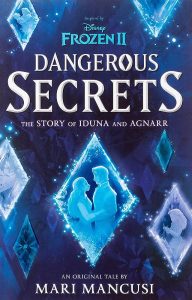
I opened today’s blog with that line from a song from the Broadway adaption of Frozen as it seems rather fitting for this book. In the lead-up to Frozen II, there were quite a few books released including one that was a prequel to the events of the first movie and gave us insight into how the king and queen of Arendelle fell in love.
Which for my money is the best Frozen book that has been released yet. As I’ve mentioned before though the Frozen books are usually of high quality. And I appreciate how they pull from real Nordic mythology for the two books that dabble in horror. In this book, they use a creature called the Nattmara, they are mostly accurate to what the Nattmara does but it does not take the appearance of a young woman.
A member of the race of Nattmara, or Nightmare People, appears as a skinny woman, very pale, with long black hair and nails, wearing a nightgown. The Mara could shape-shift to sand and slip into even the tiniest crack in a wall. They terrorized people by riding on their chests and giving them nightmares. They play somewhat the same role as banshees do in other cultures—they’re an ill omen.
The Nattmara does serve the same purpose as it causes a blight to fall over Arendelle which makes the animals sick and puts almost everyone into a deep sleep that traps them in their worst nightmares. And towards the end of the book when it attacks Elsa, she is turned into black sand. The Nattmara instead takes the shape of a wolf and we don’t learn this until the end but this comes from Elsa’s childhood because as a little girl, she’d use a trick to rid herself of her nightmares by pretending to feed them to a creature named Ulf the Wolf.
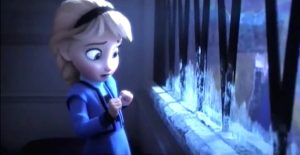
This aligns with what her father Agnarr taught which was well-meaning but bad advice.
Conceal, Don’t Feel
Elsa had hidden her fears for so long and pretended nothing scared her that eventually, her fear caught back up with her.
Author
Kamilla Benko
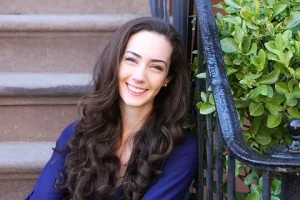
I’ll admit before reading this book that I was not aware of Benko but it seems to me that she was the perfect fit for a Frozen book as besides writing a middle-grade trilogy titled The Unicorn Quest, her blurb mentions as a little girl she built a snowgirl that she hoped would come to life but instead was blessed with a little sister. And that just screams Frozen considering the bond of sisterhood is so important to the franchise.
Benko truly taps into how strong the bond of sisters is and I have to if she picked her younger sister’s brain considering this is an Anna-centric book that focuses on Anna feeling inadequate in the shadow of her older sister. This reminds me a bit of her cut song, More Than the Spare.
I’m not part of the town, not born to be queenJust somebody hopelessly in-betweenShe’s the scholar, athlete, poetI’m the screw up, don’t I know itBut then who could ever compare?Of course they’re gonna think I’m just the spareWell, I won’t care
Much like how “Fear will be your enemy” helps to underline the theme of this book, More Than The Spare speaks to how Anna is characterized and the journey she goes on in this book with her fears and nightmares consuming her.
Cover
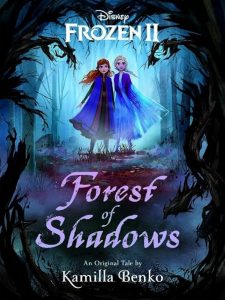
This cover is great at selling the fear aspect of the book as you see Anna and Elsa (I have to wonder if this cover was the first time they were seen in their Frozen II outfits) as the forest surrounds them and it looks as if the trees are trying to grab them and stop them from carrying on their journey. In many ways, these creepy trees remind me very much of the haunted forest scene from Snow White.
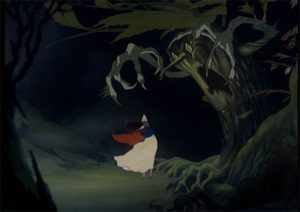
This speaks to how in the right hands, a forest can become a terrifying setting that could scare anyone with how dangerous the forest can be. If one is to take this further and this is admittedly a stretch, I believe it also speaks to how much we fear the unknown before seeing its full beauty. This can be seen when Elsa finally confronts her fear and The Nattmara, is no longer a scary shadowy wolf, it turns into an adorable wolf pup that starts playing with and licking Elsa.
The Plot
I appreciate how this book eases you by starting with a prologue focusing on a five-year-old Anna much like how both movies started with prologues of the sisters as little girls.
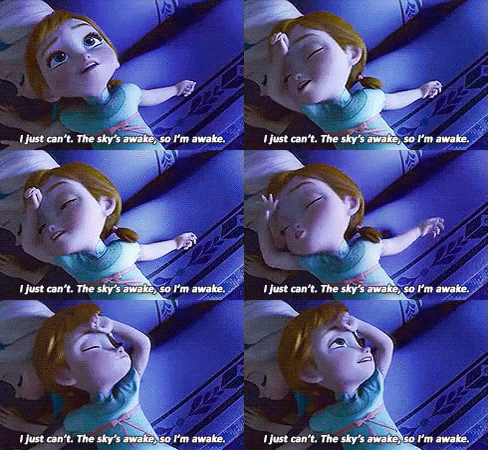
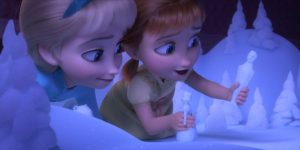
It feels familiar to the audience and there is a sense of safety as little Anna to us is just being a troublemaker as she was at five. But soon that was pulled away from us as Anna was scared and attacked by the wolf.
Anna’s scream stuck in her throat as a giant white wolf prowled out from the thicket with unusual grace, its long limbs uncurling like smoke. Its fierce yellow gaze fixed on her, and Anna’s eyes ran its huge, horse-sized body… to see four fearsome paws, each the size of the large shields of her father, King Agnarr. But that wasn’t the worst of it.
No, the worst was the red-stained fur around its claws and jaw.
Red. The color of blood.
The Frozen books tend to put Anna in danger in some form or another as we will see again when looking at the next book. Now, this is but a nightmare that young Anna is woken up by her mother. The final arc from the Frozen Dark Horse arc features a similar moment of Iduna coming to the aid of her youngest daughter.
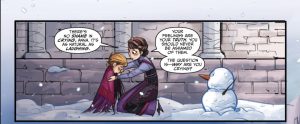
I believe that these speak to how their mother meant so much to Elsa and Anna that they still think of her all these years later when they’re scared. Consider how Elsa wears Iduna’s scarf in the sequel and it serves as both a way of keeping her close to the memory of her mother and a comfort item.
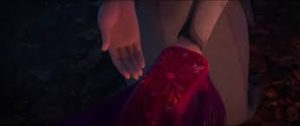
It is essentially a security blanket because as long as they have the memory of their parents, they’ll feel safe. It may not be logical but neither are fears. This book delves into various nightmares Anna experiences such as one where she experiences still being engaged to Prince Hans and when she tries to remove the engagement ring, it won’t come off.
Hans grabbed her wrist and jammed the ring onto her finger. “Your hand in marriage of course. Your sister has given her blessing. She has no use for you”.
For some reason, I misremembered this scene as the ring causing Anna’s engagement finger to bleed. That does not happen but this does play on Anna’s biggest fear in the book that Elsa has no need for her younger sister. I know some Frozen fans didn’t like this and said it felt inconsistent with Anna but I must disagree as pointed out by the YouTube channel, Cinema Therapy Anna suffers from Attachment Anxiety.
To take this further, here’s a definition of what Attachment anxiety feels like.
Attachment anxiety is the fear of being separated from loved ones such as parents, friends, and spouses. It corresponds to a negative working model of self-image and low self-esteem. People who suffer from it are chronically preoccupied with fear, vigilance, jealousy, and fear of abandonment. It is an insecure attachment style.
This tracks with what we know of Anna and Elsa’s relationship, the scene of them on either side of Elsa’s bedroom door after their parents die exemplifies Anna’s need to be loved.
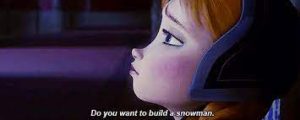
Some might argue that Anna feeling this way is her going backward after how close she and Elsa were shown to be at the end of the first movie but much like depression, these feelings don’t magically go away. There’ll be ebbs and flows of days where we are feeling good and something can trigger these emotions to rise to the surface and in the case of Anna, it’s Elsa going on a royal tour to the neighboring kingdoms without her. This might seem small and not something that should upset Anna but that’s just it, the smallest thing can cause these feelings to haunt us. And this foreshadows where Anna finds herself during Frozen II.
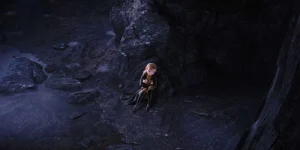
The Next Right Thing shows Anna at her lowest and I believe that this book shows how Anna feels as though she has fallen to this place. Also, I very much appreciate Anna beating herself up over the smallest mistake as she believed by reciting a magic spell, she brought the Nattmara to Arendelle. It furthers my belief that Anna could be read as autistic. While the first two nightmares I mentioned are harrowing, there’s one where Anna is frozen yet conscious and sees she has been replaced by another girl in her birthday dress that I find the most horrifying.
She was a girl of ice, standing outside the castle, only able to peer into the window and never enter through the door. Inside she could see Elsa reading aloud to a girl, whose glossy white was pulled back in two braids. Anna didn’t recognize the girl–her back was to the window–but she did recognize the girl’s dress, a soft green one with sunflowers embroidered on the hem. She could see Kristoff entering the room strumming his guitar and smiling at the girl.
Who are you? Anna wanted to yell at the ivory-haired girl. But her frozen lips could not speak and Anna had to wait, impatiently and horribly, until at last the girl turned around to reveal… Anna’s eyes. Anna’s nose. Anna’s smile. The white-haired girl was Anna–but she wasn’t. Anna had been replaced. By this other person.
This is horrifying for two different reasons, first, there is the sense that Anna feels throughout the entire book of not being needed and being easily replaced in her sister’s eyes. There is also the unease of body horror with how Anna is frozen yet conscious. That adds a new layer of eeriness to this moment from the first movie.
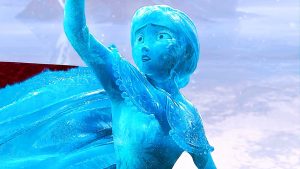
The fact that Anna can think yet move or speak while trapped in this form is legitimately scary to me. It reminds me of something Linkara mentioned from a Doctor Who episode about how dead bodies were conscious even as they went under the knife. It makes the person feel helpless to stop whatever is happening and in the case of Anna, it mirrors her feelings of feeling helpless to her older sister because being encased in ice truly makes her helpless.
This is also where the book gets rather interesting as it is suggested they looked for what is known as the Revolute blade that was used by Aren of Arendelle in a fight against a dragon. They came across this after meeting Soreson who the kingdom believed to be a mystic but he calls himself a scientist as before he met the sisters, he did not believe magic and myth to exist. Along the way, they come across creatures known as Hulderfolk which are pulled from folklore much like how the Nattmara comes from mythology.
A hulder (or huldra) is a seductive forest creature found in Scandinavian folklore. Her name derives from a root meaning “covered” or “secret”.[1] In Norwegian folklore, she is known as huldra (“the [archetypal] hulder”, though folklore presupposes that there is an entire Hulder race and not just a single individual
Anna recognized these creatures from a bedtime story her mother used to tell her and Elsa as little girls.
They are tall and strong with sharp ears. And they’re sensitive. Which is why, little Elsa, Mother has said with a tug on the hem of Elsa’s pajama bottoms, if you ever see one, you must not mention their tail.
And if you do–a young Anna had popped up from behind her pillow fort, making a scary face and shaping her hands into claws–they might eat you.
Elsa had burst into giggles, which had only made Anna wrinkle her face more and add an extra growl.
The idea that Anna remembered the Hulderfolk from stories her mother told her and Elsa again speaks to the bond she had and how that helped her. This help would be greatly needed when the sisters finally returned to Arendelle after finding the Revolute Blade, the Nattmara had become kaiju-sized. It is Anna who realizes that the Nattmara is a manifestation of Elsa’s fears and encourages Elsa to face her fears as Elsa is so scared to do so.
…Fear only grew the longer it was ignored. Avoiding a nightmare only made it more powerful, more terrifying when it finally erupted again. And if Elsa had ignored her fears for years–if she had her nightmares away, then maybe they had taken on their own life, taken on their own shape…
It turns out that Elsa was afraid of being a bad leader and that was brought the Nattmara to Arendelle and caused the Blight. Anna is able to her older sister overcome this fear by showing her she is a good leader and that she will always be there to support her sister. I like this as it shows how far Anna has come yet as we see with the epilogue set during Into The Unknown there is a sense of unease as Anna is hopeful that her sister will never leave her but is afraid of what this journey holds for them.
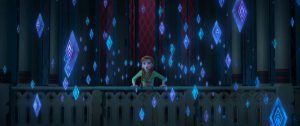
This is a good ending to lead into the sequel.
My Final Thoughts
I really like this book as it does a great job of showing it’s okay to be scared and that you can ask for help in facing what scares you. Anna was the perfect choice for a story about facing fears and being afraid of your worst nightmares consuming you as underneath the happy cherry nature she exudes, there is a young woman who is still grappling with who she is meant to be. Join me next time as we look at yet another Frozen book.
Polar Nights: Cast Into Darkness

About Author


